
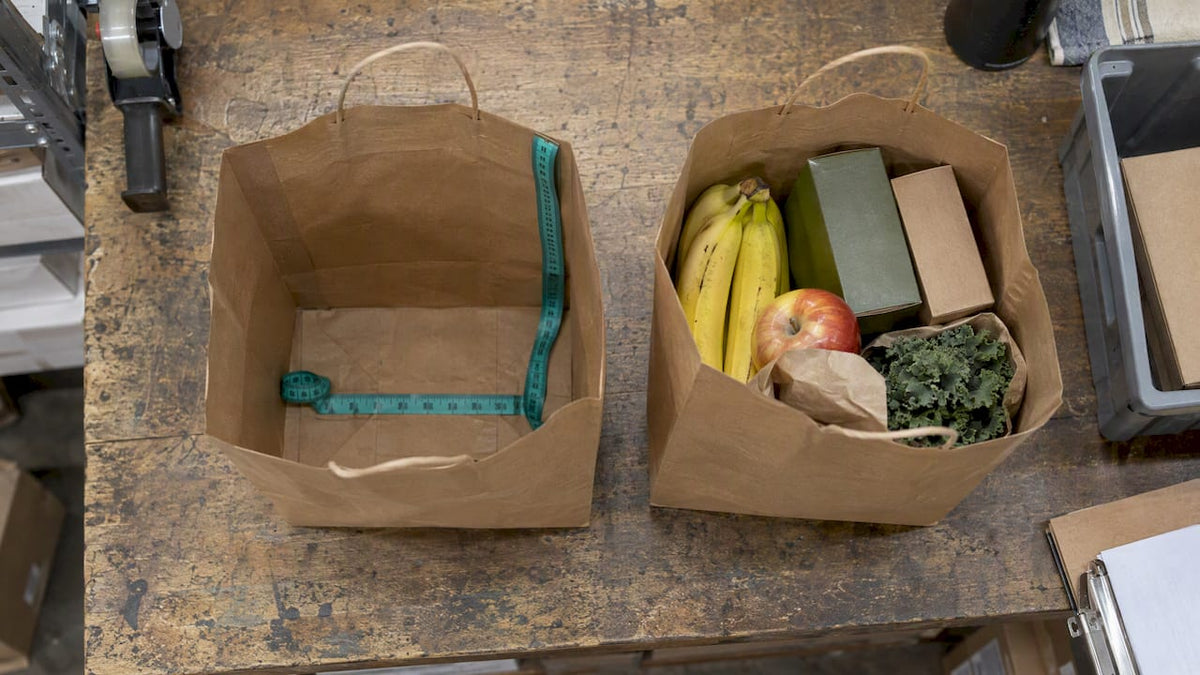
You can estimate a paper bag’s usable capacity by multiplying width by height by gusset depth, then cross-checking that volume against the paper grade and construction. For confirmed load limits rather than estimates, ask your supplier for EN13590-style repeated-lift results or an ASTM D5276 drop test report.
TL;DR:
- Measure internal width, height, and gusset depth; multiply them and divide cubic centimeters by 1,000 for liters, allowing for folds that flatten imperfectly.
- Kraft grades span 70 to 90 g/m² for light retail, 90 to 120 for common shopping, and 120 to 150 or more for grocery bags.
- Request lab reports for large retail or shipped orders: EN13590 repeated lifts target at least 6 kg, while ASTM D5276 covers loaded bag drop tests.
- A flat or box bottom distributes weight better than a pinched bottom, while reinforced handles, seams, and ply structure affect load performance.
- Moisture weakens paper before visible damage, so store bags dry and off concrete, and leave a safety margin for repeated use.
Table of Contents
- How do you measure a bag and calculate its internal volume?
- What do grammage and tensile strength tell you about carrying capacity?
- Which design choices change how much a bag can actually hold?
- How do industry test standards verify rated carrying capacity?
- How do humidity, storage, and reuse affect real-world capacity?
- How do you match a bag spec to your use case and brief a supplier?
- How we test and build bags that meet capacity needs
- Specifying for strength, cost, and sustainability at once
- Get a bag spec, prototype, or test report from our team
- FAQ
- Sources
How do you measure a bag and calculate its internal volume?
Start with three measurements: width, height, and gusset depth (the folded side panel that gives a bag its box shape). Measure the inside dimensions whenever possible, since printed panels and seam allowances shave a few millimeters off the usable space compared to the outer cut size.
The formula is straightforward:
- Multiply width by height by gusset depth to get volume in cubic centimeters or cubic inches.
- Convert cubic centimeters to liters by dividing by 1,000.
- Convert inches to centimeters first (multiply by 2.54) if your spec sheet uses imperial units.
A few worked examples show how this plays out:
- A small lunch bag at 13 cm wide, 23 cm tall, and 8 cm gusset holds roughly 2.4 liters, enough for a sandwich, fruit, and a small snack.
- A medium retail bag at 25 cm wide, 33 cm tall, and 15 cm gusset holds about 12.4 liters, suited to apparel, gift items, or a few boxed products.
- A large grocery-style bag at 30 cm wide, 40 cm tall, and 18 cm gusset holds close to 21.6 liters, comparable to the volume of a standard grocery haul of canned goods and produce.
Pro Tip: Round gusset depth down slightly in your math, since folded paper rarely sits perfectly flat once a bag is loaded.
These figures are geometric maximums. What the bag actually carries without tearing or sagging depends on the paper and construction, which is the next variable to check.

What do grammage and tensile strength tell you about carrying capacity?
Grammage, measured in grams per square meter (g/m²), is the first spec to check once you know the volume you need. Lightweight kraft runs around 70 to 90 g/m² and suits small retail or bakery bags. Mid-weight stock in the 90 to 120 g/m² range covers most shopping and takeout applications, while heavier 120 to 150+ g/m² kraft is used for grocery and multi-use carriers.
Grammage alone does not guarantee strength:
- Tensile strength determines how much pulling force the handles and side walls resist before the paper fibers give way.
- Tear resistance affects how a small nick at a seam or hole behaves under load, whether it stays contained or runs across the panel.
- Bending stiffness, which research on multi-ply paperboard shows depends on both grammage and how plies are distributed, affects whether a bag holds its shape when loaded rather than collapsing inward.
A thesis on multi-ply paperboard found that a three-ply structure can optimize bending stiffness for a given grammage and thickness, which means two bags with identical paper weight can perform differently depending on how the plies are built. Industry guidelines from CEPI set a practical benchmark: a high-quality reusable carrier bag should carry typical supermarket loads and be reusable multiple times.
Pro Tip: Pushing grammage up to chase strength raises cost and can dull print clarity, so match the paper grade to the product rather than defaulting to the heaviest option available.
For a deeper breakdown of how grammage choices translate into specific weight limits, our procurement guide on bag weight capacity walks through supplier-side numbers in more detail, and our kraft paper grades guide covers how different grades are specified.
Which design choices change how much a bag can actually hold?
Volume and paper grade set the ceiling, but converting decisions determine how much of that capacity you can use safely.
- Gusset width adds cubic volume quickly, but a wider gusset also shrinks the flat print panel available for branding, so balance graphics against capacity needs early in the design.
- A flat or box bottom stands upright and distributes weight evenly across the base, giving better cubic efficiency than a pinched or pasted bottom, which tends to sag under heavier loads.
- Handle choice shifts stress away from the paper itself: twisted paper handles work for light to medium loads, while reinforced or cotton webbing handles anchored with patches spread the pulling force over a wider area for heavier or repeated-use bags.
- Seam type matters for reuse expectations, since glued seams are standard for single or limited-use bags, while reinforced or double-stitched seams hold up better across multiple trips.
These choices are where a lot of real-world capacity gets lost or gained, independent of the paper grade on the spec sheet.
How do industry test standards verify rated carrying capacity?
Geometry and paper specs give you an estimate. Testing gives you a number you can put in a contract. EN13590 and related CEPI industry guidelines use a repeated-lift test to measure how many times a loaded bag can be picked up before handles or seams fail, and they set a target of at least 6 kg of carrying capacity for a high-quality reusable carrier bag. Separately, ASTM D5276 covers drop testing of loaded containers, including bags, by free fall, which matters for anything that gets handled through shipping or warehouse transit rather than carried directly out of a store.

Among the most useful figures a supplier test report should include: sample bag dimensions, the paper grade and grammage used, the test method applied, the number of lift or drop cycles completed, and the pass or fail criteria against that target.
When a bag is going into a high-volume retail program or a shipped order, insist on a lab test report rather than relying on in-house sample checks alone. For everyday retail bags at lighter loads, supplier QC samples combined with the grammage and construction review above are usually enough.
How do humidity, storage, and reuse affect real-world capacity?
A bag rated for 6 kg under lab conditions will not necessarily hold that once it has sat in a damp stockroom. Paper fibers absorb moisture from the air, and that absorption softens tensile and compressive strength well before a bag looks visibly damaged.
- Store bags dry and off the floor, ideally on shelving rather than stacked directly on concrete where moisture wicks upward.
- Plan a safety margin below the rated capacity for any bag expected to survive multiple uses, since handles and seams weaken with each cycle of loading and abrasion.
- Watch compressive stability when bags are packed or shipped flat in bulk, since stacked weight over time can crease gussets and weaken fold lines before the bags ever reach a retail floor.
Pro Tip: Build reuse expectations into your spec from the start rather than hoping a single-use bag design holds up to repeat trips.
How do you match a bag spec to your use case and brief a supplier?
Matching a starting spec to your product category saves a round of samples. Small retail items generally fit a lighter grammage bag in the 70 to 90 g/m² range with a modest gusset. Bakery and takeout bags favor mid-weight kraft with grease-resistant coatings where needed. Grocery and multi-item retail bags need the heavier grammage and wider gusset combination discussed above, and apparel or heavier specialty items often call for reinforced handles regardless of grammage.
When you brief a supplier, include:
- Required internal volume in liters.
- Expected weight per bag in kilograms.
- Reuse target, whether single-use or multi-trip.
- Printing and finish requirements, including color count and coatings.
- Handle preference and any certification or test report requirements.
A checklist like this cuts down on sample revisions and gets you a usable quote faster. Our design guide for retail bags covers how these specs translate into a production-ready die line, and starting with recycled fiber is worth raising early if sustainability targets matter to your brand, as covered in this partner guide on eco-friendly packaging.
How we test and build bags that meet capacity needs
We draw on extensive manufacturing and importing experience, with production based in Toronto to enable faster turnaround than overseas sourcing typically allows. Our product range includes turn top, serrated top, and tamper-resistant serrated top paper bags, available with 8-color flexo printing and options of FSC-certified or recycled paper.
When capacity support is needed, we build a sample prototype based on the stated volume and weight target, recommend a grammage and ply combination suited to the product, and coordinate test reports when lab-verified numbers are required. Our quality assurance process includes die-line review, pre-press proofing, and pre-production prototyping before printing, helping to catch capacity and strength issues early.
Specifying for strength, cost, and sustainability at once
The biggest mistake we see in capacity planning is treating grammage as the only lever worth pulling. A well-built gusset and handle combination often outperforms a heavier paper grade at lower cost, and recycled kraft can match virgin fiber strength when the ply structure is right. Specify to the product and handling profile in front of you, not to a worst-case scenario that rarely applies, and use a sample run to confirm before committing to a full order.
— Taylor
Get a bag spec, prototype, or test report from our team
If you have a target volume and weight in mind but need help translating that into a finished bag, we can assist. Our production based in Toronto aims to offer shorter lead times than those typical of overseas suppliers, and our design and QA teams handle die-line preparation, pre-press proofing, and prototyping to ensure accuracy before printing.
Browse our paper bag product lines to see the turn top, serrated top, and tamper-resistant styles available, or reach out through our consultation and quoting page to get a prototype and capacity recommendation started for your next order.
FAQ
How many plastic bags equal 1,000 pounds?
This question compares two different materials and units that are not directly interchangeable without knowing each bag’s actual weight and intended load, which varies by design and thickness. For a paper bag capacity question, the more useful comparison is checking a specific bag’s rated carrying weight against its grammage and construction rather than a cross-material conversion.
What is the typical weight of a paper bag?
Paper bag weight depends on grammage and size rather than a single fixed figure, with lighter retail bags using kraft paper in the 70 to 90 g/m² range and heavier grocery-style bags using 120 g/m² or more. The bag’s own weight is separate from its carrying capacity, which is set by paper grade, construction, and handle reinforcement.
Are paper bags food safe?
Paper bags intended for food contact use food-grade paper and coatings designed to resist grease and moisture for the handling time involved, and these specifications are set at the material and converting stage. Buyers sourcing takeout or delivery bags should confirm food-contact suitability directly with their supplier for the specific paper grade and coating used.
How many liters is a standard paper grocery bag?
A large grocery-style bag at 30 cm wide, 40 cm tall, and 18 cm gusset holds close to 21.6 liters, comparable to the volume of a standard grocery haul of canned goods and produce. Actual usable volume depends on the specific width, height, and gusset depth of the bag in question, so measuring and calculating per the formula above gives a more accurate figure than a general estimate.
Share:
Handle Attachment Methods for Paper Bag Buyers: Test the Failure Point
SOS Paper Bags: 500 per Case, Sizes, and Canadian Rules