
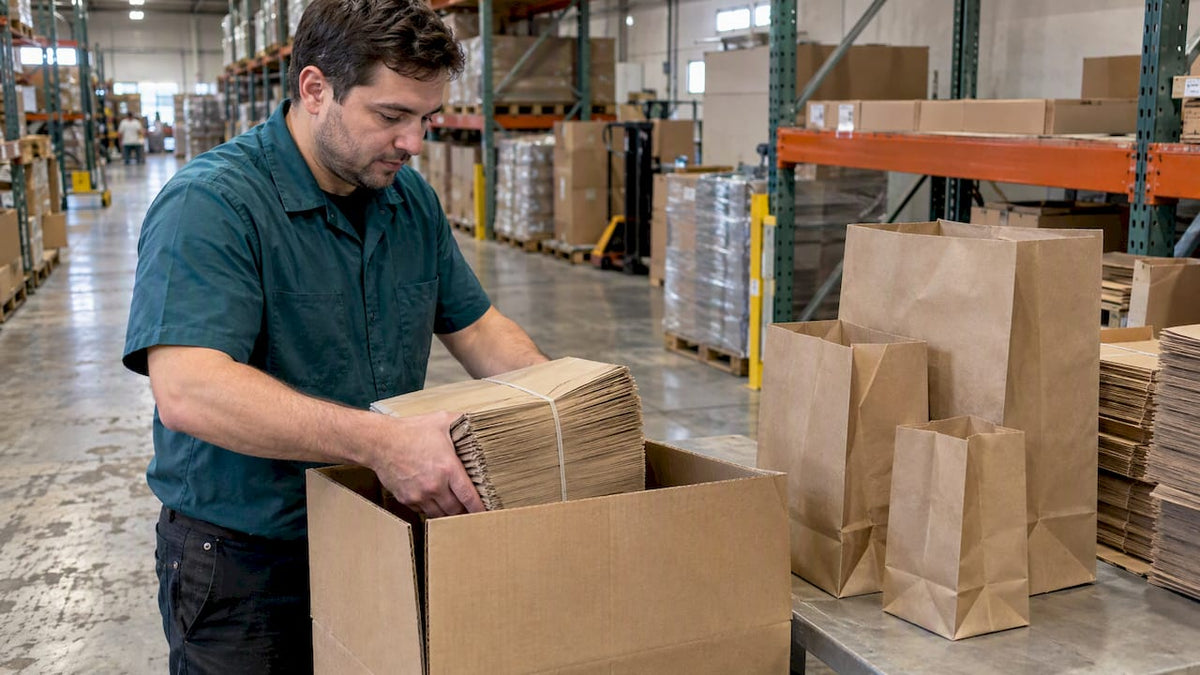
Most retail and foodservice buyers should start with stock kraft SOS bags in the pound size that matches their product weight and handling needs, because kraft balances load strength, clean print results, and recyclability better than lighter paper options. From there, the right call depends on grease exposure, branding needs, and order volume. This guide covers sizing, materials, ordering specs, and sustainability requirements so you can specify with confidence.
TL;DR:
- Pound ratings describe product capacity, not bag weight: 3# and 5# fit small bakery or deli items, while 10# to 20# suit groceries.
- For oily or moist goods, specify greaseproof or barrier paper and list GSM, lining, closure, print colors, and proof requirements in the RFQ.
- Stock sizes commonly ship 500 per case; custom printing or nonstandard dimensions can raise minimums and extend lead times, so request a prototype before production.
- Paper bag recycling access in Canada exceeds the 50% threshold for unqualified recyclable claims, but verify local acceptance and request FSC Chain of Custody documentation.
Table of Contents
- Common SOS Bag Sizes and Pound Capacities
- Materials and Construction Options for SOS Bags
- Matching SOS Bag Styles to Your Industry and Product
- How to Specify and Order SOS Paper Bags
- Sustainability Claims and Canadian Regulatory Context
- Why Procurement Teams Choose Gather Packaging for SOS Bags
- A Procurement-Led Take on Buying SOS Bags
- Get a Quote on Custom SOS Paper Bags
- FAQ
- Sources
Common SOS Bag Sizes and Pound Capacities
SOS bags are rated by pound capacity, a convention tied to the weight of goods they’re built to carry, not the bag’s own weight. Each rating corresponds to a standard width, gusset, and length, which keeps sourcing comparable across suppliers.
Stock SKUs typically ship 500 per case, with palletization varying by case cube and weight. Smaller pound sizes (3# and 5#) suit single pastries or small deli items, while 10# through 20# cover grocery, bulk produce, and multi-item retail purchases. Specialty formats like 1/8 and 1/6 barrel sacks exist for bottles and other tall, narrow products.
| Pound size | Typical dimensions (W x G x L) | Common use case |
|---|---|---|
| 3# | 4.75" x 2.75" x 8" | Single pastry, small bakery item |
| 5# | 5.25" x 3.44" x 8.13" | Deli snack, small retail item |
| 6# | 6" x 3.63" x 11" | Bakery goods, light grocery |
| 8# | 6.13" x 4" x 12.38" | Sandwich, light produce |
| 10# | 6.75" x 4.38" x 13.25" | Grocery, packaged goods |
| 12# | 7.06" x 4.5" x 13.75" | Multi-item retail, grocery |
| 14# | 8" x 4.75" x 16" | Bulk produce, larger retail orders |
| 20# | 8.25" x 5.25" x 16.13" | Large grocery or bulk retail |
These standard SOS dimensions and pack quantities give you a baseline for comparing quotes across suppliers before layering on custom print or material changes.
Materials and Construction Options for SOS Bags
Paper grade and finishing determine how a bag performs once it’s loaded, printed, and handled at checkout. Kraft paper remains the default for strength and cost, while recycled kraft and white paper serve different appearance and branding goals.
- Kraft paper offers the highest tear resistance and the cleanest flexo print contrast for most retail branding.
- Recycled kraft suits buyers prioritizing recycled content claims, though print contrast is slightly softer than virgin kraft.
- White paper works best for brands wanting sharp color reproduction on light backgrounds.
- Poly-lined or greaseproof barrier papers protect against oil and moisture for bakery or deli products.
- Serrated top, turn top, and tamper-resistant serrated top are the main closure and finishing choices, each suited to different handling speeds and security needs.
When requesting quotes, state the paper weight (GSM), whether a lining or barrier coating is needed, and whether you want windows or a tin-tie closure.
Pro Tip: Always specify GSM and lining requirements on your RFQ. Vague requests like “sturdy paper” lead to mismatched quotes and rework later.

Matching SOS Bag Styles to Your Industry and Product
The right SOS bag depends on what you’re packing and how it’s handled after purchase. A few patterns hold across most industries:
- Foodservice (takeout and delivery): grease resistance matters most, and paper bags are a common compliant substitute where plastic checkout bags are restricted.
- Bakery: smaller pound sizes with greaseproof paper handle pastries and bread without staining through.
- Retail and grocery: mid-to-large pound-rated SOS bags carry produce, deli items, and packaged goods reliably.
- Specialty (bottles, tall items): 1/8 and 1/6 barrel sack formats fit bottles and other items that don’t suit a standard rectangular bag.
Matching the pound rating and finish to the actual product weight and handling pattern prevents the two most common complaints procurement teams report: bags that tear under load and bags that print poorly once filled.
How to Specify and Order SOS Paper Bags
A clear RFQ gets you comparable quotes faster and avoids mid-production surprises. Build your request around these specifics:
- Dimensions and pound rating matching your product weight and shelf presentation.
- Paper grade and GSM, plus any lining or barrier requirement.
- Print colors and finish (serrated top, turn top, or tamper-resistant serrated top).
- Case pack and palletization needs for your warehouse or store network.
- Artwork files and proof requirements, including whether you need a pre-production prototype before full run approval.
Stock sizes commonly ship at 500 units per case, and custom printing or non-standard sizing typically raises minimum order quantities and extends lead times compared to stock SKUs. A step-by-step paper bag design guide can help you prepare artwork files correctly before submission.
Pro Tip: Ask every supplier for a cost breakdown by component (paper, print, finishing, freight) so you can compare quotes on equal terms rather than a single bundled number.
Sustainability Claims and Canadian Regulatory Context
Buyers making recyclability or sustainability claims need to back them with documentation, not assumption. PPEC reporting submitted to the Competition Bureau shows that paper bag recycling access in Canada sits well above the 50% threshold commonly used to support unqualified “recyclable” claims. Confirming local acceptance still matters, since provincial programs vary.
- Request FSC Chain of Custody documentation when a sourcing claim needs to be auditable rather than asserted.
- Confirm local recycling acceptance for paper packaging before finalizing a green claim.
- Understand that Canada’s Single-use Plastics Prohibition Regulations restrict certain plastic checkout bags, which is why paper SOS bags are a common substitute for takeout and retail checkout uses.
- Review provincial recycling program listings when operating across multiple provinces.
Buyers weighing broader environmental trade-offs in packaging and logistics can also review third-party resources like sustainable packaging and logistics guidance when building an internal sourcing policy.
Why Procurement Teams Choose Gather Packaging for SOS Bags
We manufacture custom SOS paper bags domestically, which keeps turnaround shorter and shipping costs lower for North American buyers compared to overseas sourcing. Our turn top, serrated top, and tamper-resistant serrated top bags come with FSC-certified material options and 8-color flexo printing for sharp branding at scale.
We handle die-line prep, pre-press proofing, and pre-production prototyping before any full run starts, which cuts the risk of a mismatched order. Our quality assurance and logistics support carry through from first quote to delivered pallet.
A Procurement-Led Take on Buying SOS Bags
Specify for the product, not the catalog page. Request a pre-production prototype before committing to volume, document any sustainability claim with real certification, and weigh domestic supply against freight risk, not just unit price.
— Taylor
Get a Quote on Custom SOS Paper Bags
If you’re ready to move from specs to a real quote, we make that step simple. Have your pound size, case pack, print colors, and any lining requirements ready, and we’ll turn that into a comparable quote with a prototype timeline attached.
Our product lines cover turn top, serrated top, and tamper-resistant serrated top styles, all producible with FSC-certified material and domestic manufacturing out of Toronto.
| What you get | Where to start |
|---|---|
| Custom SOS bag quote | Product styles and specs |
| Design, prototyping, and QA | Consultation and services |
| Domestic manufacturing advantage | Made in Canada production |
Reach out through our products page or contact our team directly to discuss your paper shopping bag or retail packaging needs.
FAQ
What does the pound rating on an SOS bag mean?
The pound rating refers to the weight of product the bag is built to carry, not the bag’s own weight. Ratings like 3#, 10#, and 20# each correspond to a standard set of dimensions that scale with capacity.
What is a typical minimum order for custom SOS paper bags?
Minimum order quantities depend on customization level, with stock sizes generally ordered in standard case packs and custom printing raising both minimums and lead times. Contact us directly for a quote based on your specific size, print, and volume needs.
Are paper SOS bags compliant for checkout and takeout use in Canada?
Canada’s Single-use Plastics Prohibition Regulations restrict certain plastic checkout bags, and paper bags are commonly used as a compliant alternative for takeout and retail checkout. Always confirm your specific use case against the current regulation text.
Why does FSC Chain of Custody matter for paper bag sourcing?
FSC Chain of Custody provides auditable proof of where the paper came from and how it was handled through production, which FSC Canada requires before any FSC claim can be made on packaging. Buyers who need defensible sustainability claims should request CoC documentation directly from their supplier.
Does Gather Packaging offer FSC-certified SOS bags?
Yes, our bag styles are available with FSC-certified material options alongside 8-color flexo printing and domestic manufacturing in Toronto. Review our FSC-certified packaging guide for what documentation to request.
Share:
Paper Bag Capacity for Canadian Buyers: Volume Is Not Load Capacity
Warehouse Humidity Control: Align Paper Bag Specs Before Damage