

TL;DR:
- FSC-certified packaging guarantees the materials originate from responsibly managed forests with a verified chain of custody.
- Verification relies on documented proof—certificate codes and claim types—rather than just logos or verbal assurances.
- New 2026 standards introduce mandatory labeling and digital verification options, requiring ongoing compliance checks.
FSC-certified packaging is a verified guarantee that your paper and cardboard packaging materials come from responsibly managed forests, tracked through a documented chain of custody from harvest to finished product. For packaging buyers and retail brands, FSC certification is the most widely recognized third-party standard for responsible fiber sourcing. This guide to FSC-certified packaging covers how to verify supplier credentials, understand the 2026 trademark updates, source certified suppliers reliably, and build procurement practices that hold up under audit. Whether you’re selecting FSC-certified bags for the first time or tightening existing compliance, the steps here apply directly to your operation.
What does the guide to FSC-certified packaging actually verify?
FSC, which stands for Forest Stewardship Council, certifies two distinct things: forest management practices and the chain of custody that follows certified material through every step of processing and trade. Chain of Custody certification ensures traceability of FSC material through all processing steps and is mandatory for any supplier legally selling FSC claims. This means the paper in your shopping bag has a documented record connecting it back to a certified forest.

The label type on your packaging communicates exactly what that material contains. FSC Recycled refers to products made entirely from post-consumer or reclaimed material. FSC Mix may include a combination of FSC-certified virgin fiber and recycled content. Understanding the difference matters because it affects how you describe your packaging in marketing, sustainability reports, and retailer compliance documentation.
FSC certification also carries real business weight beyond environmental values. Many brands build FSC certification into sustainability reporting, tender compliance, and B2B purchasing policies to reduce reputational risk and meet retailer demand. If your retail accounts or procurement policies require certified packaging, FSC is the standard most commonly specified.
How to verify the authenticity of FSC-certified packaging
Verifying FSC certification is a document-level process, not a visual one. A logo on a bag does not confirm compliance. Traceable documentary proof and consistent claim handling are what protect your certification standing during an audit. Follow these steps every time you onboard a new supplier or receive a new shipment:
-
Request the supplier’s FSC Chain of Custody certificate. Every certified supplier holds a valid CoC certificate with a unique license code in the format FSC C######. Ask for this before placing any order.
-
Confirm the certificate is current. Use the FSC’s official certificate database at info.fsc.org to look up the supplier’s license code. Confirm the certificate status is active and that the scope covers the product type you are purchasing.
-
Check the FSC claim type on invoices and delivery notes. Every FSC order must be supported by documentary specifics including the supplier’s FSC CoC certificate code and the correct FSC claim type. The claim type, such as FSC Mix Credit or FSC Recycled Credit, must appear on the invoice or delivery note, not just on the physical product.
-
Verify the claim type matches what you ordered. FSC Mix and FSC Recycled are not interchangeable. If your purchase order specifies FSC Recycled and the invoice shows FSC Mix, that is a discrepancy you need to resolve before accepting the shipment.
-
Retain all documentation. Store certificates, invoices, and delivery notes together. Missing certificate or claim information on invoices or delivery documents constitutes a non-conformity that can break FSC traceability during audits.
Pro Tip: Even if a supplier states they are FSC certified verbally or on their website, always request the specific certificate code and claim details in writing before the order is confirmed. Verbal assurances do not satisfy audit requirements.
The most common verification mistake is treating the FSC logo as sufficient proof. Logos can be misused. The certificate code and claim documentation are what auditors check.
What changed with FSC trademark requirements in 2026?
FSC published revised trademark standards on January 1, 2026, under FSC-STD-50-001 Version 3-0. Compliance became mandatory by July 1, 2026, with a transition period running until January 1, 2029, allowing gradual adaptation for existing packaging inventory. If you are currently designing or reprinting packaging, the new requirements apply now.
The key changes that affect packaging buyers and designers include:
- FSC QR labels. The updated standard introduces a new FSC QR label for on-product use, enabling consumers to scan and verify certification details digitally. This is a new mandatory option for on-product labeling that connects physical packaging to digital verification.
- Revised mandatory label elements. On-product FSC labels must now include the FSC label type, the license code, and the FSC logo in its approved form. Revised rules also address logo placement, minimum size, and color reproduction requirements.
- No alteration of FSC logos. Proper use of FSC trademarks requires correct logo selection, inclusion of the license code, and no alteration or improper placement. Stretching, recoloring, or repositioning the logo outside approved guidelines constitutes misuse.
- Coordination with your packaging supplier. Any packaging currently in production or scheduled for reprint needs to be reviewed against the new requirements before going to press.
Pro Tip: Align FSC labeling updates with your packaging production schedule before approving new artwork. Launching bags that do not meet the 2026 on-product requirements creates a compliance gap that is expensive to correct after print runs are complete.
The transition period through 2029 gives businesses time to work through existing inventory, but any new packaging produced after July 1, 2026, must meet the updated standard. Managing the FSC trademark is a compliance process that demands ongoing training to avoid misuse that can undermine brand trust and certification validity.
How to source FSC-certified packaging suppliers reliably
Finding a credible FSC-certified supplier starts with one authoritative source. FSC’s official Find FSC Products & Suppliers platform is the correct starting point for locating certified suppliers, rather than relying on marketing claims or general web searches. The platform connects buyers to certificate holders whose scope and claims have been verified.
When evaluating suppliers beyond that initial search, apply these criteria:
- Certificate scope. Confirm the supplier’s FSC certificate covers the specific product category you need. A certificate covering paper reels does not automatically cover finished shopping bags.
- Certificate validity date. FSC certificates require annual surveillance audits. A certificate that expired six months ago is not compliant, regardless of what the supplier’s website says.
- Claim type capability. Confirm the supplier can provide the specific claim type you need, whether FSC Mix, FSC Recycled, or FSC 100%, and that this is documented in their certificate scope.
- Documentary track record. Ask for a sample invoice from a previous FSC order to confirm they include the certificate code and claim type correctly. Suppliers who cannot produce this quickly are a risk.
| Supplier Evaluation Criteria | What to Check |
|---|---|
| Certificate code | Format FSC C######, verified at info.fsc.org |
| Certificate scope | Covers finished paper bags or your specific product type |
| Claim type offered | FSC Mix, FSC Recycled, or FSC 100% as required |
| Invoice documentation | Certificate code and claim type present on all FSC sales documents |
| Certificate status | Active, not suspended or expired |
Working with a domestic Canadian manufacturer carries specific advantages for FSC sourcing. Local sourcing for packaging reduces supply chain complexity, shortens lead times, and makes it easier to conduct supplier audits or request documentation quickly. When your supplier is in the same country, resolving a certificate discrepancy takes days rather than weeks.
Best practices for managing FSC procurement and compliance
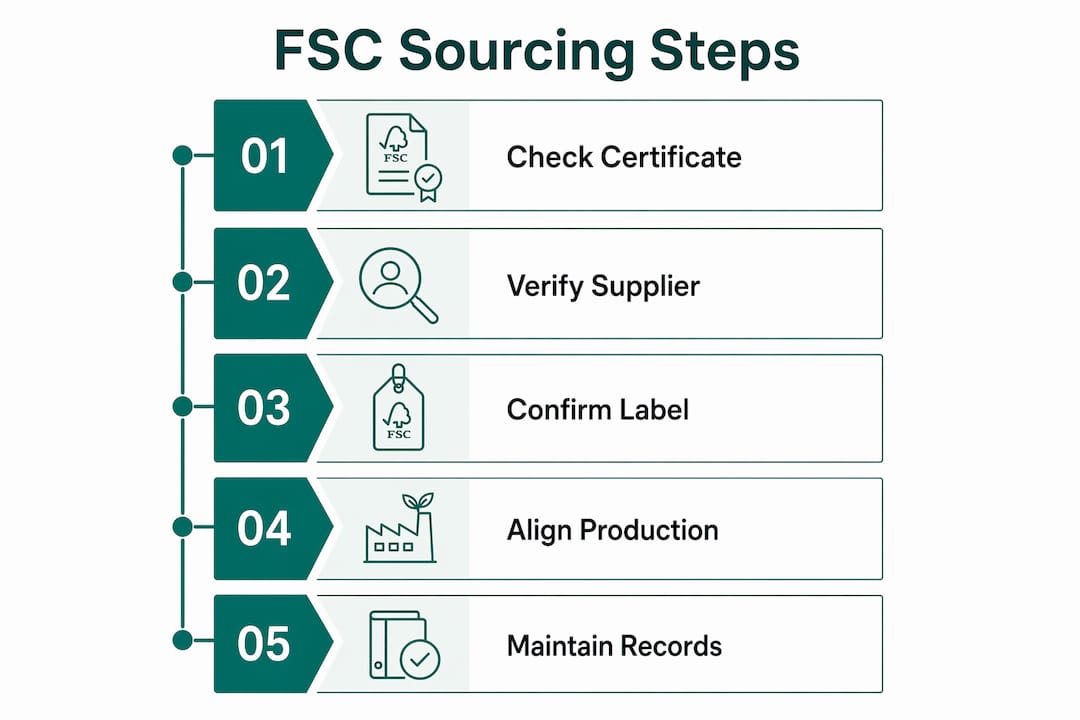
Procurement compliance for FSC-certified packaging is an ongoing process, not a one-time check. Procurement procedures require verifying supplier certification, FSC claims on invoices, and handling situations with questionable claims at every transaction. Building this into your standard purchasing workflow removes the risk of gaps appearing under audit.
Follow this sequence for each FSC procurement cycle:
-
Include FSC requirements in your purchase orders. State the required claim type, the supplier’s certificate code, and the requirement for FSC documentation on all delivery notes. This creates a contractual record.
-
Review invoices before payment. Confirm the FSC CoC code and claim type appear correctly on every invoice. A missing code is a non-conformity. Flag it immediately and request a corrected document before closing the transaction.
-
Add FSC certificate verification to supplier onboarding. When approving a new packaging supplier, require certificate documentation as a condition of approval. Set a calendar reminder to re-verify certificates annually, since they require renewal.
-
Track certificate updates and suspensions. FSC certificates can be suspended or withdrawn following audits. Check info.fsc.org periodically for any changes to your active suppliers’ certificate status, particularly before large orders.
-
Align with your sustainability reporting cycle. If your business produces an annual sustainability report or responds to retailer sustainability questionnaires, your FSC procurement records are the evidence base. Gaps in documentation create gaps in reporting.
A sustainable packaging workflow that integrates FSC verification at each procurement stage protects your brand from the reputational risk of greenwashing claims and keeps your supply chain audit-ready at all times. Packaging compliance is also increasingly tied to regulatory requirements in markets like the EU, where the European Union Deforestation Regulation (EUDR) raises the documentation bar further for forest-derived materials.
Key takeaways
FSC-certified packaging requires verified documentation at every transaction, not just a logo on the product.
| Point | Details |
|---|---|
| Verify with documents, not logos | Request the FSC CoC certificate code and claim type on every invoice and delivery note. |
| Know your label types | FSC Recycled and FSC Mix are not interchangeable; each has distinct marketing and compliance implications. |
| Apply 2026 trademark updates now | New on-product labeling requirements under FSC-STD-50-001 Version 3-0 are mandatory for packaging produced after July 1, 2026. |
| Source through official channels | Use FSC’s Find FSC Products & Suppliers platform to locate and verify certified suppliers. |
| Build compliance into procurement | Integrate certificate checks, invoice review, and annual re-verification into your standard purchasing process. |
Why FSC compliance is harder than it looks in practice
I’ve reviewed enough packaging procurement workflows to say with confidence that most compliance failures are not intentional. They happen because teams treat FSC as a one-time supplier approval rather than an ongoing documentation process. A supplier gets approved, the certificate code gets filed somewhere, and then nobody checks whether that certificate was renewed or whether the claim type on the last three invoices actually matched what was ordered.
The 2026 trademark updates make this more urgent. The introduction of QR labels and revised mandatory elements means packaging artwork that was compliant last year may not be compliant today. If you’re reprinting bags this year, that review needs to happen before the artwork is approved, not after the bags arrive at your warehouse.
The other thing I’d push back on is the assumption that a domestic supplier automatically means fewer compliance headaches. It helps, but it doesn’t replace the documentation process. What domestic manufacturing does give you is faster access to corrected paperwork, easier audit coordination, and a supplier relationship where you can pick up the phone and get answers the same day. For FSC compliance specifically, that responsiveness matters more than most buyers realize until they’re in the middle of an audit.
FSC certification is genuinely worth the administrative effort. It supports your sustainability commitments, satisfies retailer requirements, and gives your brand a credible, third-party-verified environmental claim. The work is in building the habit of checking documentation consistently, not in the certification itself.
— Taylor
Gatherpackaging’s FSC-certified paper bags
Gatherpackaging manufactures FSC-certified paper shopping bags in Toronto, Canada, giving retail brands and packaging buyers a domestic source for certified, custom-printed bags with short lead times. Every bag is produced using FSC-certified materials, water-based inks, and recycled content options, with full documentation support to keep your procurement records audit-ready. If you’re sourcing eco-friendly paper bags or need custom kraft bags that meet your sustainability specifications, Gatherpackaging’s team can walk you through material options, claim types, and print capabilities. Contact Gatherpackaging directly to discuss your paper shopping bag requirements and get a quote from a Canadian paper bag manufacturer that understands FSC compliance from the ground up.
FAQ
What does FSC-certified packaging mean?
FSC-certified packaging means the paper or cardboard materials used in the packaging come from forests managed to Forest Stewardship Council standards, with a verified chain of custody tracking the material from forest to finished product.
How do I check if a packaging supplier is FSC certified?
Look up the supplier’s FSC license code, formatted as FSC C######, in the FSC certificate database at info.fsc.org to confirm the certificate is active and covers the product type you need.
What is the difference between FSC Mix and FSC Recycled?
FSC Recycled means the product is made entirely from post-consumer or reclaimed material, while FSC Mix may include a combination of FSC-certified virgin fiber and recycled content. The distinction affects how you describe the packaging in marketing and sustainability reporting.
What changed with FSC labeling requirements in 2026?
FSC published revised trademark standards on January 1, 2026, introducing a new QR label option and updated mandatory on-product label elements, with compliance required for new packaging produced after July 1, 2026, and a full transition deadline of January 1, 2029.
What documentation do I need to maintain FSC traceability?
You need the supplier’s FSC CoC certificate code and the correct FSC claim type recorded on every invoice and delivery note. Missing this information on any transaction document constitutes a non-conformity that can break chain-of-custody traceability during an audit.
Share:
The Role of Shelf Appeal in Packaging for Brand Managers
What Is Multi-Industry Packaging and Why It Matters