
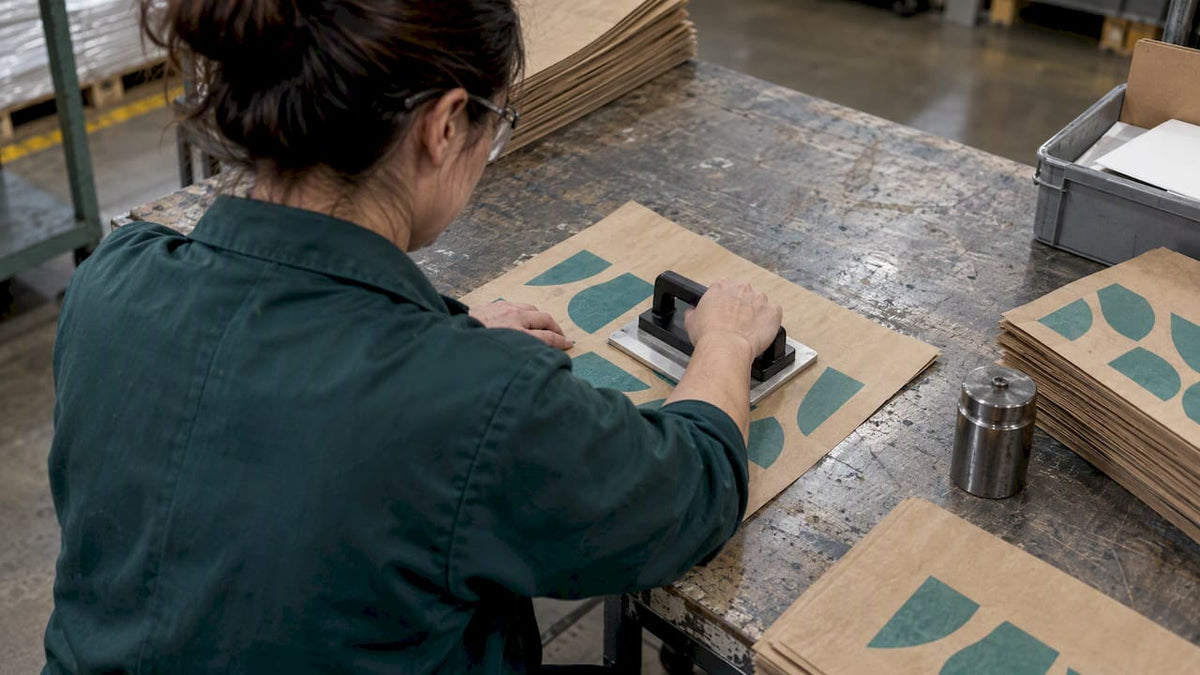
Ink rub resistance measures how well a printed ink holds up to smudging, transfer, or scuffing during handling, and the production control that decides most of that outcome is ink film formation: whether the ink has fully cured and bonded to the substrate. The fastest way to confirm it is a standard rub test, run under controlled temperature and humidity, before a print run ships.
TL;DR:
- Rub resistance testing should include both dry and wet rub conditions, especially if the packaging will be exposed to moisture or condensation.
- Proper sample conditioning at around 22-23°C and 47-65% relative humidity is crucial for reliable rub test results.
- Using surface treatments like surface sizing or silane additives can significantly improve ink adhesion and abrasion resistance on various substrates.
- Confirm equipment calibration for weight, stroke speed, and receptor material to avoid false failures or passes during rub testing.
- Incorporating in-house prototyping and quality checks before shipment helps ensure durable print performance in real-world handling.
Table of Contents
- What ink rub resistance is and why it matters for packaging
- Standards and test methods you should know
- How to perform rub testing and interpret results
- Equipment, test setup, and common pitfalls
- Proven ways to improve rub resistance in production
- Production checklist for paper shopping bags
- Practitioner perspective: when lab tests aren’t enough
- How Gather Packaging helps: QA, prototyping, and custom paper bags built for durable print
- FAQ
- Sources
What ink rub resistance is and why it matters for packaging
Rub resistance describes how a dried or cured ink film reacts to friction. When it fails, you see one of a few things: smudging, where ink smears without lifting off; transfer, where ink moves onto a second surface; peel, where the film separates from the substrate; or color loss, where repeated contact dulls or lightens the print.
For packaging, these failures show up at the worst possible moments. A shopping bag that rubs against a customer’s coat in the store aisle, or a folded carton that scuffs against its neighbors during automated case filling, can arrive at the retail floor looking damaged before it’s ever opened. Wet or condensing environments make this worse, since moisture softens some ink films and accelerates transfer.
Common failure points in bag and carton production include:
- Ink rubbing off high-contact areas like handles, side seams, and bottom folds.
- Print dulling or smearing after stacking in cartons during shipping.
- Color transfer onto adjacent bags when stacked under pressure or humidity.
Standards and test methods you should know
Three references come up constantly in packaging QC conversations, and each answers a slightly different question.
- ASTM D5264 is a standard practice built around the Sutherland rub tester. It applies broadly to labels, folding cartons, corrugated boxes, and other printed packaging, and it specifies the apparatus, receptor options, and general procedure.
- TAPPI T830 focuses specifically on containerboard and corrugated board. It defines several test variants: dry rub, wet rub, wet bleed, wet smear, and functional rub, which simulates the kind of contact a package experiences in real use.
- The Sutherland rub tester itself measures abrasion resistance under controlled mechanical pressure and stroke count, while an MEK (methyl ethyl ketone) or solvent rub test checks chemical resistance, how well the ink holds up against a solvent-soaked wipe rather than dry friction.
Choosing which to specify depends on what your bag or carton will actually encounter. Dry rub is the baseline for most retail packaging. Wet rub matters when there’s any chance of moisture exposure, condensation on a cold product, a damp warehouse, humid transit. Solvent or alcohol wipes matter when the package might get sanitized or cleaned, which is increasingly common in foodservice contexts.
How to perform rub testing and interpret results
A repeatable rub test depends on controlling variables that are easy to overlook. Sample conditioning is the first one: test specimens should equilibrate at a set temperature and relative humidity before testing, since ink films behave differently in dry versus humid air. Peer-reviewed abrasion studies commonly condition samples at around 23°C and 47% relative humidity, and similar protocols call for roughly 22°C and 65% relative humidity for 24 hours before testing begins.
A basic protocol looks like this:
- Condition samples at the specified temperature and humidity for the recommended period.
- Record tester settings: pad or block mass, stroke length, cycles per minute, and total stroke count.
- Specify the receptor material, paper, fabric, or another printed sample, since receptor choice changes the result.
- Run the test for a set number of cycles (common benchmarks include 10, 20, or 50 cycles).
- Evaluate the printed surface and the receptor for transfer, smearing, or film loss.
Statistic Callout: Aminopropyltriethoxysilane added to water-based flexographic inks at about 1.0% to 1.5% concentration improved adhesion and abrasion resistance on common packaging films like PE, BOPP, and PET. That range is a useful starting point for formulation trials, not a universal setting, since every ink system and substrate combination behaves differently.
Scoring can be visual (a pass/fail grade against a reference standard), instrumental (spectrophotometric ΔE measured before and after cycling), or physical (percent ink transfer onto the receptor, or adhesion tape pull tests). Any acceptance threshold you set, say, no visible ink transfer after 20 dry rub cycles, needs site-specific validation against your own ink, substrate, and end-use conditions before it becomes a formal spec.

Equipment, test setup, and common pitfalls
Not every machine marketed as an ink rub resistance tester runs the same way. Before trusting a result, verify the equipment against the method you intend to follow, since testers vary in weight range, stroke speed, and specimen capacity.
Checklist items worth confirming on any tester:
- Block or pad weight matches the standard’s specified load.
- Stroke length and cycles per minute are calibrated and logged, not estimated.
- Receptor material matches the standard’s specification, not whatever is on hand.
- Replicate count is high enough to catch variation across a print run, not just one sample.
Common pitfalls include testing samples straight off the press before the ink has fully cured, skipping conditioning time, using a worn or mismatched receptor, and reporting a single data point as if it represents the whole lot. Any of these can make a genuinely durable print look like it failed, or worse, let a weak one pass.
Proven ways to improve rub resistance in production
Most rub failures trace back to one of three places: the ink itself, the substrate it’s printed on, or the process conditions during printing and curing.
On the ink side, adhesion promoters like aminopropyltriethoxysilane can meaningfully improve bonding. Controlled studies found bonding strength increases of roughly 26% on PE, 35% on BOPP, and 102% on PET with silane additives, though higher concentrations risk shifting color, so any formulation change needs a color check alongside the rub test. Choosing the right water-based ink system for the substrate matters just as much as any additive.

On the substrate side, surface sizing with TBPU/PVA systems has been shown to raise surface energy and improve ink retention on paper, which often delivers a bigger gain than tweaking the ink alone. Surface porosity and capillary action in the paper itself are decisive factors, and choosing a lower-absorbency stock can outperform ink-side fixes when the substrate is the real bottleneck. Specialty coatings and corona or primer treatments, including options explored by surface treatment specialists in the pulp and paper industry, are another lever worth testing.
On the process side, dryer zone temperature, ink film thickness, and press-side viscosity all affect final cure. Water-based systems commonly run dryer zones around 60°C to 70°C, and over-drying can weaken mechanical anchoring if the vehicle evaporates before it fully binds to the pigment.
- Test any adhesion promoter or varnish change for color shift, not just rub performance.
- Validate press-side viscosity against the ink supplier’s spec sheet, not by eye.
- Re-run the rub test after any substrate, ink, or process change, never assume carryover.
Pro Tip: Validate adhesion promoter performance with a spectrophotometer at 24 hours and again at 7 days, since some bonding improvements only show up after the chemistry fully sets.
Production checklist for paper shopping bags
Translating these principles onto a bag production floor means checking rub resistance at three points. In prepress and prototyping, confirm ink selection, underbase control, and plate thickness specs match the substrate you’re printing on, since trapping and laydown both affect final film strength. On press, monitor cure zone temperatures and run inline spot checks for ink film formation rather than waiting for a finished roll to fail.
Before shipment, run a dry rub test and, for bags likely to face moisture or handling in humid conditions, a wet rub or alcohol wipe check. Document results alongside the order so the retailer or brand receiving the shipment has a record of what was tested.
Checks for rub resistance are integrated into prototyping, pre-press proofing, and quality assurance processes for custom paper shopping bag orders, so rub performance is confirmed before a full production run ships.
Practitioner perspective: when lab tests aren’t enough
Standard rub tests are a floor, not a ceiling. If your bags travel through automated filling lines or conveyors, extend stroke counts or swap in a receptor that matches that contact surface, since industry practice often modifies standard tests to reflect real plant conditions. Add wet condensation or alcohol wipe scenarios when the end use calls for it, and write the modified protocol into your supplier agreement so everyone tests the same way.
— Taylor
How Gather Packaging helps: QA, prototyping, and custom paper bags built for durable print
Rub resistance is easier to get right when the people printing your bags are also the people testing them. Prototyping, pre-press proofing, and quality assurance are handled in-house, alongside 8-color flexo printing on FSC-certified materials and water-based inks.
Relevant services for teams focused on print durability include:
- Prototyping and pre-press proofing to catch adhesion issues before a full run.
- Quality assurance checks built into the production process, not added after the fact.
- Turn Top, Serrated Top, and Tamper-Resistant Serrated Top paper bag lines with customizable printing.
If your team wants to discuss sample rub testing or run a production order, contact Gather Packaging to talk through your paper shopping bag or retail packaging needs.
FAQ
How do you calculate abrasion resistance?
Abrasion resistance is typically measured by running a set number of rub cycles under controlled pressure, then scoring the result visually, by percent ink transfer, or by spectrophotometric color change (ΔE). There’s no single formula, since the method depends on which standard, such as ASTM D5264, you’re following.
What is the Sutherland rub test?
The Sutherland rub test uses a weighted, reciprocating block to rub a printed sample against a receptor material for a set number of strokes, then evaluates ink transfer or wear. It’s defined in ASTM D5264 and applies to labels, cartons, and other printed packaging.
What is the MEK rub test?
The MEK rub test checks how well a printed or coated film resists methyl ethyl ketone, a solvent, rather than dry mechanical friction. It’s used when a package might be exposed to solvents, cleaning agents, or similar chemical contact during handling or storage.
What does abrasion resistance mean for packaging?
Abrasion resistance describes how well a printed surface withstands physical contact, rubbing, scuffing, or scraping, without losing ink or finish. For packaging, it determines whether printed graphics and branding survive shipping, shelf handling, and customer use intact.
Sources
- Enhancing ink adhesion of specialty paper using an interpenetrating PVA-blocked polyurethane sizing system (PMC)
- Effect of Aminopropyltriethoxysilane on the adhesion of flexographic water-based ink to packaging films (MDPI, 2023)
- D5264 Standard Practice for Abrasion Resistance of Printed Materials by the Sutherland Rub Tester (ASTM)
Share:
Designers: Prototype with 8 color Flexo to Print on Recycled Kraft
Prevent Halftone Reprints on Kraft for Packaging Buyers With NPC