
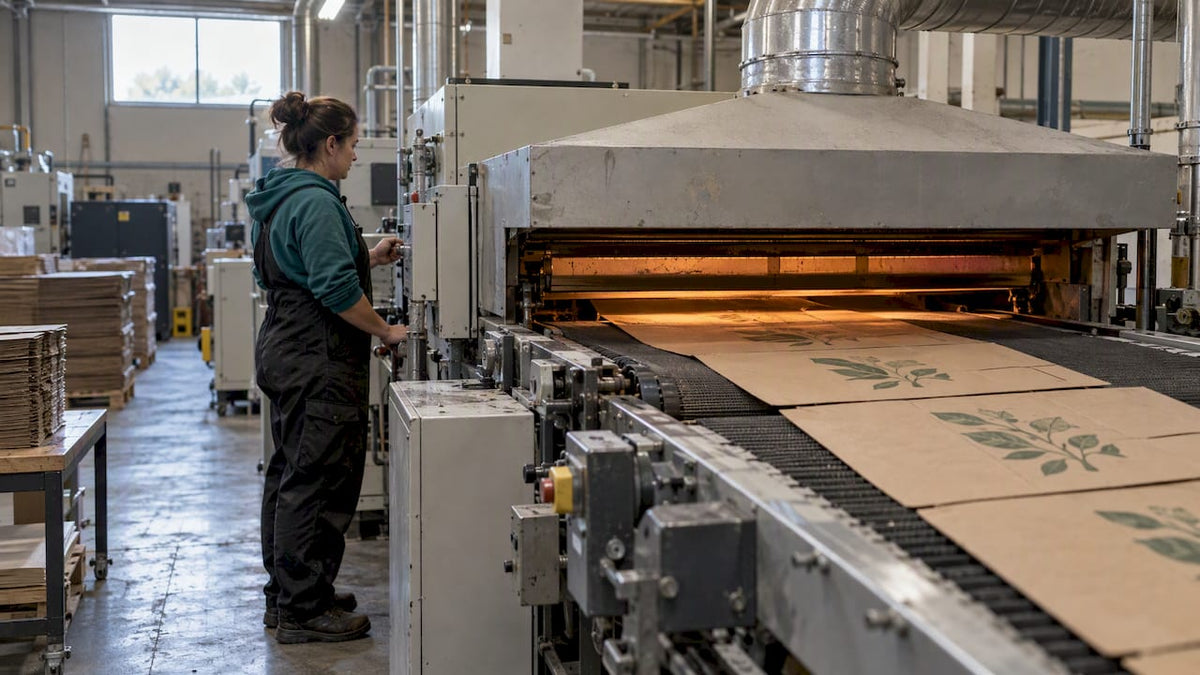
To get water-based ink dry and washfast, you need to evacuate the water from the ink film before the binder reaches cure temperature. In practice, that means adequate dryer dwell plus high airflow and exhaustion. A common shop benchmark is roughly 330°F with 2 to 3 minutes of dwell as a starting point, and airflow is usually the first thing worth upgrading.
TL;DR:
- Ensuring water has fully evaporated before curing is crucial, requiring adequate dwell time, airflow, and exhaust capacity, regardless of dryer temperature.
- Thicker ink deposits and high solids content demand longer drying times, and poor airflow can cause undercuring even at recommended temperatures.
- Upgrading airflow and exhaust systems is more effective than increasing dryer temperature in improving drying performance for water-based inks.
- Proper cure verification involves visual, hand, wash, and tape tests, with 2 to 3 minutes at 330°F as a common benchmark for achieving washfastness.
- Converting from solvent or plastisol systems often necessitates investing in exhaust and airflow equipment, with water-based inks requiring tighter workflow discipline.
Table of Contents
- Why water-based inks dry differently than solvent or plastisol systems
- Hot-air tunnels, IR dryers, and the airflow upgrades that matter most
- Cure targets and the tests that confirm washfastness
- Screenroom and pressroom habits that prevent drying-in
- Troubleshooting common drying and curing problems
- How manufacturing controls reduce drying and curing risk on retail packaging
- Perspective: what adopting water-based printing actually costs a shop
- Request cured samples and quotes from Gather Packaging
- FAQ
- Sources
Why water-based inks dry differently than solvent or plastisol systems
Water-based ink drying happens in two distinct stages, and conflating them is the root of most cure failures. First, the water carrier has to evaporate out of the film. Second, once that moisture is gone, the binder resin can reach the temperature needed to cross-link and bond permanently to the fabric or substrate. Heating the print before the water has left just boils moisture trapped under a skinned-over surface, which produces a tacky, undercured result that looks dry but fails a wash test.

Film thickness and ink solids content both extend how long this takes. A heavier deposit, common with discharge or high-opacity white underbases, holds more water and needs longer dwell or slower belt speed to clear it. Thin, well-reduced films dry faster but can still undercure if airflow is poor.
Rheology matters too. Water-based inks are shear-thinning, so they flow easily under the squeegee but set up quickly once shear stops, which is good for screen performance but means heat transfer into a thick, settled film is slower than into a thin solvent-based coating.
- Evaporation must finish before binder cure begins, not simultaneously.
- Thicker deposits and higher ink solids require longer dwell times.
- Shear-thinning behavior affects how heat penetrates the settled film on the belt.
Hot-air tunnels, IR dryers, and the airflow upgrades that matter most
Shops converting from solvent or plastisol to water-based ink often assume a hotter dryer is the fix. It usually is not. Case studies from wide-web flexographic conversions found that dryer capacity upgrades to air volume, velocity, and exhaust were the change that actually got drying performance to an acceptable level, more so than raising peak temperature. A separate flexographic case study on reducing solvent emissions reached the same conclusion: air volume and velocity often matter more than maximum temperature when drying water-based systems.
Hot-air conveyor dryers push heated, moving air across the print, which does double duty: it supplies heat and carries evaporated moisture away. Infrared dryers heat the ink film itself very efficiently, but they still depend on strong exhaust to pull that moisture out of the chamber; without it, the dryer interior saturates with humid air and drying stalls even as the ink surface feels hot. IR units also punish slow belt speeds: running too slow to compensate for weak exhaust can overheat and degrade the ink rather than cure it.
- Hot-air tunnels move heat and moisture together, which suits thicker water-based deposits.
- IR dryers heat fast but need high-velocity exhaust or they trap humid air inside the chamber.
- Slowing the belt without fixing exhaust risks overheating the print instead of curing it properly.
When in doubt, lengthen the tunnel or slow the belt before raising the set-point temperature, and treat blower and exhaust CFM as the first line item to check against the dryer’s rated specs.
Pro Tip: Before adjusting temperature, hold a sheet of paper near the dryer exhaust vent. If you cannot feel steady outward airflow, your drying problem is almost certainly exhaust capacity, not heat.
Cure targets and the tests that confirm washfastness
A useful starting reference for water-based screen printing is roughly 2 to 3 minutes of dwell at about 330°F, understanding that exact numbers shift with ink chemistry, deposit thickness, and substrate. That benchmark assumes the water has already left the film; if it hasn’t, no amount of dwell at that temperature will finish the cure properly.
Crosslinkers and catalyst additives can shorten the cure window needed in-line, which helps on runs where dryer length or belt speed is already maxed out. They are a formulation fix, not a substitute for adequate airflow.
To confirm a print is actually cured rather than just dry to the touch, run these checks in order:
- Visual and hand check: the print should feel soft and matte, not tacky or rubbery, once it has cooled to room temperature.
- Wash test: launder a sample per the garment’s care instructions and inspect for cracking, fading, or ink loss.
- Tape test: press adhesive tape onto the cured print and pull it away; ink transfer to the tape signals undercure.
A common shop benchmark for water-based curing is roughly 2 to 3 minutes of dwell at about 330°F, which gives operators a repeatable starting point before fine-tuning for a specific ink and fabric combination.
Screenroom and pressroom habits that prevent drying-in
Water-based ink’s fast set-up is an asset on the dryer belt and a liability on press. The same shear-thinning behavior that lets ink flow under the squeegee and then grab the mesh means a stalled press can dry ink into the screen in minutes, especially in low-humidity or heated shop environments.
Keep screens properly tensioned and emulsion fully dried before coating, since residual moisture in the stencil changes how the ink releases. On press, maintain a steady print-and-flood rhythm rather than letting screens sit loaded between pulls, and match squeegee durometer and angle to the mesh count so ink deposits consistently without excess shear heat.
- Flood every screen between pulls during any pause longer than a few seconds.
- Use a squeegee durometer and angle suited to your mesh count to avoid uneven, overworked deposits.
- Preheat pallets only enough to assist initial tack, not enough to start curing ink on the platen.
- Keep ink buckets covered and additive bottles clearly labeled to avoid accidental dilution or cross-contamination.
- Run a cool-down station after the dryer so hot prints are not stacked while still releasing moisture.
Troubleshooting common drying and curing problems
- White on dark garments going chalky or thin: usually traces to insufficient binder cure, an underbuilt underbase, or weak dryer extraction; confirm cure temperature at the ink film with a surface thermometer and check that exhaust is pulling moisture, not just recirculating warm air.
- Tacky prints coming off the dryer: often belt speed outrunning dwell time, exhaust that cannot keep up with humid ambient air, or an ink film thicker than the dryer was sized for; slow the belt or lengthen the tunnel before raising heat.
- Ghosting or shifted registration: frequently a sign prints are still soft when stacked or handled, pointing back to incomplete cure rather than a press alignment issue.
- Substrate refusing to hold ink: synthetic or coated surfaces like polyethylene may need surface treatment or a different ink chemistry entirely, since standard water-based formulations are built for cotton and natural fibers.
How manufacturing controls reduce drying and curing risk on retail packaging
Printed paper bags carry the same risk as printed garments: an undercured or tacky ink film on a retail bag reads as a quality defect the moment a customer handles it. Our 8-color flexo printing runs on water-based inks, and we build quality assurance and migration testing into production rather than treating it as a final check.
Buyers vetting any printed-bag supplier should ask for a few concrete proof points before committing to a run:
- A cured production sample, not a wet proof, to evaluate ink hand and adhesion.
- A current safety data sheet and migration test results for the specific ink system used.
- Dryer specifications, including dwell time and airflow capacity, for the equipment running the order.
- A white underbase or opacity sample on the actual bag stock when color coverage matters.
These checks catch undercure and tackiness before a full production run ships, which matters more on packaging than on a single garment because a batch of bags is a much harder defect to absorb.
Perspective: what adopting water-based printing actually costs a shop
Shops moving from plastisol or solvent systems to water-based ink tend to underestimate the equipment side and overestimate the ink-formulation side. Expect to spend on dryer exhaust and airflow before you spend on anything else, and expect screenroom discipline to tighten, since water-based ink punishes a sloppy workflow faster than plastisol ever did. Crosslinkers and hybrid formulations are a reasonable bridge while equipment catches up, not a permanent workaround. Procurement teams writing an RFP should require a cured-sample approval step and written dryer specifications rather than taking a supplier’s cure claims on faith.
— Taylor
Request cured samples and quotes from Gather Packaging
Printed paper bags only look as good as the ink cure behind them, and we incorporate cure verification into our production process. Our lineup includes Turn Top, Serrated Top, and Tamper-Resistant Serrated Top paper bags, all printed with water-based inks on 8-color flexo equipment and backed by quality assurance and migration testing before bags ship.
Procurement teams working with us can request production samples, safety data sheets, lead time estimates, and pre-press proofing before committing to a full run. Our production runs domestically in Toronto, which keeps turnaround predictable and gives buyers a direct line to the team managing print quality on their order.
If you are comparing suppliers for custom kraft paper bags or specifying packaging for an FBA or retail compliance program, teams reviewing requirements like the FBA packaging guide often find it useful to request a sample cure check alongside their spec sheet. Contact our team at Gatherpackaging to discuss your paper shopping bag needs and request a quote or cured sample.

FAQ
What are the downsides of using water-based ink?
Water-based ink dries faster in the screen than plastisol, which can cause clogging in low-humidity shops if screens sit uncovered between pulls. It also typically needs more dryer airflow and exhaust capacity to cure reliably, which can mean an equipment upgrade for shops converting from solvent or plastisol systems.
What ink dries the fastest?
Drying speed depends more on dryer setup than ink type alone, since water-based ink needs its moisture evaporated before the binder can cure, while plastisol cures through heat alone without a separate evaporation step. In practice, IR dryers paired with strong exhaust tend to cure water-based films faster than standard hot-air tunnels of similar length.
Does water-based ink wash out?
A properly cured water-based print should hold up through repeated washing, since the binder cross-links permanently into the fabric once it reaches cure temperature. A print that fades or cracks after washing usually points to an undercured film rather than a flaw in the ink itself.
Is water-based ink permanent?
Yes, once fully cured, water-based ink forms a permanent bond with the fabric through the binder’s cross-linking reaction rather than sitting on top as a surface coating. Reaching that permanence depends on removing all moisture first and then holding the print at cure temperature, commonly around 330°F for 2 to 3 minutes, for long enough.
Share:
Prevent Halftone Reprints on Kraft for Packaging Buyers With NPC