
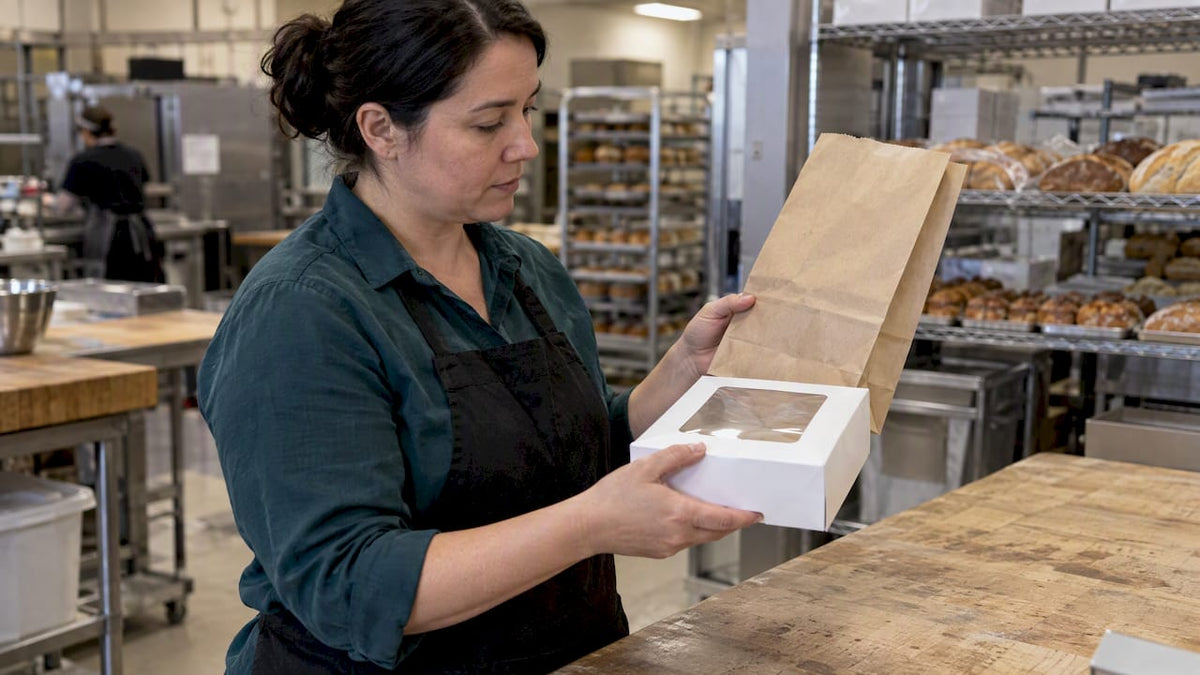
In Canada, sustainable bakery packaging is packaging your local system can actually recover. For most bakeries that means clean, simply printed paper bags that go in the blue bin, with grease resistance that doesn’t rely on PFAS, and a clear understanding of the producer responsibility rules that now apply to the bags you hand out. A “biodegradable” label on its own settles very little.
This guide is for packaging buyers, procurement teams and retail operations leads who source paper bags for bakeries, cafés and takeout counters. It covers what to specify, what to verify and which claims to be careful with.
TL;DR
- Recovery beats labels: pick the material your municipality already collects, which for clean bakery bags is usually paper in the blue bin.
- Compostable is a risky default in Canada. A 2020 study found only a small share of facilities accepted fiber compostables.
- Heavy ink coverage, laminations and adhesives can undermine recyclability, so keep print water-based and purposeful.
- If you supply bags to customers in Ontario, BC or Nova Scotia, you are likely a “producer” under provincial EPR rules, so budget for it.
- Ask your supplier for specs and documents, not adjectives: fibre source, ink type, grease treatment and test results.
Table of Contents
- What “sustainable” means for a bakery bag in Canada
- Blue bin or green bin: where bakery packaging ends up
- Why compostable is not the safe choice it seems
- Grease resistance without PFAS
- Print and branding: design for the sorting line
- Recycled content and fibre sourcing
- The compliance side: EPR and plastic rules
- Takeout and delivery bags: what to specify
- Our perspective
- A buyer’s checklist before you order
- Working with Gather Packaging
- FAQ
- Sources
What “sustainable” means for a bakery bag in Canada
Sustainability is local. The same bag can be recycled in one city and landfilled in another, because the answer depends on the sorting and processing infrastructure behind your customer’s bin. The Baking Association of Canada advises bakeries to favour materials that local systems already target, such as standard paper and cardboard, over novel materials that sorting facilities cannot process.
In practice, three questions decide whether a bakery bag is sustainable:
- Will it be collected? Is the format accepted in municipal blue box programs where your customers live?
- Will it be sorted correctly? Size, colour, coatings and print all influence whether a bag is identified as paper.
- Is there more material than the job needs? Right-sizing and a lighter bag cut waste before recycling even enters the picture.
The third point matters more than it sounds. Federal consultation material on food packaging stresses reduction and reuse ahead of recycling, which for a counter operation means a bag sized to the loaf, box or pastry it carries, not the largest stock size.
Blue bin or green bin: where bakery packaging ends up
City guidance is a good reality check. The City of Calgary’s page on bakery boxes and bags lists bread bags, dessert bags and cookie, donut and pie boxes, and splits disposal into two routes: clean paper to recycling, food-soiled pieces to organics.

Ontario is moving toward a province-wide list. A January 2026 report on the Blue Box transition says paper such as flour bags and paper produce bags is accepted province-wide, along with paper laminate packaging including food service paper bags. Check your own municipality’s list before you print recycling claims on a bag, because collection rules still vary by region.
A simple rule for your customer-facing instructions:
| Condition of the bag | Where it usually belongs | Note |
|---|---|---|
| Clean, dry paper bag | Blue bin | Confirm with the local program |
| Heavily grease-soiled or food-soaked | Organics or green bin where accepted | Local rules differ |
| Bag with plastic window or film lamination | Check locally | Mixed materials complicate sorting |
Why compostable is not the safe choice it seems
Compostable packaging looks like the obvious answer for food. The Baking Association of Canada cites a 2020 study of 97 Canadian facilities in which only 10.4% accepted fiber compostable packaging and just 1.0% accepted all compostable options, including bioplastics. Unless you have confirmed that the facility serving your customers takes it, a compostable bag may be treated as contamination.

That doesn’t make compostable claims worthless. It means the claim should be backed by a recognized standard and matched to local capacity. We cover what to check in our guide to biodegradable paper bags and the ASTM D6400 and D6868 standards. For Ontario’s reporting rules, the regulator treats certified compostable packaging as its own category, which is another reason to read the definition before you write the claim on your bag.
Grease resistance without PFAS
Baked goods leave oil on paper. For years, fluorinated chemicals did the grease-proofing. The Baking Association of Canada notes that PFAS are increasingly prohibited in grease-proof bakery bags, and that seeking PFAS-free assurance or BPI certification for grease-resistant coatings is now standard practice.
When you buy, ask for:
- A written statement of whether the paper or coating contains intentionally added PFAS.
- The grease-resistance test method and result for the exact paper grade, not a generic product.
- The coating type, since it affects whether the bag can still go into paper recycling.
- A real-world trial with your product: butter croissants, glazed donuts and cookies behave very differently.
Our procurement guide to grease-resistant paper bags goes through these checks in more detail.
Print and branding: design for the sorting line
Your bag is also your brand, and a bakery bag with a loud, full-coverage design looks great on the street. The tension is that recycling facilities rely on optical sorters. The Baking Association of Canada warns that large-area labels or heavy dyes can stop sorters from identifying the material, and recommends water-based, non-bleeding inks and avoiding heavy lamination and adhesives. It also notes that small items, with two sides under two inches, tend to fall through sorting equipment.
What this means for a design brief:
- Use ink where it earns its place. A strong one- or two-colour logo on natural kraft can look more premium than full coverage.
- Choose water-based inks and ask the converter how they are tested for bleed.
- Avoid add-on plastics. Windows, film laminations and foil stamping make recovery harder.
- Print the instruction. A short “Please recycle” line tells customers what to do. Make sure it is true where you operate.
We look at this balance in design for recyclability: paper bag specs Canadian buyers can verify and in our sustainable branding guide for retail paper bags.
Recycled content and fibre sourcing
Two claims appear on nearly every eco-friendly bag: recycled content and responsibly sourced fibre. Both are worth specifying, and both need paperwork. FSC certification applies to the fibre chain, while recycled content is a separate measurement. A bag can be one, the other, both or neither.
For recycled content, ask the supplier to show how the figure is calculated and whether it is post-consumer or pre-consumer. We argue in our piece on requiring mill run data for recycled content claims that a percentage with no documentation shouldn’t get through procurement. For specification wording, see what Canadian buyers should specify for recycled paper bags.
Also remember that strength is part of sustainability. A bag that tears and gets doubled up, or replaced, uses more fibre than one that was properly specified for the load.
The compliance side: EPR and plastic rules
Sustainability choices now carry legal weight. Under provincial extended producer responsibility (EPR) regimes, a business that supplies packaging to consumers can be a “producer”. British Columbia’s guidance says producers supplying packaging and paper products in the province must take responsibility for the product’s life cycle, including end-of-life management. It also describes exemptions for small producers based on revenue or volume, so check the thresholds for your business rather than assuming either way.
In Ontario, the regulator’s Blue Box compliance bulletin explains which materials must be reported. Circular Materials publishes provincial registration requirements for producers. Because rules and deadlines differ by province and change, confirm your obligations with the relevant regulator or a compliance adviser. For how bag choices tie into fees and RFQ wording, read our posts on cutting EPR fees with kraft bags and what to add to paper bag RFQs.
Plastic is regulated too. Ottawa’s Single-use Plastics Prohibition Regulations prohibit the manufacture, import and sale of six categories of single-use plastic items, and some provinces have their own measures, such as Nova Scotia’s ban on single-use plastic shopping bags at checkout. Paper is the straightforward replacement for a takeout bag, provided it is specified well.
Takeout and delivery bags: what to specify
For bakeries, cafés and takeout counters, the bag has more jobs than a retail bag. It has to carry weight, resist grease and moisture, survive a delivery driver’s handling and, ideally, show whether it was opened on the way.
| Requirement | What to specify |
|---|---|
| Closure | Turn top for easy folding, or serrated top for a tear-off seal |
| Tamper evidence | Tamper-resistant serrated top for delivery orders |
| Grease | PFAS-free treatment, tested on your products |
| Water-based inks, restrained coverage | |
| Size | Matched to your largest typical order, so you don’t over-pack |
| End of life | Clear on-bag instruction, verified against local programs |
The format questions are covered in our guide to choosing paper bags for retail and foodservice.
Our perspective
We manufacture paper shopping bags in Toronto, and the questions we get from buyers have shifted. A few years ago the request was “make it green”. Now it is “prove it”, and we think that is the right question.
Our view is that the most defensible bakery bag is a plain one done well: FSC-certified paper, recycled content you can document, water-based inks, a print layout that leaves the paper recognizable, and a size that fits the product. We would rather talk a customer out of a full-coverage design that hurts recyclability than print something that photographs well and ends up in landfill.
Making bags domestically also changes the conversation. Samples, prototypes and revisions move faster, so you can test grease resistance and print on real product before you commit to a run. Shorter distances mean less freight too, and we handle pre-press proofing, prototyping and quality assurance in one place.
— Taylor
A buyer’s checklist before you order
- Define the job. Product, weight, grease level, takeaway or delivery.
- Check local recovery. Confirm blue bin and green bin rules in the markets you serve.
- Request documents. FSC certification, recycled content evidence, ink details and PFAS statement.
- Approve a prototype. Load it, leave it overnight with a greasy product, then handle it roughly.
- Review the artwork for sortability. Coverage, colours, laminates and adhesives.
- Settle your EPR position. Know whether you report, with whom and at what cost, before you finalize the budget.
- Plan supply. Agree on lead times, storage and call-off schedules so you aren’t forced into rush substitutions.
Working with Gather Packaging
We make custom turn top, serrated top and tamper-resistant serrated top paper bags with up to 8-color flexo printing, water-based inks and FSC-certified and recycled materials. Our consultation and quotation service includes die-line preparation, graphic design, pre-press proofing, prototyping and warehouse and logistics support. If you are specifying a bakery or takeout bag, contact us with your product, volumes and the provinces you serve, and we will walk through the options with you. You can also read more about paper shopping bags made in Canada.
FAQ
Are compostable bakery bags better than recycled paper bags in Canada?
Not by default. Only a small share of Canadian composting facilities accepted fiber compostables in a 2020 study cited by the Baking Association of Canada. Clean paper bags fit existing blue bin programs in many places, so confirm local acceptance before choosing compostable.
Do small bakeries have to deal with EPR?
Possibly. Provincial rules in places like Ontario, British Columbia and Nova Scotia treat businesses that supply packaging to consumers as producers, with exemptions based on revenue or volume thresholds in some provinces. Check the thresholds with your provincial regulator or Circular Materials.
How do I keep bakery bags grease resistant without PFAS?
Ask your supplier for a written PFAS-free statement and grease test results on the exact paper grade. Then run your own trial with your butteriest products. Keep in mind the coating type, since it can affect recyclability.
Does colourful printing stop a bag from being recycled?
Heavy coverage and dyes can stop optical sorters from identifying the material, according to the Baking Association of Canada. Water-based inks and restrained coverage lower the risk, and a verified “please recycle” instruction helps customers sort correctly.
Sources
- Packaging pivot: considerations for sustainable bakery packaging, Baking Association of Canada
- How to recycle bakery boxes, City of Calgary
- More items can be recycled through Ontario’s Blue Box program, CP24
- Taking responsibility for your packaging and paper products, Government of British Columbia
- Blue Box compliance bulletin, Resource Productivity and Recovery Authority
- Provincial requirements, Circular Materials knowledge base
- Primary food plastic packaging consultation, Canada.ca
- Single-use Plastics Prohibitions Regulations technical guidelines, Canada.ca
- Single-use plastic bag ban, Government of Nova Scotia
Share:
Water-Based Ink Printing on Paper Shopping Bags
Brand Guidelines for Bags: A Buyer's Spec Sheet