
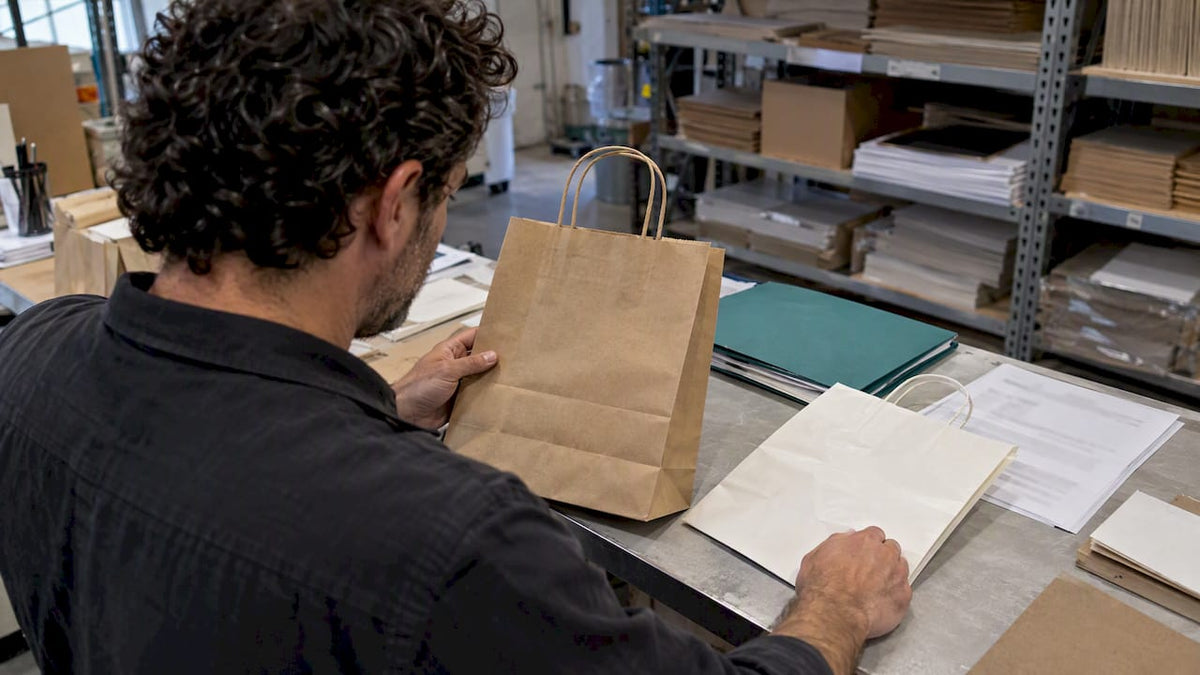
Most uncoated paper shopping bags are biodegradable and are commonly accepted in municipal organics or recycling programs when they carry no plastic lining. Coated or hybrid bags need third-party compostability certification, such as BPI certification under ASTM D6400 or D6868, and even then, acceptance depends on your local facility. Before placing a bulk order, verify the certificate number and confirm acceptance with your hauler. Our team at Gather Packaging can discuss those specs with you before you commit to a production run.
TL;DR:
- Compostability certification tests breakdown under managed industrial conditions, so it does not show that a bag will break down reliably in a backyard pile.
- Water based inks and adhesives keep uncoated kraft bags easier to recycle, while heavier coatings and laminates can complicate processing.
- For food contact bags, request written confirmation that no PFAS were intentionally added, or proof that fiber structure provides the grease barrier.
- Before approving samples, request strength results at relevant humidity levels because moisture can weaken glue joints and handle attachments.
- British Columbia requires new paper shopping bags to contain at least 40% recycled content and carry recyclable labeling that states the percentage.
Table of Contents
- Biodegradable vs. Compostable: What Buyers Need to Know
- Which Paper Bag Materials Are Compostable or Recyclable?
- Certifications and Standards: What They Confirm and What They Don’t
- How Paper Bags Actually Break Down After Use
- Procurement Checklist: What to Request Before You Order
- Comparing the Environmental Footprint of Paper, Plastic, and Hybrid Bags
- Additives and Treatments That Affect How Bags Break Down
- Disposal Guidance Manufacturers and Municipalities Recommend
- Avoiding Contamination When Biodegradable Bags Enter Compost Streams
- Why Domestic Manufacturing Makes Compostable Specs Easier to Verify
- Request a Sample or Spec Review for Compostable Paper Bags
- FAQ
- Sources
Biodegradable vs. Compostable: What Buyers Need to Know
“Biodegradable” is a broad term. It means a material will break down naturally over time, but it carries no fixed timeline and no guarantee of where or how that breakdown happens. “Compostable” is narrower and testable: a bag earns that label only when it meets performance standards such as ASTM D6400 or D6868, verified under controlled industrial composting conditions.
That distinction matters for procurement because certification tests disintegration and biodegradation under specific, managed composting conditions, not in a backyard bin and not in every municipal facility. A bag that meets a compostability standard may still be rejected at your local composting site if that site does not accept certified compostable products.
Buyers should also watch regulatory direction here. Canada’s proposed labelling rules would restrict use of terms like “biodegradable” on plastics unless backed by third-party certification, and would require specific labelling for compostable plastics. If you’re sourcing bags with any plastic component, ask your supplier how they plan to meet that direction.
Which Paper Bag Materials Are Compostable or Recyclable?
Kraft paper, whether virgin or recycled content, is the baseline material for most shopping bags and is generally both recyclable and biodegradable when left uncoated. Design guidance for recyclability notes that water-based inks and adhesives keep kraft bags easier to recycle, while heavier coatings or laminates complicate end-of-life handling.
Coatings change everything about how a bag gets processed after use. A bag lined with conventional plastic film may not be suitable for paper recycling or composting. Check local program rules before making disposal claims. A bag lined with a bioplastic coating designed for composting needs D6868-style certification with a verifiable certificate number before you can call it compostable on packaging or marketing materials.
Grease-resistant bags deserve particular scrutiny. Some grease barriers historically relied on fluorinated chemicals (PFAS), which raise health and regulatory concerns and can affect compostability claims. Ask suppliers for a written statement of no intentionally added PFAS, or request proof that grease resistance comes from fiber structure rather than a chemical coating. Our grease-resistant paper bag guide covers what to specify for takeout and food-adjacent retail bags.
Certifications and Standards: What They Confirm and What They Don’t
Certification marks and documentation can help buyers distinguish tested products from general environmental claims.
- BPI certification confirms a product meets ASTM D6400 or D6868 performance criteria under commercial composting conditions, verified through the BPI product search.
- A certificate number should be checkable against the supplier’s documentation and the certifying body’s public list, not just printed on the bag.
- A visual mark does not replace checking the certificate and confirming acceptance with the local facility.
- Certification does not guarantee local acceptance. Your specific hauler or municipal facility still decides what it processes.
Regulatory trends reinforce the need for documentation rather than marketing language. The Government of Canada’s consultation on labelling is moving toward requiring third-party certification before a product can be called “compostable,” which means vague claims on packaging will carry more legal risk going forward. Our eco-friendly bag certifications list breaks down the marks most commonly requested by retail buyers.
How Paper Bags Actually Break Down After Use
End-of-life outcomes depend heavily on where a bag ends up, not just what it’s made of.
Industrial composting facilities run at sustained high temperatures for set periods, conditions that certified compostable materials are specifically tested to handle. A backyard compost pile rarely reaches those temperatures consistently, so a certified bag may still take much longer to break down at home than it would in a commercial facility, a point the compostable products primer addresses directly.
Uncoated paper bags are often accepted in both recycling and organics programs, but coated or hybrid bags frequently get excluded from one or both streams. Municipal rules vary widely: Niagara Region’s program accepts paper bags and certain certified compostable bags in its green-bin collection, while other jurisdictions publish narrower approved lists. Calgary’s guidance on takeout containers notes that glossy or coated paper must carry a compostable label to be accepted; unlabeled glossy items typically go to recycling instead.
Before specifying a bag for a region-wide rollout, confirm acceptance with the local hauler in each market, not just the market where your packaging is designed.
Procurement Checklist: What to Request Before You Order
A clear RFQ protects you from acceptance and supply problems after the bags are already printed and in your warehouse.
- Mill run data confirming recycled content percentage, especially where your packaging claims a specific recycled content figure.
- Third-party compostability certificate, including the certificate number, for any coated or hybrid construction.
- Material and glue specifications, covering paper weight, coating type if any, and adhesive formulation.
- Grease-resistance test results, along with a written statement of no intentionally added PFAS if the bag will touch food.
- Strength testing at relevant humidity levels, since moisture significantly affects glue joint strength and handle attachment in storage or retail environments.
- Production samples and pre-production proofs before committing to a full run, so you can verify construction and print quality firsthand.
- Written confirmation of municipal or hauler acceptance for your target markets, plus a clear list of acceptable disposal streams for customer-facing labeling.
Pro Tip: Request humidity-range strength data before finalizing handle and patch specs; a bag that tests fine in dry conditions can fail at the point of sale during humid months.
Lead times and supply continuity matter as much as the material spec itself. If consistent supply is a priority, ask whether your manufacturer produces domestically or relies on overseas production runs with longer replenishment cycles. Our recycled content documentation guide walks through how to request and verify mill data specifically.
Comparing the Environmental Footprint of Paper, Plastic, and Hybrid Bags
Uncoated paper bags break down through natural biological processes and, when made with recycled content, draw on material already diverted from landfill. Plastic bags and paper bags can have different end-of-life outcomes. Check the applicable local requirements when selecting bags. British Columbia’s shopping bag regulation requires new paper bags to contain at least 40% recycled content and be labeled recyclable, with the recycled content percentage noted.
Non-biodegradable paper bags, meaning those laminated with conventional plastic film or treated with non-compostable coatings, lose most of the end-of-life advantage that plain paper offers. They can’t be composted and often can’t be recycled with standard paper streams either, since the lamination contaminates the pulping process. That puts them closer to plastic bags in practical environmental terms, despite being made primarily of paper fiber.
For buyers deciding between options, the clearest environmental gain comes from choosing uncoated or certified-compostable paper over any plastic-lined alternative, and from avoiding bags whose coatings strip away recyclability without adding genuine compostability. A bag that is technically paper but functionally plastic in its disposal behavior does not deliver the outcome most retail brands are trying to achieve with a paper bag in the first place.
Additives and Treatments That Affect How Bags Break Down
Not all paper bags are plain fiber. Several common treatments change how a bag performs at end of life, for better or worse.
Water-based inks and adhesives are widely considered recyclable-friendly and don’t interfere meaningfully with biodegradation or composting, according to recyclability design guidance. Water-based inks and adhesives can make kraft bags easier to recycle.
Grease-resistant treatments are where additives create the most risk. Historically, some grease barriers relied on PFAS compounds, and while fiber-based alternatives are increasingly available, buyers need to confirm which approach their supplier uses, especially for any bag that will contact food. Conventional plastic coatings, used to add moisture resistance or structural rigidity, block both composting and standard paper recycling unless they’re specifically formulated and certified as compostable film.
Bioplastic coatings designed for compostability sit in a different category: they can be processed in industrial composting facilities, but only when certified under standards like ASTM D6868, and only when the facility in question accepts that category of material. A bag with an uncertified “plant-based” coating is not automatically compostable just because the coating isn’t petroleum-based. The safest approach for procurement teams is to treat any coating, regardless of what it’s made from, as a flag that requires documentation before you make a disposal claim to customers.
Disposal Guidance Manufacturers and Municipalities Recommend
The simplest disposal instruction applies to uncoated paper bags: they generally go into recycling or organics collection, depending on local program rules, and don’t require any special handling. Manufacturers typically recommend keeping these bags free of food residue or grease buildup before disposal, since heavy contamination can affect how a recycling facility processes the batch.
For coated or certified compostable bags, both manufacturers and municipal programs converge on the same advice: check the local program’s accepted list before assuming a bag belongs in the green bin. Niagara Region’s guidance explicitly lists which paper and certified compostable bags are accepted, rather than leaving it to general assumption. Calgary’s guidance on takeout packaging takes a similar approach, specifying that glossy coated paper needs a compostable label to qualify for the organics stream, with unlabeled glossy items directed to recycling instead.
For brands printing disposal instructions directly on packaging, the practical recommendation is to state the material composition plainly (for example, “uncoated kraft paper, recyclable”) rather than using a generic green claim that may not hold true in every market where the bag is sold. Because municipal rules differ by region, a bag accepted in one city’s organics program may need to go in standard recycling elsewhere. Printing a QR code or web link to updated disposal guidance gives you flexibility to adjust that information as local rules change, without needing a full packaging reprint.

Avoiding Contamination When Biodegradable Bags Enter Compost Streams
Composting facilities process large volumes of material on tight schedules, and a bag that looks compostable but isn’t certified can create real problems downstream. Uncertified bags marketed loosely as “eco-friendly” or “biodegradable” sometimes end up in organics bins despite not meeting the facility’s processing standards, which can slow disintegration and reduce the quality of the finished compost.
This is one of the reasons provincial guidance on compostable plastics notes that compostable plastics remain problematic in some facilities and are excluded from certain organics programs until testing or infrastructure improves. Acceptance of certified compostable material varies by facility, so confirm local rules before specifying a bag.
For brands, the contamination risk cuts both ways. An unsupported compostability claim can mislead customers and may conflict with applicable labelling rules. Confirm the product’s certification and local acceptance before printing disposal claims. The safest practice is to only use compostable claims on products with a verifiable certificate number, and to make sure any coating or lamination has been tested under the same standard as the base paper. Buyers should also avoid mixing certified and uncertified SKUs that look visually similar, since staff and customers at the point of disposal can’t tell the difference without reading fine print most people skip.
Why Domestic Manufacturing Makes Compostable Specs Easier to Verify
Working with a domestic manufacturer shortens the distance between a spec sheet and a verified answer. Discuss production location, material certifications, inks, and printing options with Gather Packaging to confirm which specifications are available for your order.
That proximity speeds up prototyping and makes it easier to confirm mill data, certificate numbers, and adhesive specs before a full order ships. Ask Gather Packaging what quality assurance checks and documentation are available for your paper shopping bag order.
— Taylor
Request a Sample or Spec Review for Compostable Paper Bags
If you’re specifying paper bags that need to meet compostability, recycled content, or grease-resistance requirements, we can work through the documentation with you before you commit to a production run. We manufacture Turn Top, Serrated Top, and Tamper-Resistant Serrated Top paper bags, customizable in size and print.
Contact Gather Packaging to discuss samples, material specifications, handle construction, and any certification documentation needed for your order. If grease resistance or coated-paper compostability is part of your spec, our kraft paper bag options are a good starting point for comparison.
Contact Gather Packaging to discuss your paper shopping bag or retail packaging needs, request a sample, or get a custom quote through our consultation page.
FAQ
What’s the difference between compostable bags and biodegradable bags?
Biodegradable means a material breaks down naturally over time, with no fixed timeline or testing requirement. Compostable is a narrower, certifiable claim that requires a product to meet specific performance standards, such as ASTM D6400 or D6868, under managed composting conditions.
Does Dollarama sell compostable bags?
We don’t have visibility into specific retailers’ current product assortments, and that information isn’t something we can verify here. For compostable paper bag sourcing, check for a certificate number and confirm the claim against the BPI product list rather than relying on packaging alone.
What are some environmentally friendly paper bags?
Uncoated kraft paper bags made with recycled content and water-based inks are generally the most straightforward environmentally friendly option, since they’re both biodegradable and commonly recyclable. Bags with certified compostable coatings, verified through a traceable certificate number, are a good option when grease resistance or moisture protection is required.
Is 100% biodegradable the same as compostable?
No. A product can be fully biodegradable without meeting the specific disintegration and testing criteria required for a compostable certification under standards like ASTM D6400 or D6868. Compostable is a tested, time-bound claim; biodegradable is a broader, less specific one.
Share:
Warehouse Humidity Control: Align Paper Bag Specs Before Damage
Design for Recyclability: Paper Bag Specs Canadian Buyers Can Verify