
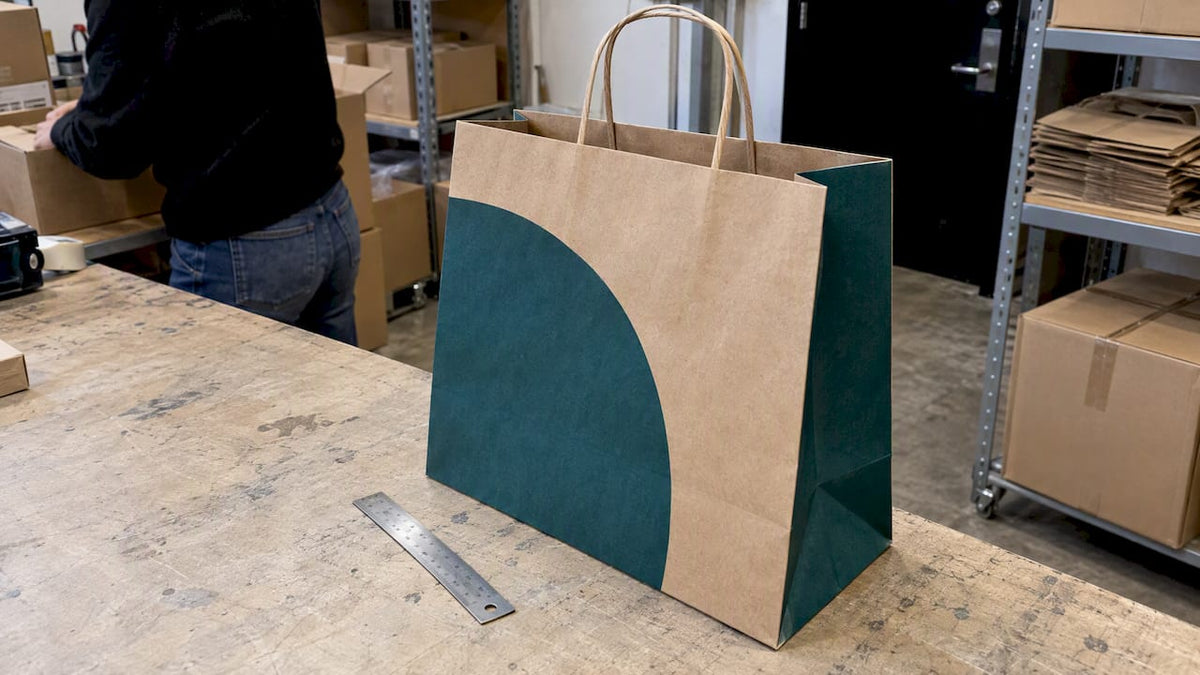
Brand guidelines for bags are the rules that tell a printer how your logo, colors, copy and claims must appear on a shopping bag, and how the finished bag will be judged. A good set fits on a few pages, speaks the language of print production, and survives a change of supplier or a reorder a year later. Below is what to put in yours, written for packaging buyers, procurement teams and agencies working on paper shopping bags in Canada.
TL;DR
- A general brand book is not enough. Bags need a production addendum: logo placement on each panel, spot colors on the correct paper stock, minimum line weights, and an approval process.
- Color on kraft or uncoated paper will not look like color on a screen or a coated brochure. Define a target, a tolerance and a physical reference.
- Any environmental wording on the bag (recyclable, recycled content, FSC) must be provable. Put approved claim wording in the guidelines.
- Lock in proofing and prototyping before the run, and keep the approved sample as the benchmark for reorders.
- Send the draft to your manufacturer early. Constraints found at the die-line stage cost far less than constraints found at press.
Table of Contents
- Why a bag needs its own guidelines
- What to put in your bag brand guidelines
- Color consistency across reorders
- How shoppers read a paper bag
- Environmental claims: write them down before they are printed
- A one-page template you can adapt
- Our perspective
- Work with a manufacturer on your bag specifications
- FAQ
- Sources
Why a bag needs its own guidelines
Most brand books are built around screens, signage and flat print. A paper shopping bag is a different object. It is a folded, glued, three-dimensional surface with gussets, a bottom seam, handles or a turn top, and a paper surface that absorbs ink. Your logo sits across a fold line. Your brand color lands on fibre, not on coated board.
That is why the same logo can look crisp on a business card and muddy on a bag. A bag addendum closes that gap. It translates your identity into decisions a press operator and a quality inspector can act on.
The addendum also protects continuity. Retail operations teams reorder; agencies rotate; suppliers change. When the rules are written down, the bag you receive in month eighteen can match the bag approved in month one.
What to put in your bag brand guidelines
Treat the document as a checklist a stranger could follow. Here are the sections we see matter most on paper shopping bags.
Logo placement and clear space
Specify where the primary logo sits on the front and back panels, how far it stays from the top edge, the bottom fold and the side gussets, and the minimum clear space around it. Say which logo version to use on a dark kraft stock versus a white one. If your bag has a turn top, state whether any artwork may fall into the turned-over band.
Give a minimum size for the logo and any fine text. Thin strokes and small reversed type are the first things to fail on uncoated paper, because ink spreads slightly into the fibre.
Color: target, stock and tolerance
This is the section buyers ask about most, and the one that causes the most disputes. Write down:
- The color reference. Name the spot color and the swatch book it comes from. Spot colors are normally specified from a formula guide for the paper type, and uncoated and coated guides can show the same color differently.
- The substrate. Natural kraft, white kraft or a recycled stock will each shift the result. A color that is vivid on white paper will look deeper and warmer on brown kraft.
- The tolerance. Decide how much variation you will accept within a run and between reorders, and say how it will be judged: against a signed press proof, a physical drawdown or a retained sample.
- The fallback. If a color cannot be hit on a given stock, say whether you prefer a close match or a different ink strategy, such as a bolder flat color or a one-color design.
Printers in this market publish their own tolerances. One bag maker, for example, notes that tints and tones can fluctuate within a run or reorder, and that spot-color matching is limited to certain bag types. The lesson is general: ask every supplier what variation to expect and write it into your document rather than assuming it is zero.
Print process constraints
Bag artwork is often printed by flexography, using flexible plates on a cylinder. It handles bold, flat color well. It is less forgiving of hairline details, tight color registration between many colors and soft gradients. Your guidelines should state the preferred treatment for gradients, photography and fine rules, and tell designers when to simplify.
We print with up to 8-color flexo at our Toronto plant, which gives room for brand colors plus supporting inks. More colors do not remove the need for restraint. Ask us which parts of your design are safe and which need adjusting before you commit to artwork.
Typography, copy and tone on the bag
List approved typefaces for the bag, minimum point sizes on kraft, and approved taglines or URLs. If the bag carries a QR code, give its minimum size, quiet zone and contrast requirement, and require a scan test on a printed sample, not just on a screen.
Bag construction details that affect branding
Name the style, size, paper weight, handle type and finish. Our range covers turn top, serrated top and tamper-resistant serrated top bags. Each style changes what the customer sees: a serrated top gives a different edge detail from a turn top, and a tamper-resistant bag for takeout delivery carries sealing needs that change where artwork can sit. Your guidelines should reference the construction, because the same artwork file rarely transfers unchanged from one style to another.

Approval workflow
Write down who signs off, in what order, and what they sign. A workable chain is: die-line check, pre-press proof, physical prototype, then a production reference sample. State that production is measured against the approved sample.
Color consistency across reorders
Buyers searching for color consistency on bags are usually reacting to one bad experience: the second order looked different from the first. The causes are ordinary. A different paper lot, a different ink batch, a different press, or a file that was quietly altered.
You can reduce the risk with the document itself:
- Keep one master artwork file and one version history. Record the date of every change.
- Retain a signed physical sample from the first production run, and request that your supplier retain one too.
- Specify the same stock and weight on every purchase order, not just “kraft”.
- Ask your manufacturer how it controls ink and checks color during the run.
- Define in advance what you will do if a reorder falls outside tolerance.
Domestic production helps here in a practical way. When your manufacturer is in the same country, a prototype can be reviewed in person or by courier in days, and a disagreement over a sample can be settled before the full run is committed. That is part of why we manufacture in Toronto. If you want to see how local production changes the process, read about our Canadian-made paper shopping bags.
How shoppers read a paper bag
People searching for consumer perception of paper bags want to know whether the material says something about the brand. We will not quote a statistic we cannot source, so here is what we can say from experience in production: the bag is carried through a street, a mall or a neighbourhood after the sale, so what shoppers see is the front panel, the color and the finish. A clean, well-registered print on a sturdy stock reads as care. A smeared logo or a wobbly handle reads as the opposite.
That is why print quality and construction belong in the same document as logo rules. Perception is formed by details that guidelines can control: contrast, margins, legibility and how the bag holds its shape.
Environmental claims: write them down before they are printed
Many bag buyers add a line such as “eco-friendly” or a recycling symbol to the artwork. In Canada that is a compliance matter, not decoration. The Competition Bureau’s labelling guidance says claims must be accurate and meaningful, and businesses should hold the evidence behind a claim before making it.
The practical consequences for your guidelines:
- Avoid vague terms. The Quebec packaging body ÉEQ advises replacing generic wording with specific facts in its packaging communication guide. “Contains recycled fibre” needs a stated, verifiable amount to be useful.
- Do not rely on the chasing arrows alone. The symbol without context is not enough to show recyclability, as the Paper and Paperboard Packaging Environmental Council explains. The same page reports that 96% of Canadians had access to paper bag recycling as of 2023, which is the sort of evidence that supports a recyclable claim for paper.
- Approve claim wording in advance. List the exact sentences the bag may carry, and the document that proves each one.
FSC marks need a traceable chain
If you want an FSC logo on the bag, buying certified paper is not the whole story. FSC’s paper, print and packaging booklet describes third-party audits of businesses in the chain, and certified products must be identifiable and kept separate. Your guidelines should therefore say that the FSC mark appears only when the supplier can document the order. Ask for that at the quote stage, not after the artwork is final.
Our materials include FSC®-certified options and recycled content, and we use water-based inks. Tell us which claim you want to make and we will discuss what can be documented for your order.
Ask suppliers about the process, not only the paper
Sustainable packaging guidance from Sustainable Packaging Canada points out that the source of the fibre and the energy used in making and converting paper both matter. A good brand guideline includes a short list of supplier questions on these points, so procurement can compare quotes on the same footing. For deeper reading, see our pieces on recycled paper bags buyers should specify, requiring mill run data for recycled content claims and design for recyclability.
A one-page template you can adapt
Use this structure as the skeleton for your own addendum.
| Section | What to specify | Who signs off |
|---|---|---|
| Logo | Placement per panel, minimum size, clear space, version per stock | Brand manager |
| Color | Spot color names, swatch book, stock, tolerance, reference sample | Brand and procurement |
| Process, number of colors, gradient and fine-line rules | Designer and manufacturer | |
| Construction | Style, size, paper weight, handles, finish | Procurement |
| Claims | Approved wording, evidence file, FSC rules | Legal or compliance |
| QR and codes | Size, contrast, scan test | Marketing |
| Approval | Proof, prototype, retained sample | Named approver |
| Reorders | Same file, same stock, same tolerance, comparison to sample | Procurement |
Keep it short. A guideline that nobody reads on the press floor is a guideline that does not work.
Our perspective
We make paper shopping bags in Toronto, and the most common problem we see is not bad design. It is design that was never tested against the paper. A logo drawn for a screen arrives at the press with hairlines that will fill in and a color that was never checked on kraft.
So we push the conversation earlier. Die-line preparation, graphic layout, pre-press proofing and prototyping exist to catch these issues while they are cheap to fix. When a buyer arrives with a written bag addendum, the process is quicker for everyone, because the questions we would ask are already answered.
On sustainability, we would rather a brand print one precise, provable statement than three attractive but vague ones. The rules in Canada point the same direction, and so does good procurement practice.
— Taylor
Work with a manufacturer on your bag specifications
If you are drafting or revising bag guidelines, we can review them against what our presses and materials can do. Our services cover consultation and quotation, die-line preparation, graphic design and layout, pre-press proofing, prototyping, and warehouse and logistics, alongside our paper bag styles. Start from the Gather Packaging home page and contact us to discuss your paper shopping bag or retail packaging needs.
If you are also setting supplier criteria, our questions to ask packaging suppliers is a good companion checklist. Distributors and agencies may also like our shopping bag branding ideas for distributors.
FAQ
Do I need separate guidelines for bags if I already have a brand book?
Yes, a short addendum is worth writing. A brand book rarely covers paper stock, fold lines, spot-color tolerance on uncoated paper or claim wording. The addendum should reference the brand book for identity and add the production rules.
How do I keep my brand color the same from one order to the next?
Name the spot color and the swatch guide for the paper type, specify the exact stock, and keep a signed sample from the first run. Agree on a tolerance in advance and compare each reorder to the sample, not to a screen.
Can I print “eco-friendly” on my bags?
It is better to avoid it. The Competition Bureau expects environmental claims to be accurate and supported by evidence, and ÉEQ recommends specific, factual wording instead of general terms. State what is true and documented, such as the type of certification or the recycled content you can prove.
Can I put the FSC logo on my bag?
Only if the supply chain is certified and documented for that order. FSC describes audits across the chain, so ask your manufacturer to confirm what it can document before you finalize the artwork.
Share:
Bakery Packaging Sustainability: A Canadian Buyer's Guide
Twisted Handle vs Flat Handle Paper Bags: How to Choose