

TL;DR:
- Asking detailed questions ensures quality, cost control, and transparency from packaging suppliers. Verifying manufacturer status, material certifications, quality control processes, and lead times helps prevent costly errors and delays. Using suppliers like Gatherpackaging provides transparent processes, eco-friendly options, and reliable North American delivery.
The right questions to ask packaging suppliers reveal more about a vendor than any sales pitch ever will. Procurement teams and retail buyers who skip structured supplier evaluation end up with quality failures, missed lead times, and hidden costs that compound across every reorder. This guide covers the key supplier interview questions that matter most for paper shopping bags and retail packaging: manufacturing verification, material quality, sustainability credentials, pricing structure, and delivery reliability. Each question is paired with an explanation of what a strong answer looks like.
1. Are you a direct manufacturer or a trading company?

Direct manufacturers offer greater accountability, better price control, and deeper technical expertise than intermediaries. A trading company places orders with third-party factories, which adds a layer of distance between you and the people actually making your bags. That distance makes it harder to resolve quality issues, customize specifications, or get honest answers about production capacity.
Ask for proof. Request factory registration documents, photos of the production floor, and references from clients who have visited the facility. A legitimate manufacturer will not hesitate to provide these.
- Can you share your factory registration or business license?
- Do you manufacture all products in-house, or do you subcontract any processes?
- Can I arrange a factory visit or video walkthrough?
- Who is the point of contact for technical questions about materials and production?
Pro Tip: If a supplier deflects the factory visit question or offers only a showroom tour, treat that as a red flag. Domestic manufacturers like Gatherpackaging, based in Toronto, Canada, can typically facilitate direct facility access far more easily than overseas intermediaries.
2. What paper types, GSM weights, and sustainable materials do you offer?
Material capability is the foundation of every packaging supplier evaluation. For paper shopping bags, GSM (grams per square meter) determines bag strength and perceived quality. A supplier who cannot specify GSM guarantees or paper grade options is not equipped to meet consistent quality standards across reorders.
Ask about the full range of materials and whether the supplier can source FSC-certified or recycled content papers. The Forest Stewardship Council (FSC) certification confirms that paper comes from responsibly managed forests. Sustainable Forestry Initiative (SFI) certification serves a similar function in North American supply chains.
- What GSM range do you offer, and can you guarantee consistent weight across production runs?
- Do you carry FSC-certified or SFI-certified paper stocks?
- Can you supply bags made with recycled content or post-consumer waste fiber?
- Do you offer compostable or biodegradable bag options?
- What inks and adhesives do you use, and are they water-based or solvent-based?
Ink and adhesive details are critical for compliance, especially when bags contact food products or enter markets with chemical restriction regulations. A supplier who cannot answer these questions in writing is not ready for serious retail or foodservice accounts. Gatherpackaging uses water-based inks and FSC-certified materials as standard, which sets a clear benchmark for what a credible answer looks like.
Buyers focused on building a sustainable packaging workflow should also ask whether the supplier has a formal eco-design process or simply offers a “green” option as an afterthought.
3. How do you handle quality control during and after production?
Quality control is the single area where supplier answers diverge most sharply from supplier reality. Pre-production samples must be evaluated against acceptance checklists covering structure, color accuracy, and finish before any bulk run begins. Skipping this step is the most common cause of costly production failures.
Ask about every stage of the QC process, not just the final inspection. A supplier with documented in-line checks catches problems before they multiply across thousands of units.
- Do you provide pre-production samples for approval before bulk production starts?
- What does your in-line quality inspection process look like during production?
- How do you track defect rates, and what is your acceptable defect threshold?
- What is your policy for misprints, structural failures, or color deviations?
- Who reviews and approves artwork files before plates are made?
- Do you provide a written QC report with each shipment?
A packaging quality assurance checklist specific to paper shopping bags should cover handle attachment strength, base integrity, print registration, and color consistency across the run.
Pro Tip: Only accept suppliers who can provide documented QC protocols in writing. A verbal assurance of “we check everything” is not a quality system. Ask to see the actual checklist or inspection form they use.
4. What does your pricing structure include, and what fees are not in the base quote?
Total cost of ownership extends well beyond unit price. Tooling fees, plate charges, artwork change fees, and storage costs can add significantly to the real cost of a packaging program. Buyers who focus only on the per-unit price routinely get surprised by invoices that look nothing like the original quote.
Ask for a fully itemized quote that separates every cost category. Then ask specifically about what happens on reorders.
- Is the tooling or die-cut setup fee a one-time charge, or does it recur on every order?
- Can artwork files and printing plates be reused on reorders at no additional cost?
- Are there storage or warehousing fees if production finishes before I am ready to receive?
- What are your payment terms, and do you offer net-30 or net-60 options?
Tiered pricing structures tied to minimum order quantities (MOQs) are standard in paper bag manufacturing. Understanding the volume thresholds that unlock lower unit costs helps buyers plan order cycles around cash flow rather than just immediate need.
Overrun and underrun policies govern how much the final delivered quantity can vary from what was ordered. Agreeing on acceptable tolerances in writing before production starts prevents billing disputes and inventory shortfalls after delivery.
5. What are your realistic lead times, and can you deliver in phases?
Lead time questions expose more about a supplier’s actual capacity than almost any other inquiry. Realistic lead times should be verified using data from recent comparable orders, not theoretical minimums quoted from a sales sheet. A supplier who quotes two weeks for a custom print run of 10,000 bags without referencing actual recent production data is giving you a number designed to win the order, not manage your expectations.
Phased delivery matters for retail buyers managing warehouse space or seasonal inventory cycles. Ask whether the supplier can produce a full order and ship in batches tied to your stocking schedule.
- What was the actual lead time on your last three orders of similar size and complexity?
- Can you deliver in multiple shipments if my warehouse cannot absorb the full quantity at once?
- What is your production capacity during peak seasons like Q4?
- If a production delay occurs, how and when will you notify me?
- What is your communication channel for order status updates?
Domestic manufacturers hold a structural advantage here. A Toronto-based facility like Gatherpackaging ships within North America without the port delays, customs clearance timelines, or ocean freight variability that affect overseas suppliers. That geographic reality translates directly into shorter, more predictable lead times.
Key Takeaways
Asking the right supplier interview questions before committing to a paper bag program protects quality, controls costs, and builds a supply relationship that holds up under real production pressure.
| Point | Details |
|---|---|
| Verify manufacturer status | Ask for factory documents and facility access before any other evaluation step. |
| Confirm material certifications | Require FSC or SFI certification and written ink and adhesive specifications. |
| Demand documented QC | Only accept suppliers with written inspection protocols and pre-production sample approval. |
| Itemize all costs | Request a fully separated quote covering tooling, plates, storage, and reorder fees. |
| Test lead time claims | Ask for recent order data, not theoretical minimums, and confirm phased delivery options. |
What I have learned from watching buyers skip these questions
The most expensive packaging mistakes I have seen come from buyers who treated supplier selection as a price comparison exercise. They asked for a quote, picked the lowest number, and discovered three months later that the “manufacturer” was a trading company with no direct control over production quality. The bags arrived with inconsistent handle attachment, color drift across the run, and no QC documentation to support a claim.
Not all packaging vendors possess equal technical expertise. The ones worth working with have structured audit processes, credentialed staff, and the confidence to answer hard questions in writing. When a supplier hedges on material certifications or cannot produce a sample approval checklist, that hesitation tells you everything.
Sustainability questions deserve the same rigor. Asking whether a supplier is “eco-friendly” is nearly useless. Asking for FSC chain-of-custody documentation, water-based ink specs, and a formal statement on recycled content percentage produces answers you can actually verify. Gatherpackaging publishes its sustainability credentials openly, which is the standard every supplier should be held to.
The buyers who get the best outcomes treat supplier evaluation as an ongoing relationship, not a one-time gate. They revisit lead time performance, defect rates, and material consistency at every reorder. That discipline compounds over time into a supply chain that actually works.
— Taylor
Gatherpackaging: paper bags built for retail brands that ask the right questions
Gatherpackaging manufactures custom paper shopping bags in Toronto, Canada, with FSC-certified materials, water-based inks, and 8-color flexo printing as standard. Every order includes pre-production sample approval, documented quality inspection, and North American lead times that do not depend on ocean freight schedules.
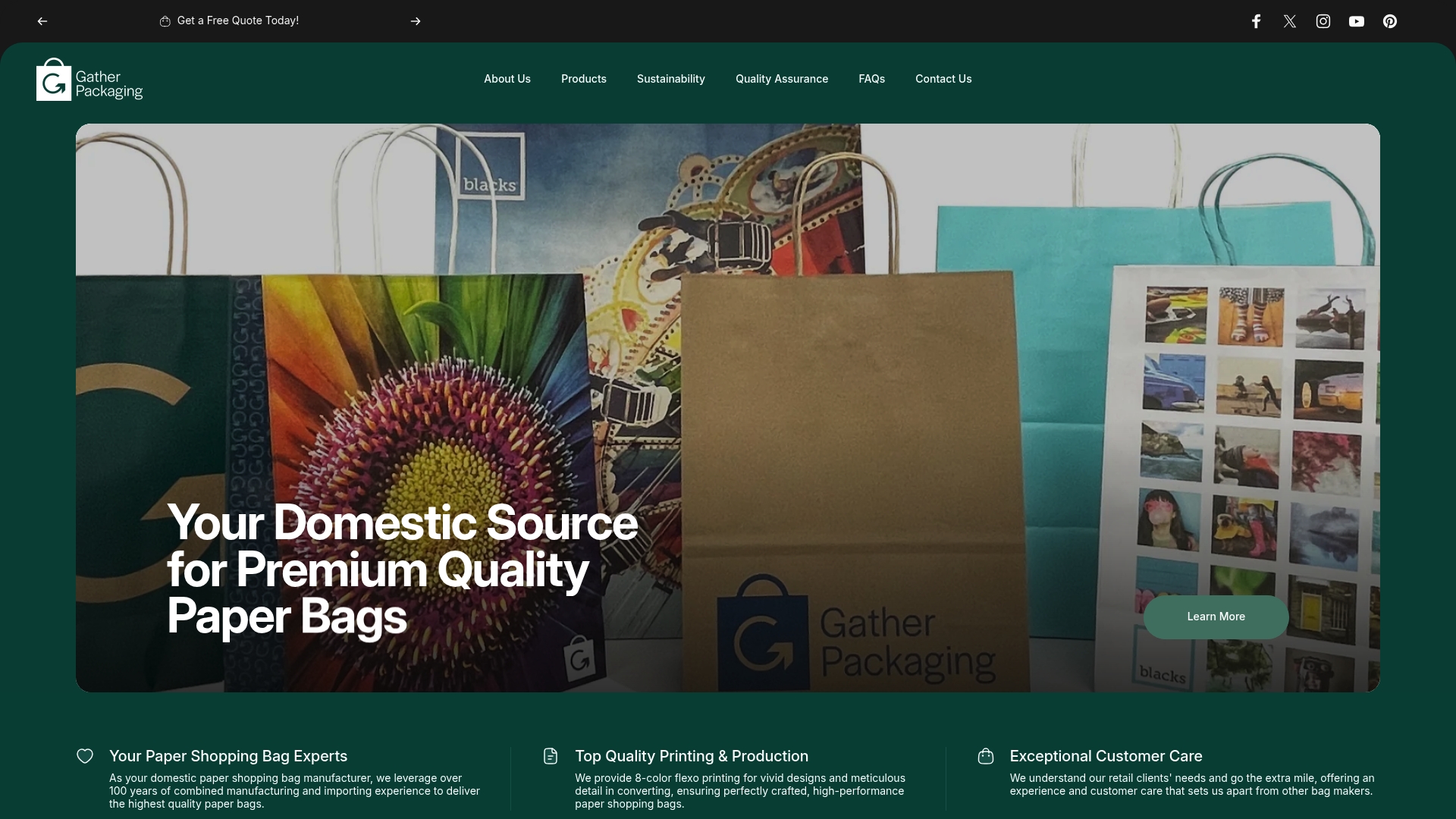
Retail buyers and procurement teams can request samples, get itemized quotes, and review full material specifications directly. Gatherpackaging’s eco-friendly paper bags include compostable, recycled content, and biodegradable options backed by documented certifications. For buyers who want to see the full product range and custom printing capabilities, the custom paper bag catalog covers every available style and size. Contact Gatherpackaging to discuss your paper shopping bag program and get a quote built around your actual volume and delivery requirements.
FAQ
What is the most important question to ask a packaging supplier?
Ask whether the supplier is a direct manufacturer or a trading company. Direct manufacturers provide better quality control, more accurate pricing, and direct technical accountability than intermediaries.
How do I verify a packaging supplier’s sustainability claims?
Request FSC or SFI chain-of-custody certification documents and written specifications for inks and adhesives. Verbal sustainability claims without supporting documentation are not verifiable.
What should a pre-production sample approval process include?
Samples should be evaluated against a checklist covering structure, color accuracy, print registration, and finish before bulk production begins. Any deviation from approved specs should trigger a revised sample, not a production waiver.
How do overrun and underrun policies affect my order?
Overrun and underrun policies define how much the final delivered quantity can vary from the ordered amount. Agreeing on tolerances in writing before production prevents billing disputes and inventory shortfalls.
Why do domestic manufacturers offer shorter lead times than overseas suppliers?
Domestic manufacturers ship within the same country or region, eliminating port delays, customs clearance, and ocean freight variability. For North American retail buyers, a Canadian or US-based manufacturer typically delivers faster and with more predictable scheduling than an overseas source.
Share:
How to Source Packaging Domestically: A Retail Guide
What Is High-Volume Bag Production: A 2026 Guide