

Most retail packaging mistakes don’t announce themselves. They show up as a torn handle at the checkout counter, a logo that prints muddy brown instead of forest green, or a bag so oversized it collapses around a small gift box. By the time you notice, the customer already has.
The top retail packaging mistakes fall into predictable categories, and most are avoidable with better spec decisions upfront:
- Poor design and inconsistent branding that undercuts perceived product value
- Inadequate product protection from weak paper grades and failing handle construction
- Wrong bag sizing that wastes material and looks sloppy on the shelf
- Ignoring sustainability when consumers and retailers increasingly require it
- Unclear messaging and labeling that confuses customers and risks compliance failures
- Skipping retailer and regulatory requirements that cause shipment rejections
- Difficult opening and poor usability that frustrates customers at the worst moment
- Low-quality materials chosen on price alone, without checking full specifications
- Hidden financial costs from returns, reprints, and brand damage that compound fast
Each of these errors has a direct line to lost sales, customer complaints, or supply chain disruption. The sections below break down exactly what goes wrong and how to fix it.
1. Design and branding errors that erode customer trust

Your packaging is the last brand touchpoint before a customer walks out the door. A bag that looks off-brand, cluttered, or cheaply printed tells the customer something about the product inside, even if that product is excellent.
The most common design errors include:
- Mismatch between packaging and brand identity. A premium apparel brand using a generic kraft bag with a single-color stamp signals commodity, not quality.
- Overcrowded layouts. Stacking logos, taglines, social handles, and promotional copy onto one bag face creates visual noise. Strong logo placement, controlled brand colors, and clean typography consistently outperform designs that try to say everything at once.
- Inconsistent color reproduction. Color consistency testing across production batches is non-negotiable for brand integrity. A logo that shifts even slightly between orders trains customers to distrust the brand.
- Finish choices that don’t match brand positioning. Overly complex designs and excessive printing finishes raise costs without improving customer value. Matte lamination reads premium on a fine jewelry bag. The same finish on a grocery takeout bag is wasted spend.
Print quality matters beyond aesthetics. Poor registration, ink bleed, or surface scratching all show up in public packaging complaints, and they reflect directly on the product inside the bag.
2. Inadequate product protection that leads to damage and returns
A paper shopping bag that fails under load is not a minor inconvenience. It’s a damaged product, a frustrated customer, and a return that costs more than the bag ever did.
Weak handle construction and poor material choice are among the most common reasons paper bags fail. Handles that tear or detach under normal carry weight are a direct result of under-specified paper grade or inadequate reinforcement at the attachment point. Industry guidelines from the paper bag sector recommend fixing handles inside the bag and reinforcing them with a paper patch for maximum strength.
Common protection failures include:
- Thin paper grades that can’t support the product weight the bag is sold to carry
- Weak bottom gussets that buckle when products are dense or heavy
- Inadequate seam adhesion from mismatched glue viscosity or poor application
- No reinforcement at stress points like handle holes and bottom folds
The EN13590 durability standard provides objective testing for bag resistance and carrying capacity through tensile, burst, and drop tests on production batches. Testing to this standard confirms consistent performance across the full run, not just the sample you approved.
3. Wrong bag sizing wastes material and hurts shelf presentation
Size is one of the most overlooked variables in retail bag specification, and getting it wrong costs money in multiple directions at once.
Wrong sizing wastes material, affects shelf appearance, and can damage products during transport. A bag too large for its contents looks empty, collapses on the shelf, and uses more paper than necessary. A bag too small forces staff to double-bag or creates a poor packing experience that can damage product boxes.
The sizing errors that appear most often:
- Ordering one standard size for multiple product lines with different dimensions and weights
- Ignoring gusset depth when products are bulky or irregularly shaped
- Failing to account for shipping stacking when bags will be packed and transported before use
- Choosing size by visual estimate rather than measuring actual product pack dimensions
Proper size planning balances material use with product protection and presentation. For retail brands running multiple categories, this usually means two or three bag sizes rather than one universal option. The material savings from right-sizing add up across a full season’s order volume.
4. Neglecting sustainability when consumers and retailers expect it
Sustainable packaging has moved from a differentiator to a baseline expectation for many retail categories. Ignoring it creates brand risk, not just environmental risk.
Consumer preference increasingly favors sustainable packaging materials such as FSC®-certified paper, water-based inks, and biodegradable adhesives. Eco-conscious packaging now factors into brand consideration and purchase decisions across apparel, grocery, and specialty retail. Retailers sourcing bags without these credentials face pushback from both end customers and retail partners with their own sustainability commitments.
The sustainability mistakes that create the most exposure:
- Using non-certified paper when FSC® or recycled content certification is available and expected
- Specifying solvent-based inks when water-based alternatives produce comparable print quality
- Ignoring post-consumer recycled content options that reduce virgin material use
- Treating sustainability as an add-on rather than building it into the initial specification
Gatherpackaging uses FSC®-certified paper, water-based inks, and responsibly sourced adhesives as standard. Every bag is 100% curbside recyclable. For brands with eco-friendly packaging commitments, these aren’t optional features; they’re the starting point.
5. Unclear messaging and labeling that confuses customers
Packaging communicates before the customer ever opens the bag. When that communication is cluttered, illegible, or missing required information, it creates friction at exactly the wrong moment.
The most common labeling mistakes:
- Text too small to read at normal viewing distance, especially for care instructions or product details
- Competing visual elements that make it unclear what the brand is or what the product does
- Missing regulatory information required for specific product categories or markets
- Inconsistent typography across a product line that makes the brand look disorganized
Clarity and legibility aren’t just about aesthetics. For certain product categories, labeling requirements are legally mandated. The FDA sets specific requirements for food-contact packaging materials, and missing required disclosures can trigger compliance issues that go well beyond a reprint.
Pro Tip: Before finalizing any bag design, test legibility at arm’s length under retail lighting conditions. What reads clearly on screen often disappears on a printed surface under fluorescent store lights.
6. Ignoring retailer and regulatory requirements causes costly delays
Retail buyers and procurement teams often discover compliance gaps after production is complete. That’s the most expensive place to find them.
Ignoring retailer and regulatory requirements can cause shipment rejections, delays, and costly redesigns. Major retail chains specify minimum paper weights, handle types, print standards, and sustainability certifications. Arriving at a distribution center with bags that don’t meet those specs means the shipment comes back.
Regulatory requirements add another layer. Hazardous materials packaging must meet Department of Transportation standards. Food-contact materials fall under FDA jurisdiction. Retailers operating in multiple jurisdictions face overlapping requirements that a single generic spec won’t satisfy.
The compliance errors that appear most often:
- Skipping retailer spec sheets and assuming standard production will qualify
- Missing sustainability certifications that major chains now require from suppliers
- Incorrect labeling for the destination market, particularly for cross-border shipments
- Failing to document material sourcing when retail partners require chain-of-custody records
Building compliance review into the specification stage, before production starts, eliminates the most expensive category of packaging mistakes.
7. Poor usability and difficult opening frustrate customers at the worst moment
A bag that’s hard to open, uncomfortable to carry, or awkward to pack undermines the customer experience at the exact moment it should be reinforcing it.
Packaging usability, including opening ease and comfortable handles, significantly influences customer satisfaction and repeat purchase likelihood. Difficult-to-open or uncomfortable bags negatively affect brand perception and reduce the chance a customer returns.
The usability failures that generate the most complaints:
- Handles that cut into the hand under moderate load, usually from flat paper handles with insufficient width or padding
- Bag openings that are too narrow for easy packing at the checkout counter
- Twisted handles that unravel after a single use because the paper grade is too light
- Stiff or sharp edges at the bag mouth that snag tissue paper or product wrapping
Ergonomic handle design is a specification decision, not a finishing detail. The handle paper grade, width, twist density, and attachment method all determine whether the bag feels comfortable or punishing after a two-block walk. For premium retail, this is where the customer forms their lasting impression of the brand.
8. Low-quality materials chosen on price alone
Price-only purchasing decisions are the single most reliable path to packaging failure. The problem is that the quality gap rarely shows up in the quote; it shows up in the field.
Comparing quotes without verifying full bag specs frequently results in lower-quality products that fail in real-world use. Paper grade, adhesive type, handle reinforcement, and print standard are the variables that determine bag performance. None of them appear on a price-per-unit line item unless you ask for them explicitly.
The material shortcuts that cause the most damage:
- Downgraded paper weight that looks identical to spec but fails under load
- Weak adhesives that release at seams when the bag is stressed or exposed to humidity
- Thin handle paper that tears at the attachment point after one or two uses
- Inconsistent ink coverage from low-grade inks that fade or scratch after minimal handling
A full bag specification should include paper grade (gsm and type), adhesive specification, handle construction method, reinforcement details, and print standard. Comparing quotes on that basis reveals real cost differences. Comparing on price per unit alone invites substitution.
9. The hidden financial and brand costs of packaging mistakes
The direct cost of a failed bag is easy to calculate: the replacement order, the return shipping, the damaged product. The indirect costs are harder to see and usually larger.
Lost sales from packaging failures compound quickly. A customer who receives a product in a torn or visually off-brand bag is less likely to return, less likely to recommend the brand, and more likely to post about the experience. For retail brands that have invested in store design, product quality, and customer service, a cheap bag undoes a disproportionate amount of that work.
The cost categories that packaging mistakes generate:
- Direct replacement costs for failed bags, damaged products, and reprint orders
- Customer attrition from shoppers who associate the brand with poor quality
- Supply chain disruption costs when non-compliant packaging causes shipment rejections
- Rebranding and redesign expenses when a packaging error reaches the market at scale
“Packaging is a walking billboard,” as Gatherpackaging’s leadership has noted. A flimsy bag that doesn’t reflect the brand is a visible signal to every person who sees it. The reputational cost of that signal is real, even when it’s hard to put a number on it.
10. Best practices that prevent common packaging errors
Avoiding the most common retail packaging mistakes comes down to a few consistent disciplines applied at the specification stage, before production begins.
- Specify beyond price. Require paper grade, adhesive type, handle construction, reinforcement method, and print standard in every quote. Domestic sourcing reduces the risk of undisclosed substitutions that offshore suppliers sometimes make between sample approval and production run.
- Test to EN13590. Validated tensile, burst, and drop tests on production batches confirm that the bag performs consistently, not just on the sample you approved.
- Build sustainability into the spec from the start. FSC® certification, water-based inks, and recycled content options are easier and cheaper to specify upfront than to retrofit after a retailer or regulatory audit.
- Right-size for each product line. Measure actual product pack dimensions and specify bag sizes accordingly. One universal size across multiple categories is almost always a compromise that serves none of them well.
- Use domestic manufacturing for speed and consistency. Local production reduces exposure to global freight delays and tariff fluctuations, and makes it easier to inspect production and resolve quality issues quickly.
- Review retailer spec sheets before finalizing design. Compliance gaps found at the specification stage cost nothing to fix. The same gaps found after a shipment rejection cost significantly more.
Pro Tip: Ask your supplier for the full technical data sheet on the paper grade they’re quoting, not just the finished bag sample. The data sheet shows tensile strength, bursting strength, and tear resistance, which are the numbers that predict real-world performance.
11. How Gatherpackaging maintains consistent quality in retail paper bags
Quality in a paper shopping bag isn’t a single decision. It’s the result of controlled decisions at every stage, from paper selection through converting, printing, handle attachment, and final inspection.
The EN13590 standard provides the testing framework: tensile, burst, and drop tests on production batches, not just initial samples. This matters because batch-to-batch consistency is where most quality problems actually originate. One order looks right. The next feels softer, prints darker, or uses lighter handle paper. For retail buyers, that inconsistency damages brand trust faster than a single visible failure.
Gatherpackaging’s Toronto facility runs quality control across all production stages, with advanced color consistency testing and an on-site quality control lab. FSC®-certified paper, water-based inks, and responsibly sourced adhesives are standard across the product range. Bags are rated to carry up to 40 pounds, which eliminates the double-bagging workaround that signals a quality problem to every customer who experiences it.
Domestic manufacturing also addresses a supply chain risk that offshore sourcing cannot. Cross-border trade uncertainty, including tariff volatility and freight disruptions, creates lead time and cost unpredictability that affects packaging availability at the retail level. Local production in Toronto means shorter lead times, easier quality oversight, and one fewer variable in an already complex supply chain.
The durability standards that matter most to retail buyers, handle strength, seam integrity, print consistency, and load capacity, are all measurable. Gatherpackaging tests to those measures on every production run, not just on the prototype.
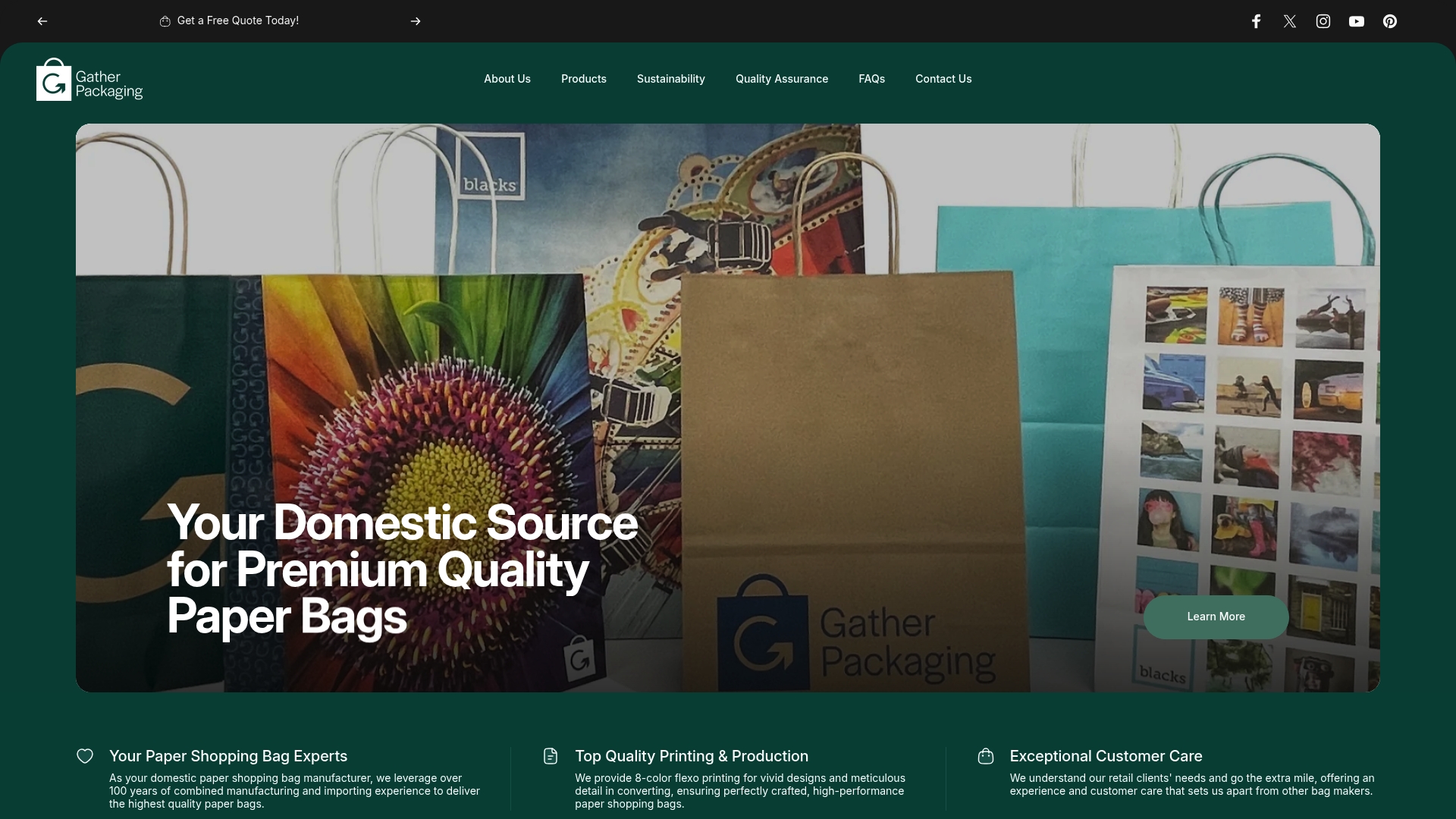
Retail packaging decisions made on price alone, without verifying full specifications, are the single most common source of bag failures, brand damage, and avoidable supply chain costs.
If your current bags are falling short on quality, consistency, or sustainability, Gatherpackaging manufactures premium paper shopping bags domestically in Toronto, with FSC®-certified materials, 8-color flexo printing, and full quality assurance on every run. Contact Gatherpackaging to discuss your paper shopping bag requirements and get a specification-based quote.
Key Takeaways
Avoiding the top retail packaging mistakes requires specifying paper grade, handle construction, and sustainability credentials before production, not after a failure.
| Point | Details |
|---|---|
| Specify beyond price | Always require paper grade, adhesive type, and handle reinforcement details in every supplier quote. |
| Test to EN13590 | Validated tensile, burst, and drop tests on production batches confirm consistent bag performance across orders. |
| Right-size per product line | Measure actual product dimensions and specify bag sizes accordingly; one universal size rarely serves multiple categories well. |
| Build sustainability in from the start | FSC® certification, water-based inks, and recycled content are easier to specify upfront than to add after a retailer audit. |
| Choose domestic manufacturing | Local production reduces exposure to freight delays, tariff volatility, and undisclosed material substitutions. |
Share:
Bag Printing Process Explained: A Production Guide
Third-Party Packaging Certification: What Retail Brands Need to Know