

TL;DR:
- End-of-life packaging management focuses on designing materials that minimize environmental harm after their use. Brands are increasingly responsible for ensuring their packaging is recyclable or compostable through better design and infrastructure awareness. Well-planned design and regional waste systems improve recovery rates and reduce contamination, supporting sustainability goals.
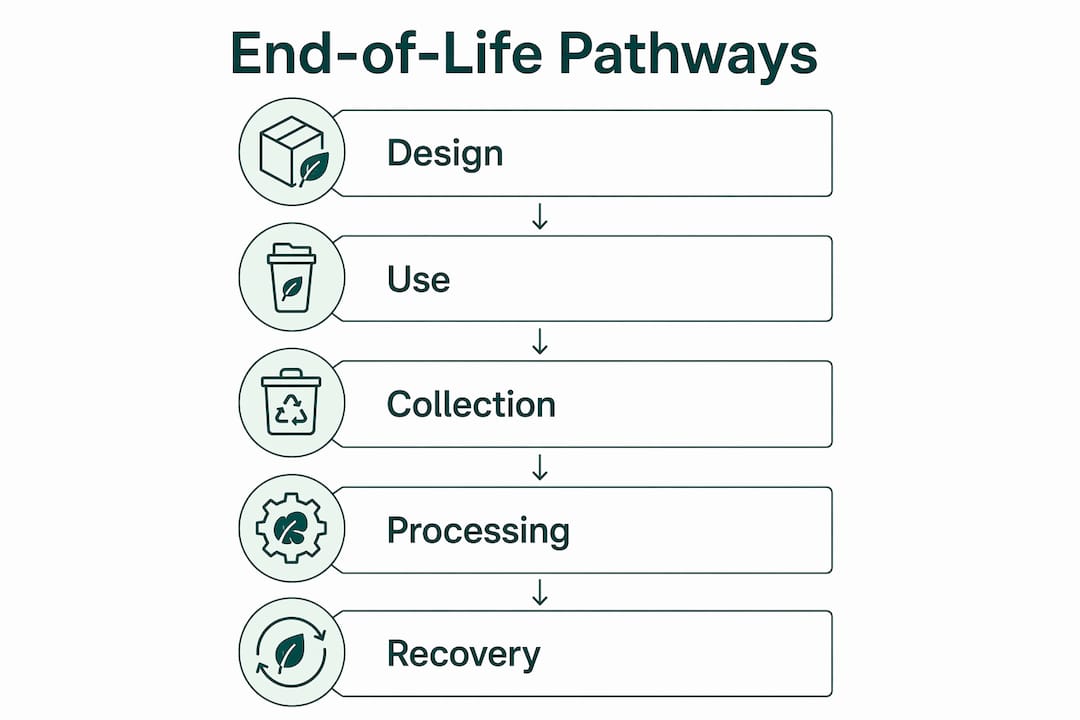
End-of-life packaging is defined as the management and design of packaging materials after their primary use to minimize environmental harm and support sustainable disposal, recovery, or reuse. The term covers every pathway a package takes once a customer is done with it, from curbside recycling to industrial composting to landfill. Brand managers and packaging specialists increasingly treat end-of-life outcomes as a design requirement, not an afterthought. Extended Producer Responsibility (EPR) legislation is accelerating that shift by making brands legally accountable for packaging waste, not just recyclability claims. Paper shopping bags, mono-material kraft formats, and FSC®-certified materials sit at the center of this conversation because they align well with existing waste management infrastructure.
What are the main end-of-life pathways for packaging materials?
Packaging waste falls into five material families: plastics, paper and cardboard, glass, metals, and composites. Each family carries distinct end-of-life options, and no single pathway works for every material or every region.
Recycling
Recycling is the most recognized pathway, but it splits into two very different processes. Mechanical recycling shreds and reprocesses materials without breaking down their chemical structure. Chemical recycling depolymerizes materials back to their base molecules, which allows recovery of materials that mechanical processes cannot handle. Paper and cardboard perform well in mechanical recycling systems. Multi-layer flexible pouches combining paper, foil, and plastics do not. Those multi-layer formats are mechanically incompatible with standard sorting lines and typically end up in landfill or incineration despite carrying recyclable-looking labels.
Composting and biological treatment
Compostable packaging breaks down through biological processes under controlled conditions. Industrial composting requires specific temperature and humidity ranges that home compost bins rarely achieve. Packaging labeled “compostable” without specifying industrial or home conditions creates confusion and contamination in both recycling and composting streams. Brands choosing compostable formats need to verify that industrial composting facilities exist in the markets where their products are sold.
Energy recovery and landfilling
Energy recovery reduces waste volume and generates electricity or heat, but it emits CO2 and requires pollution controls. It ranks below recycling and composting in most sustainability frameworks but above landfilling. Landfilling is the least preferred option. It sequesters materials for decades, generates methane from organic content, and offers no material or energy return. Both pathways represent a failure of upstream design and downstream infrastructure.
| Pathway | Key benefit | Key drawback | Best-suited materials |
|---|---|---|---|
| Mechanical recycling | Preserves material value | Requires clean, sorted mono-materials | Paper, cardboard, glass, metals |
| Chemical recycling | Handles complex materials | High cost, limited scale | Mixed plastics, composites |
| Industrial composting | Eliminates waste at source | Requires local facility access | Certified compostable formats |
| Energy recovery | Reduces landfill volume | CO2 emissions, pollution controls needed | Residual mixed waste |
| Landfilling | Low operational cost | Long-term environmental harm | Last resort only |
Pro Tip: Before selecting a packaging format, check whether your primary sales markets have the composting or recycling infrastructure to actually process it. A material that is technically recyclable but practically unrecyclable in your region adds cost without delivering environmental benefit.
How does packaging design influence end-of-life outcomes?
Packaging design determines end-of-life outcomes more than any other single factor. A material that is theoretically recyclable becomes unrecyclable the moment it is laminated to an incompatible substrate or printed with solvent-based inks that contaminate the pulp stream.

Mono-material packaging, particularly paper-based formats, aligns better with current recycling infrastructure and achieves higher recovery rates than multi-material alternatives. A plain kraft paper shopping bag enters the paper recycling stream without sorting complications. A paper bag with a plastic window, foil lining, or non-water-based ink coating does not. The design decision made at the start of a product’s life determines whether the package becomes a recovered resource or a contaminant.
Several design factors directly affect recyclability and compostability:
- Material composition: Single-material formats recycle more reliably than composites or laminates.
- Coatings and adhesives: Water-based coatings and adhesives are compatible with paper recycling. Solvent-based or wax coatings are not.
- Inks: Water-based inks, like those Gatherpackaging uses across its paper bag range, do not interfere with pulp recovery.
- Closures and handles: Twisted paper handles and glued closures are compatible with paper recycling. Plastic handles require removal before recycling.
- Labeling: Clear disposal instructions on the bag itself reduce consumer error and contamination rates.
Design for end-of-life requires early collaboration between product designers and waste management operators. A packaging format that works in Toronto’s blue-bin program may not work in a rural municipality with a single-stream system. Aligning design choices with regional disposal capabilities is the core discipline of what the industry calls “design for infrastructure.”
Pro Tip: Request a material compatibility check from your packaging supplier before finalizing a format. Gatherpackaging’s eco-friendly packaging workflow includes this step as part of the design process, which prevents costly redesigns after launch.
What are the challenges and barriers to effective end-of-life packaging management?
The gap between what packaging claims and what actually happens to it is wide. Only about 39% of packaging is recycled annually in the U.S., with nearly 40% of households lacking adequate recycling access. That statistic means a significant share of packaging labeled “recyclable” goes directly to landfill because the infrastructure to process it does not exist at the household level.
Consumer trust compounds the problem. Only 29% of consumers have high confidence that their recycled waste is actually processed. Low confidence leads to “wish-cycling,” where consumers place non-recyclable items in recycling bins hoping they will be sorted correctly. Wish-cycling contaminates entire batches of recyclable material and drives up processing costs for waste operators.
Economic barriers are real for brand owners too. 41% of European brand owners cite higher packaging costs as the main barrier to adopting sustainable, circular packaging solutions. North American brands face similar pressures, particularly when switching from low-cost multi-layer flexible formats to mono-material alternatives that cost more per unit.
EPR legislation is increasing brand responsibility for packaging waste management, making recyclability symbols alone insufficient for compliance. Brands that rely solely on the chasing-arrows symbol without verifying actual recovery rates face growing legal and reputational exposure as EPR programs expand across Canadian provinces and U.S. states.
The infrastructure gap between packaging innovation and waste management capacity is the most underappreciated barrier. Reusable packaging systems, for example, require reverse logistics and cleaning infrastructure that most brands cannot build independently. The result is that well-intentioned packaging choices fail at scale because the systems needed to support them do not exist yet.
How can brands and consumers implement effective end-of-life packaging strategies?
Effective end-of-life packaging management starts with data, not intentions. Recyclability Assessment Methodologies (RAM) give brands a structured way to evaluate packaging choices against the actual sorting and recycling capabilities of their target markets. RAM tools replace abstract material selection with region-specific compatibility data.
A practical implementation sequence looks like this:
- Audit your current packaging portfolio. Identify every material, coating, adhesive, and closure type in use. Flag any multi-layer or composite formats that are incompatible with mechanical recycling.
- Map your disposal infrastructure. Confirm what recycling, composting, and energy recovery facilities exist in your primary markets. A packaging waste management review for each key region prevents mismatched material choices.
- Select materials aligned with local systems. Paper-based mono-material formats, including FSC®-certified kraft paper bags, enter existing recycling streams without special handling. Gatherpackaging manufactures its bags with water-based inks and recycled content to maintain that compatibility.
- Add clear disposal labeling. Print specific instructions directly on the bag: “Recycle with paper,” “Compost in industrial facility,” or “Return to store.” Vague symbols do not change consumer behavior. Specific instructions do.
- Engage your waste management partners. Collaboration between designers and waste operators improves recovery rates. Ask your municipal or commercial waste provider what formats they can and cannot process before you finalize a design.
- Track EPR obligations by jurisdiction. Canadian provinces and U.S. states are rolling out EPR programs at different timelines. Build compliance tracking into your sustainable packaging workflow now rather than reacting to each new regulation.
Pro Tip: Traceability systems used in food manufacturing, like those described in food manufacturing traceability guides, apply directly to packaging material tracking. Knowing exactly what materials are in each SKU makes EPR reporting and recycling audits significantly faster.
Reducing contamination is the highest-leverage action available to both brands and consumers. Clean, sorted, mono-material paper bags recover at higher rates than any other common retail packaging format. That is not a marketing claim. It reflects how paper recycling mills actually operate.
Key Takeaways
End-of-life packaging outcomes are determined by design decisions made before a package is ever filled, not by disposal choices made after the fact.
| Point | Details |
|---|---|
| Definition matters | End-of-life packaging covers every disposal and recovery pathway after a package’s primary use. |
| Design drives outcomes | Mono-material, water-based ink formats recycle more reliably than multi-layer or laminated alternatives. |
| Infrastructure gaps are real | Only about 39% of U.S. packaging is recycled annually, with nearly 40% of households lacking adequate access. |
| EPR shifts accountability | EPR laws make brands legally responsible for packaging waste, not just recyclability labeling. |
| Paper bags lead in recovery | FSC®-certified kraft paper bags align with existing recycling infrastructure and reduce contamination risk. |
The part of end-of-life packaging most brands get wrong
Most brands treat end-of-life as a labeling problem. Slap a recycling symbol on the bag, write “made with recycled content” on the website, and call it done. I have seen this approach fail repeatedly, and the failure is always the same: the packaging is technically recyclable but practically unrecyclable in the markets where it is sold.
The uncomfortable truth is that recyclability is a local fact, not a universal property. A paper bag with a plastic window handle is recyclable in exactly zero standard paper recycling streams. A kraft bag with water-based inks is recyclable in nearly all of them. That difference is made at the design table, not at the recycling bin.
What I find genuinely encouraging is that paper-based packaging, particularly well-made kraft shopping bags, already solves most of this problem. The material is compatible with existing infrastructure. The recovery rates are real. The EPR compliance path is cleaner than for any plastic or composite format. Brands that switch to quality paper bags from a manufacturer like Gatherpackaging are not making a sacrifice. They are choosing a format that performs better at end-of-life than most alternatives on the market.
The brands that will lead on sustainability over the next decade are the ones building end-of-life thinking into their packaging briefs right now, not waiting for the next EPR regulation to force the issue.
— Taylor
Gatherpackaging’s paper bags are built for real-world end-of-life performance
Gatherpackaging manufactures paper shopping bags in Toronto, Canada, using FSC®-certified materials, recycled content, and water-based inks. Every bag in the range is designed to enter standard paper recycling streams without special handling or material separation.
For brand managers who need packaging that performs at end-of-life and not just on a sustainability checklist, Gatherpackaging offers eco-friendly paper bag options across retail, apparel, and foodservice formats. The team provides design assistance, prototyping, and quality assurance from a domestic facility with short lead times. Contact Gatherpackaging directly to discuss your paper shopping bag requirements and get a format that works for your brand and your customers’ recycling bins.
FAQ
What is end-of-life packaging?
End-of-life packaging refers to the strategies and processes that manage packaging materials after their primary use, including recycling, composting, energy recovery, and landfilling, to minimize environmental impact.
Why is end-of-life packaging important for brands?
EPR legislation is making brands legally accountable for packaging waste outcomes, and only about 39% of U.S. packaging is currently recycled, which creates significant compliance and reputational risk for brands that ignore end-of-life planning.
What packaging materials have the best end-of-life outcomes?
Mono-material paper and cardboard formats achieve the highest recovery rates because they are compatible with existing mechanical recycling infrastructure without requiring material separation.
How does packaging design affect recyclability?
Design choices including material composition, coatings, inks, and closures determine whether packaging enters a recycling stream cleanly or contaminates it. Water-based inks and single-material formats perform best.
What is Extended Producer Responsibility in packaging?
Extended Producer Responsibility (EPR) is legislation that shifts financial and legal accountability for packaging waste management from consumers and municipalities to the brands that produce the packaging.
Share:
The Role of Bag Customization in Branding for Retailers
Bag Printing Process Explained: A Production Guide