

TL;DR:
- A packaging audit is a systematic review of materials, processes, and documentation to find compliance and efficiency gaps. It helps brands prepare for EU regulations by 2026 and reduces operational risks beyond cost savings. Conducting regular audits ensures legal compliance, supplier accountability, and improved product quality.
A packaging audit is a systematic review of your packaging materials, processes, and documentation to identify compliance gaps, inefficiencies, and sustainability risks. For businesses using paper shopping bags and retail packaging, this process has moved from optional to mandatory. By August 12, 2026, companies placing packaged goods in EU markets must complete comprehensive packaging audits under the EU’s Packaging and Packaging Waste Regulation (PPWR). Even for North American brands not selling into the EU, the audit process surfaces real operational problems: overspecified materials, undocumented supplier declarations, and quality gaps that drive up cost and risk.
What does a packaging audit involve?

A packaging audit is a data-driven, phased evaluation that begins with desk research, moves through physical inspection, and ends with a scored report identifying where value is leaking. It is not a visual opinion check or a redesign project. The goal is diagnosis.
A thorough audit covers five core components:
-
SKU inventory and data collection. Build a complete list of every packaging format you use, including paper shopping bags, tissue, inserts, and secondary packaging. Record material weights, dimensions, supplier names, and certifications like FSC® or recycled content claims. Skipping this granular inventory leads to costly restarts when you hit complex regulatory requirements later.
-
Visual and structural inspection. Physically examine samples of each bag format. Check handle attachment strength, print registration, ink adhesion, and base integrity. For paper shopping bags, look for delamination, inconsistent flexo print coverage, and handle die-cut quality. These are the failure points that generate customer complaints and returns.
-
Compliance verification. Cross-reference your materials against recyclability standards and certification requirements. Confirm that FSC® chain-of-custody documentation is current, that water-based inks are documented, and that any recycled content claims are backed by supplier declarations.
-
Process and supplier review. Walk your packing lines or review your supplier’s production documentation. On-site observations consistently reveal discrepancies between what specifications say and what packers actually do. These gaps are where undocumented practices and material substitutions hide.
-
Scoring and prioritization. Apply a RAG (Red, Amber, Green) framework or equivalent scoring system to rank findings by urgency. Red items require immediate action. Amber items need a corrective plan. Green items are confirmed compliant.
Pro Tip: Build your SKU inventory in a spreadsheet with one row per packaging component, not one row per product. A single retail bag SKU may have three components: the bag itself, the handle, and the tissue insert. Each needs its own compliance check.
How does the packaging audit process align with 2026 regulatory requirements?
The EU’s PPWR is the most significant packaging regulation to take effect in 2026, and it makes formal packaging audits a legal requirement for any brand selling into European markets. Packaging audits in 2026 are no longer optional assessments. They are mandatory operational steps driven by regulatory deadlines and real financial penalties.
The PPWR introduces an A-to-E grading scale for recyclability. Packaging that scores D or E will be prohibited from EU shelves by 2030. An audit conducted now gives you time to identify your grade and correct course before the ban takes effect.
“The PPWR mandates strict design, recycling, and documentation standards with penalties for non-compliance including financial penalties and market bans. Businesses that treat the August 12, 2026 deadline as a future problem will face both regulatory and commercial consequences.”
The table below summarizes the key PPWR requirements that a packaging audit must address:
| Requirement | What it means for paper shopping bags |
|---|---|
| Design for recycling | Bags must use materials and inks compatible with paper recycling streams |
| Recyclability grading (A–E) | Bags scoring D or E face EU market bans by 2030 |
| Material documentation | FSC® certification, recycled content, and ink declarations must be on file |
| Supplier declarations | Written confirmation from suppliers on material composition is required |
| Audit completion deadline | Full compliance audit required by August 12, 2026 for EU market access |
For North American brands, the PPWR still matters if any retail partners export to Europe or if your brand operates internationally. Beyond the EU, Canadian and American retailers face growing pressure from buyers and sustainability-focused consumers who expect documented compliance. A packaging compliance checklist built around PPWR standards gives you a framework that satisfies most major market requirements simultaneously.
The financial risk of non-compliance goes beyond fines. A packaging recall or a market ban disrupts supply to retail partners, damages brand credibility, and creates reordering costs that dwarf the expense of a proactive audit.
What are the benefits of conducting packaging audits?
Packaging audits provide risk mitigation by identifying gaps that could lead to expensive recalls or fines. That is the primary benefit, and it is frequently underestimated. Most businesses approach audits as cost-cutting exercises. The real value is in what you avoid.
The concrete benefits for paper shopping bag businesses include:
- Recall prevention. Audits catch non-compliant pigments, undocumented material substitutions, and certification lapses before they reach retail shelves. A single recall costs far more than a full audit program.
- Material cost reduction. Audits regularly expose overspecification. A bag engineered for a heavier product than you currently carry uses more paper than necessary. Correcting the spec reduces material cost without compromising performance.
- Supplier accountability. Reviewing supplier declarations during an audit reveals which vendors are providing complete documentation and which are not. This protects you legally and operationally.
- Sustainability credibility. Documented audits support FSC® claims, recycled content percentages, and water-based ink certifications. Retailers and brand partners increasingly require this documentation before placing orders.
- Supply chain transparency. Audits map your full packaging supply chain, which is the foundation for material traceability requirements that regulators and buyers now expect.
Pro Tip: Treat supplier declaration gaps as red-flag findings, not administrative oversights. A missing declaration on recycled content is a compliance liability, not a paperwork delay.
The importance of packaging audits also shows up in quality assurance. Businesses that audit regularly catch print quality drift, handle failure rates, and dimensional inconsistencies before they generate customer complaints. For retail brands, bag failure at point of sale is a brand experience problem, not just a packaging problem.
How to conduct a packaging audit: practical steps for 2026
Internal teams can conduct basic annual packaging audits for low SKU counts. Complex product lines and regulated sectors should engage external agencies every 2–3 years for rigorous, unbiased evaluation. Most paper shopping bag businesses benefit from a hybrid approach: internal audits annually, with an external review when entering new markets or responding to regulatory changes.
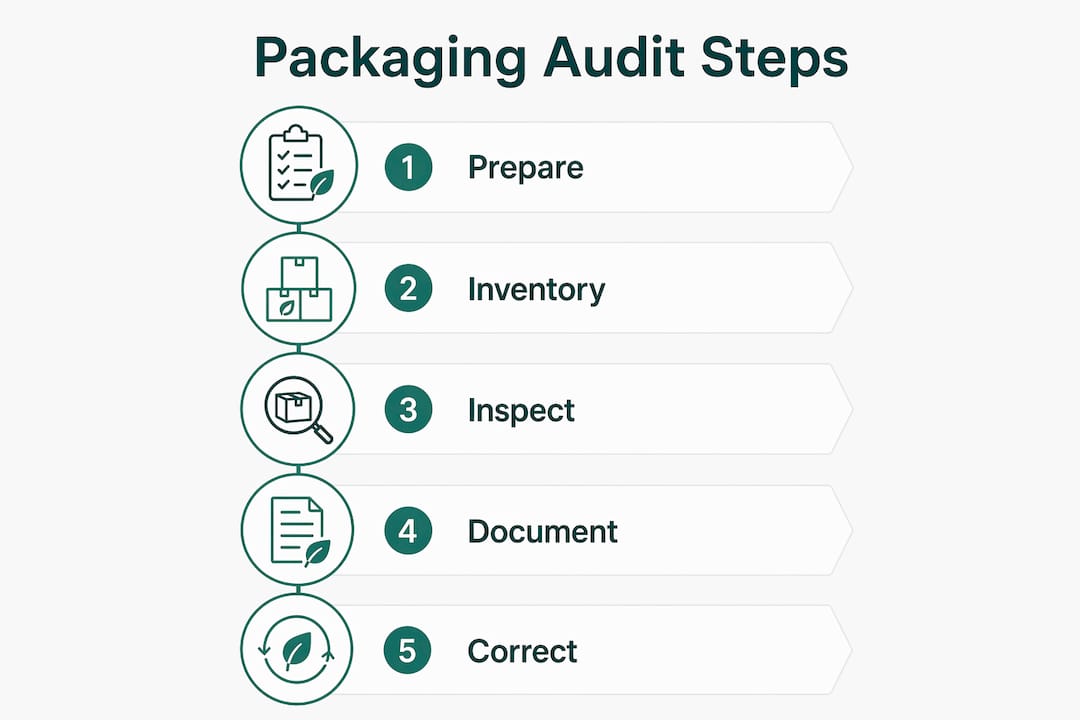
A practical audit follows this sequence:
-
Prepare your inventory. List every packaging SKU with full component breakdowns. Include the bag body, handles, tissue, stickers, and any secondary packaging. Record supplier names, material specs, and current certifications.
-
Gather documentation. Collect FSC® certificates, supplier declarations, test reports, and any existing quality assurance records. Identify gaps before the physical audit begins.
-
Conduct desk research. Review your specifications against current regulatory requirements. For PPWR compliance, check each material against the design-for-recycling criteria and assign a preliminary recyclability grade.
-
Execute physical evaluation. Inspect physical samples against your documented specs. Check print quality, structural integrity, handle strength, and material consistency. Walk your packing line or review your supplier’s production process documentation.
-
Score and report findings. Apply RAG scoring to every finding. Document corrective actions with owners and deadlines. A packaging quality assessment report should be specific enough that a procurement team can act on it without interpretation.
The table below compares internal and external audit approaches:
| Factor | Internal audit | External audit |
|---|---|---|
| Cost | Lower | Higher |
| Objectivity | Limited by familiarity | Unbiased by design |
| Frequency | Annual | Every 2–3 years |
| Best for | Low SKU counts, routine checks | Regulated markets, complex lines |
| Output | Internal report | Formal compliance documentation |
Post-audit follow-up is where most businesses lose ground. A completed audit report with no assigned corrective actions is a wasted exercise. Assign every red and amber finding to a named owner with a deadline. Schedule a 90-day review to confirm progress. Treat the audit as the start of a continuous improvement cycle, not a one-time event.
Key Takeaways
A packaging audit is the most direct way to identify compliance gaps, reduce material risk, and document sustainability claims before regulatory deadlines force the issue.
| Point | Details |
|---|---|
| Definition and purpose | A packaging audit is a systematic, phased review of materials, processes, and compliance documentation. |
| PPWR deadline | Companies selling into EU markets must complete packaging audits by August 12, 2026 or face financial penalties and market bans. |
| Recyclability grading | The PPWR A–E grading scale will ban D and E-rated packaging from EU shelves by 2030. |
| Risk over cost savings | The primary benefit of audits is risk mitigation, including recall prevention and supplier accountability, not just cost reduction. |
| Audit frequency | Internal audits annually for low SKU counts; external audits every 2–3 years for regulated markets or complex product lines. |
Why I think most brands are auditing for the wrong reason
Most packaging audits I see get commissioned for the wrong reason. A brand gets a compliance notice, a retailer asks for documentation, or a sustainability report is due. The audit becomes reactive, rushed, and focused on checking boxes rather than finding real problems.
Audits are diagnostic evaluations aimed at uncovering issues like non-compliant pigments or materials that complicate recycling. They are not redesign projects. The brands that get the most value treat the audit like a forensic exercise: follow the evidence, document what you find, and resist the urge to jump to solutions before the diagnosis is complete.
The other mistake I see constantly is skipping the foundational data work. Teams want to get to the physical inspection because it feels productive. But an audit built on an incomplete SKU inventory will miss things. You cannot assess compliance for a component you did not know existed.
For paper shopping bag businesses specifically, the audit also surfaces something most procurement teams overlook: the gap between what a supplier’s spec sheet says and what actually ships. Handle attachment methods change. Paper grades get substituted. Ink formulations shift. None of this shows up in a document review. It shows up when you walk the line or pull samples from three consecutive production runs and compare them side by side.
The 2026 regulatory environment makes this discipline non-negotiable. But the brands that build audit rigor into their operations now will have a real advantage. They will have the documentation, the supplier relationships, and the quality data that buyers and regulators increasingly require.
— Taylor
Gatherpackaging’s role in your packaging audit process
When an audit surfaces gaps in your paper shopping bag supply, the next question is where to source packaging that already meets the standards you need to document.
Gatherpackaging manufactures paper shopping bags in Toronto, Canada, using FSC®-certified materials, recycled content, water-based inks, and biodegradable options. Every bag comes with the supplier documentation your audit requires: material certifications, recycled content declarations, and quality assurance records. For retail brands and procurement teams working through a packaging compliance checklist, that documentation is not an afterthought. It is built into the supply relationship from the first order. Explore Gatherpackaging’s full range of eco-friendly paper bags or contact the team directly to discuss how your audit findings map to available bag specifications and lead times at gatherpackaging.com.
FAQ
What is a packaging audit in simple terms?
A packaging audit is a structured review of your packaging materials, processes, and compliance documentation to identify gaps, inefficiencies, and regulatory risks. It covers everything from material certifications to physical bag quality and supplier declarations.
When is the PPWR packaging audit deadline?
The EU’s PPWR requires companies placing packaged goods in EU markets to complete comprehensive packaging audits by August 12, 2026. Non-compliance carries financial penalties and potential market bans.
How often should a business conduct a packaging audit?
Internal teams should conduct basic audits annually for low SKU counts. Businesses with complex product lines or regulated market exposure should commission external audits every 2–3 years.
What does a packaging compliance checklist include?
A packaging compliance checklist covers SKU inventory, material certifications (such as FSC®), supplier declarations, recyclability grades, print and structural quality checks, and documentation of corrective actions from previous audits.
Do packaging audits apply to paper shopping bags specifically?
Yes. Paper shopping bags require compliance checks on material composition, handle integrity, ink formulation, recycled content claims, and recyclability grading under frameworks like the PPWR. These checks apply whether you manufacture bags or source them from a supplier.
Share:
What Is High-Volume Bag Production: A 2026 Guide
Why Branding Agencies Need Packaging Guides