

TL;DR:
- The leading North American alternative to planetizepackaging.ca for FSC-certified paper bags are Gatherpackaging, EcoEnclose, Noissue, and Paper Mart. Gatherpackaging offers domestic manufacturing with high-quality custom printing, quick lead times, and verified FSC certification, making it a top choice for retail brands. Choosing the right supplier depends on customization needs, speed, sustainability credentials, and documented quality assurance processes.
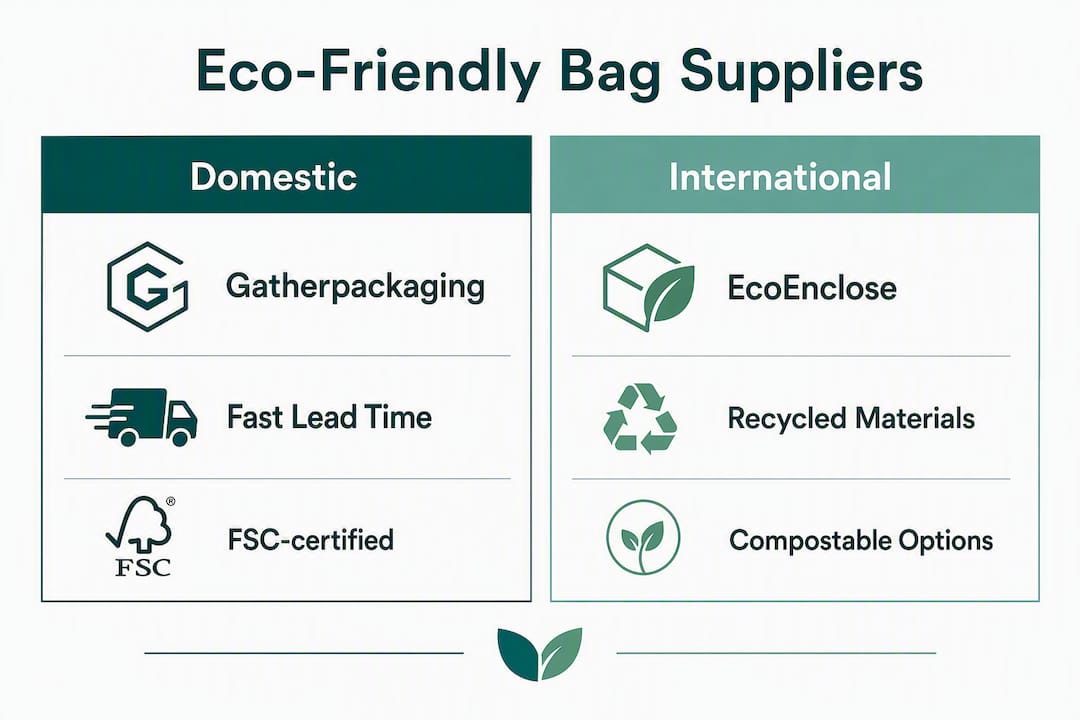
For North American brands that need dependable, FSC-certified paper shopping bags, the strongest alternatives to planetizepackaging.ca are Gatherpackaging (domestic Toronto manufacturer with 8-color flexo printing, prototyping, and QA), EcoEnclose (specialty eco supplier focused on recycled and compostable mailers and bags), Noissue (low-MOQ custom tissue and packaging for small brands), and Paper Mart (broad wholesale paper bag catalog with stock options).
TL;DR: For fast domestic turnaround and custom print quality, Gatherpackaging is the clearest choice. For the lowest possible MOQ on custom-printed pieces, Noissue fits small-run needs. For the widest range of sustainable material formats beyond paper bags, EcoEnclose covers more ground.
| Supplier | Best for | Printing | MOQ shape | Lead time / location | Sustainability |
|---|---|---|---|---|---|
| Gatherpackaging | Custom retail paper bags, domestic speed | 8-color flexo, full custom | Custom runs, flexible | Fast / Toronto, Canada | FSC, recycled, water-based inks |
| EcoEnclose | Recycled/compostable mailers and bags | Digital and custom print | Low–mid | Standard / U.S.-based | Recycled content, compostable options |
| Noissue | Small-run branded tissue and bags | Digital, limited structures | Very low (as low as 25 units) | Longer / overseas production | FSC tissue, recycled options |
| Paper Mart | Stock wholesale paper bags, fast reorder | Limited custom print | Low (stock), higher for custom | Fast / U.S. warehouse | Recycled content on select SKUs |
Table of Contents
- What are the best planetizepackaging.ca alternatives for retail paper bags?
- How do you choose the right paper-bag or retail-packaging supplier?
- What materials and sustainability claims actually matter for paper shopping bags?
- Why domestic manufacturing often lowers total cost of ownership for North American buyers
- What certifications beyond sustainability should you require from a packaging supplier?
- What should you know about return policies, guarantees, and dispute resolution?
- Key Takeaways
- A frank view on what most buyers get wrong when switching suppliers
- Gatherpackaging: a direct domestic alternative for retail paper bags
- Useful sources and further reading
What are the best planetizepackaging.ca alternatives for retail paper bags?
Choosing among these suppliers comes down to three variables: how much customization you need, how fast you need it, and what sustainability credentials your retail buyers or brand standards require. Here is how each option actually performs on those dimensions.
Gatherpackaging
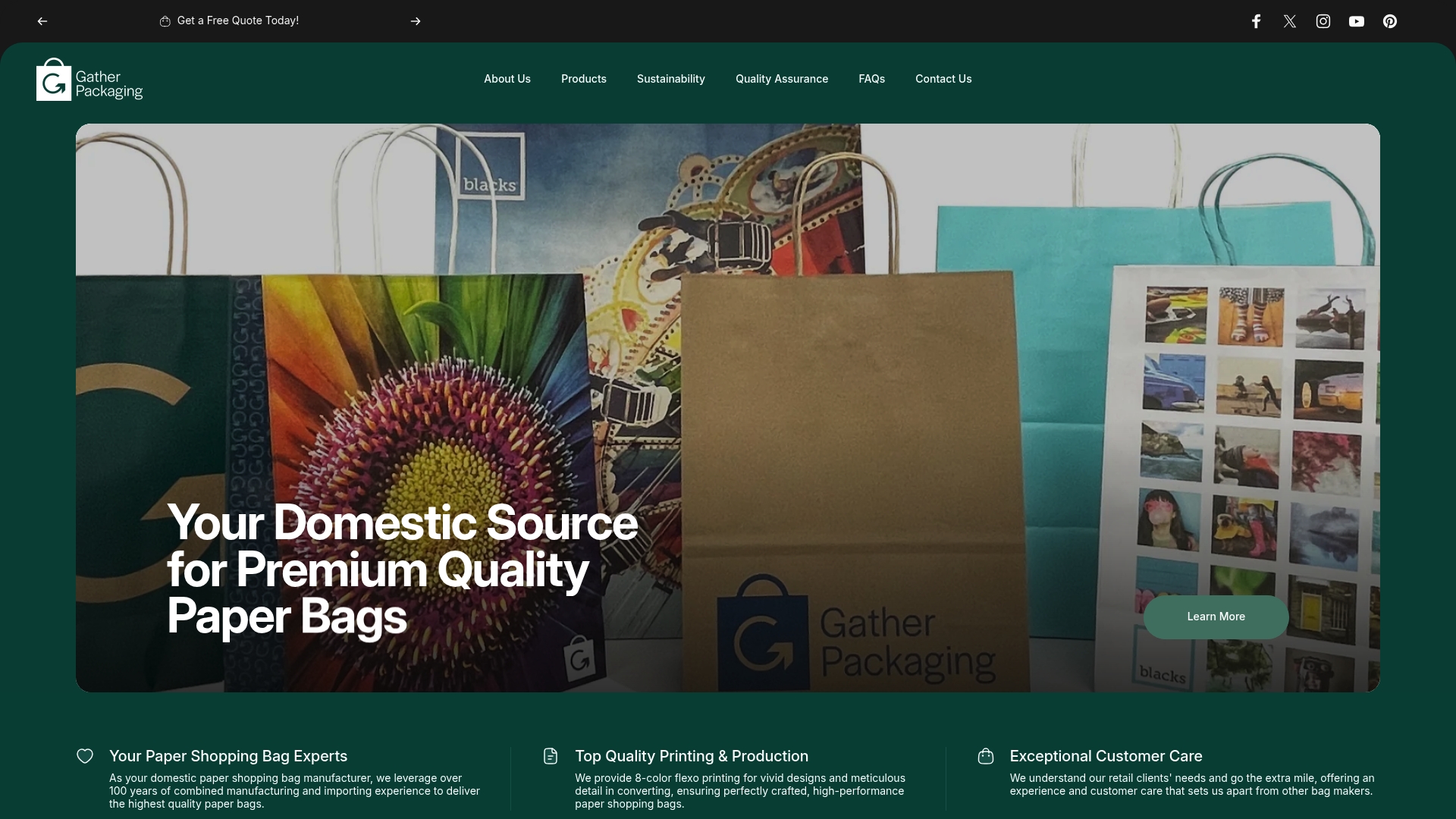
Gatherpackaging is the recommended domestic manufacturer for brands that need custom-printed paper shopping bags with documented QA and FSC chain-of-custody. The Toronto facility runs 8-color flexo printing across turn top, serrated top, and tamper-resistant bag styles. Because production is domestic, lead times are tighter than overseas alternatives, and buyers get direct access to prototyping and pre-production samples before committing to a full run. Gatherpackaging’s reliable packaging supply chain is backed by a century of combined manufacturing and importing experience through its parent company, Progress Luv2Pak.
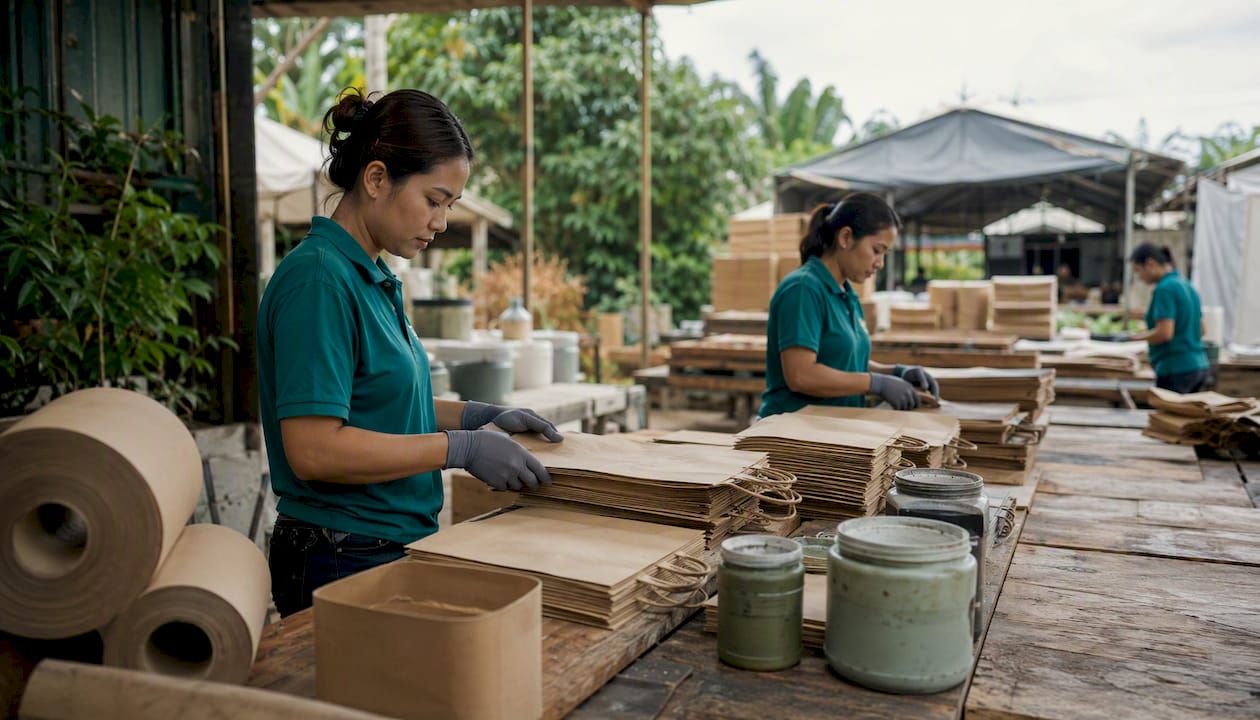
Sustainability credentials: FSC-certified fiber, recycled content options, water-based inks, biodegradable options.
Sample policy: Pre-production samples and prototyping available before full production run.
EcoEnclose
EcoEnclose is a U.S.-based supplier focused on recycled and compostable packaging formats, including poly mailers, paper mailers, and some paper bag options. Print is digital or custom, and MOQs are accessible for small and mid-size brands. The product range goes well beyond paper shopping bags, so it suits brands that want one vendor for multiple sustainable packaging formats. FSC certification is not consistently listed across all SKUs, so verify per product.

Noissue
Noissue targets small brands and independent retailers that need branded packaging in very small quantities. MOQs can be as low as 25 units on some products. The tradeoff is production location: most orders are manufactured overseas, which means longer lead times and less production visibility than a domestic manufacturer. For a brand just starting out and testing packaging designs, Noissue makes sense. For a retailer running seasonal replenishments on a tight schedule, the lead time risk is real.
Paper Mart
Paper Mart is a U.S.-based wholesale distributor with a wide catalog of stock paper bags available for fast reorder. Custom printing is available but typically requires higher minimums and longer lead times than stock orders. Sustainability credentials vary by SKU. Paper Mart is best for buyers who need a reliable stock bag in standard sizes but without specific custom print options.
Quick tradeoffs for SMB buyers:
- Speed vs. customization: Gatherpackaging and Paper Mart offer the fastest North American turnaround, but Paper Mart’s fast option is stock only.
- Low MOQ vs. print quality: Noissue wins on minimum quantity; Gatherpackaging wins on print fidelity and structural options.
- Broadest eco format range: EcoEnclose covers the most material types beyond paper bags.
- Domestic QA and certification depth: Gatherpackaging is the only option on this list with documented facility-level FSC chain-of-custody, prototyping, and transit-grade QA built into the production process.
How do you choose the right paper-bag or retail-packaging supplier?
Start here: prioritize production visibility, documented QA, and FSC chain-of-custody certification before comparing per-unit price. A supplier that cannot show you facility-specific certificates and recent test reports is a sourcing risk regardless of how competitive their quote looks.
Questions to ask every supplier before placing an order
- Which facility will manufacture my specific order, and does that facility hold its own FSC chain-of-custody and ISO 9001 certificates?
- Can you provide transit-grade test reports (compression, drop, vibration) from a recent production run in the same bag structure I am ordering?
- What is the MOQ for a custom-printed run specifically — not for stock or unprinted product?
- What is your sample-to-production consistency process, and how do you document color and structural tolerances?
- What are your lead-time guarantees, and what happens if production is delayed?
- Do you provide print proofs and tooling sign-off before production starts?
On MOQs: suppliers sometimes advertise low custom MOQs that apply only to stock or unprinted product. Always confirm in writing that the quoted MOQ covers your specific custom-printed run. Trading companies in particular may advertise low minimums that do not reflect actual production constraints at the factory level.
Pro Tip: Request facility-specific ISO 9001 and FSC chain-of-custody certificates and check the issue dates. A corporate-level certificate does not guarantee the plant making your order is certified — verify at the facility level every time.
Procurement checklist for paper shopping bag RFPs
- Confirm facility-specific FSC chain-of-custody certificate (not corporate-level).
- Request ISO 9001 or equivalent QC certificate for the manufacturing plant.
- Obtain transit test reports for compression, drop, and vibration from a recent run.
- Confirm MOQ applies to your custom-printed specification, not stock product.
- Get a pre-production sample and sign off on color, structure, and handle attachment.
- Define acceptance criteria in writing: dimensional tolerances, print registration, handle pull strength.
- Include rework/replace terms and staggered delivery options in the contract.
- Confirm on-time delivery record with references or documented metrics.
What materials and sustainability claims actually matter for paper shopping bags?
For retail paper shopping bags, the procurement-relevant attributes are FSC-certified fiber, recycled content percentage, coating and lamination choices, and ink system. These four factors determine whether a bag is genuinely recyclable and whether it meets retailer sourcing requirements.
Sustainable packaging alternatives span a wide range of materials, but for retail paper bags specifically, the field narrows quickly once you apply recyclability and retail-acceptance filters.
Material options and what they mean in practice:
- Virgin FSC-certified kraft: Strong, consistent print surface, fully recyclable in standard paper streams. The baseline for most retail paper shopping bags.
- Recycled-content kraft: Lower virgin fiber use; recyclability depends on contamination levels and local collection systems. Verify recycled content percentage on the spec sheet.
- Clay-coated papers: Better print fidelity and a premium feel, but clay coatings can complicate recyclability depending on the coating weight. Confirm with your waste-stream partner before specifying.
- Compostable-coated papers: Appropriate for specific food-contact or composting-program contexts. These require industrial composting infrastructure and are not suitable for standard curbside recycling. Use only where the end-of-life stream is confirmed.
- Water-based inks vs. solvent inks: Water-based inks preserve recyclability and are the standard for FSC-compliant production. Solvent inks can interfere with paper recycling and are increasingly restricted by retailer sourcing policies.
FSC certification is a procurement gate, not a marketing claim. Many North American and European retailers require a current FSC chain-of-custody certificate as a sourcing pre-condition. If a supplier cannot produce one, the bag cannot be sold as FSC-certified regardless of what the packaging says.
Pro Tip: On your specification sheet, require grammage (g/m²), yield, finish type, and ink system. These four fields tell you whether the bag will perform on press, hold up in distribution, and clear retailer sustainability requirements. Vague “eco” language on a quote sheet means nothing without them.
For a full breakdown of what to look for in eco-friendly paper bag materials, Gatherpackaging’s sustainability page covers FSC, recycled content, and water-based ink standards in detail.
Why domestic manufacturing often lowers total cost of ownership for North American buyers
Per-unit price is the wrong number to optimize. When you add freight, import duties, inventory holding costs, and the cost of a stockout or expedited air shipment, domestic partners frequently offer better long-term value than a lower overseas unit price suggests.
Consider a mid-size retailer ordering custom-printed paper shopping bags for a seasonal campaign. An overseas order placed 16 weeks out arrives late due to port congestion. The retailer air-freights a partial order at a cost that wipes out the per-unit savings from the original quote, and the season launches with inconsistent bag quality because there was no pre-production sample review. A domestic manufacturer with a 4–6 week lead time and a documented QA process eliminates that scenario entirely.
Domestic paper production also enables faster feedback loops on custom basis weights, finishes, and structural specs, which matters when a retail buyer requests a specification change mid-season.
Capability signals procurement teams should require:
- Documented on-time delivery rate with references
- Transit-grade test reports from recent production runs
- FSC chain-of-custody at the facility level
- ISO 9001 or equivalent QC certification
- Pre-production sample and sign-off process
- Clear lead-time guarantees in writing
Pro Tip: Build a simple supplier scorecard with five columns: unit cost, freight + duties, inventory days, stockout risk (probability × cost), and QA failure rate. Score each supplier on all five. The domestic option frequently wins on total score even when it loses on unit cost alone.
For more on the domestic manufacturing advantage for retail brands, Gatherpackaging’s blog covers the TCO case in detail.
What certifications beyond sustainability should you require from a packaging supplier?
FSC and recycled content get most of the attention, but a complete supplier evaluation covers several additional compliance dimensions.
ISO 9001 is the baseline quality management certification. It confirms the supplier has a documented system for controlling production consistency, handling nonconformances, and managing corrective actions. Without it, QA depends entirely on the supplier’s word.
Fair labor and social compliance certifications — such as WRAP (Worldwide Responsible Accredited Production) or BSCI (Business Social Compliance Initiative) audits — matter increasingly to retail buyers and brand procurement policies. Request the most recent audit report, not just a certificate.
Food contact compliance applies if you are sourcing takeout delivery bags for foodservice. Materials and inks must meet FDA (U.S.) or Health Canada standards for food contact. Confirm this in writing with the supplier and request the relevant compliance documentation.
FBA and e-commerce channel requirements add another layer. If your bags will ship through Amazon FBA or similar fulfillment networks, packaging must meet specific dimensional and marking requirements that affect material choice and structure. Confirm compliance early in the specification process, not after tooling is set.
Verify that every certificate is issued to the specific facility making your order, not to a parent company or a different plant. Facility-level certificates can differ significantly from corporate-level claims.
What should you know about return policies, guarantees, and dispute resolution?
Most custom packaging manufacturers do not accept returns on printed orders because the product is made to your specification. What protects you instead is a well-written acceptance criteria clause before production starts.
What to negotiate before you sign:
- Acceptance criteria in writing: Define dimensional tolerances, print registration standards, color delta (ΔE), and handle pull-strength minimums. If the delivered product falls outside these, you have a documented basis for a rework or replacement claim.
- Rework and replacement terms: Specify whether the supplier will rework, reprint, or replace non-conforming units at their cost, and within what timeframe.
- Pilot order clause: For a first order with a new supplier, negotiate a smaller pilot run with full acceptance review before committing to the full volume. This is standard practice with domestic manufacturers and protects both sides.
- Dispute resolution process: Confirm whether disputes go to mediation, arbitration, or litigation, and in which jurisdiction. For Canadian buyers working with a Toronto-based manufacturer, domestic jurisdiction simplifies resolution considerably compared to an overseas supplier.
- Staggered delivery: For large orders, staggered delivery lets you inspect the first shipment before the remainder ships, reducing exposure on a full-run quality issue.
A supplier that resists putting acceptance criteria in writing is a supplier to avoid. Documented QA and clear dispute terms are standard practice for any manufacturer running a professional operation.
Key Takeaways
For North American brands sourcing eco-friendly paper shopping bags, domestic production with facility-level FSC certification and documented QA consistently outperforms overseas alternatives on total cost of ownership, lead-time reliability, and dispute resolution simplicity.
| Point | Details |
|---|---|
| Prioritize facility-level certificates | Request FSC chain-of-custody and ISO 9001 issued to the specific plant, not the parent company. |
| Clarify MOQs before quoting | Confirm the quoted MOQ applies to your custom-printed run, not stock or unprinted product. |
| Build a TCO scorecard | Include freight, duties, inventory holding, and stockout risk — not just unit price — when comparing suppliers. |
| Define acceptance criteria upfront | Set dimensional, print, and structural tolerances in writing before production starts to protect against disputes. |
| Gatherpackaging for domestic supply | Gatherpackaging offers FSC-certified, custom-printed paper shopping bags from Toronto with prototyping, QA, and flexible MOQs. |
A frank view on what most buyers get wrong when switching suppliers
The most common mistake buyers make when searching for planetizepackaging.ca alternatives is optimizing for the wrong variable. They compare per-unit price and MOQ, pick the lowest number, and then discover six months later that the real costs were in freight delays, inconsistent print quality, and the time spent managing supplier disputes from 12 time zones away.
The second mistake is treating sustainability certifications as a checkbox. “Eco-friendly” on a product page means nothing without a current FSC chain-of-custody certificate issued to the facility making your order. Plenty of suppliers use recycled-content language in their marketing while sourcing from uncertified mills. The certificate is the only thing that holds up when a retail buyer audits your supply chain.
What actually works is simpler than most procurement guides suggest: find a supplier with production visibility, get a pre-production sample, define your acceptance criteria in writing, and run a pilot order before committing to volume. A domestic manufacturer makes all of that easier because you are working in the same time zone, under the same legal jurisdiction, and with a supplier who cannot hide behind a 16-week lead time when something goes wrong.
The brands that build durable packaging supply chains are not the ones that found the cheapest unit price. They are the ones that treated the first order as a qualification test and built the relationship from there.
Gatherpackaging: a direct domestic alternative for retail paper bags
If you need custom-printed, FSC-certified paper shopping bags manufactured in North America with real prototyping and QA built in, Gatherpackaging is the direct answer. The Toronto facility produces turn top, serrated top, and tamper-resistant bags with 8-color flexo printing, recycled content options, and water-based inks. Lead times are domestic, production is visible, and the QA process includes pre-production samples and documented acceptance criteria.
For foodservice operators, Gatherpackaging also produces custom takeout delivery bags that meet food-contact compliance requirements. Whether you are replacing a current supplier or sourcing custom bags for the first time, the process starts with a conversation about your specifications, volume, and timeline.
Contact Gatherpackaging to request samples, discuss your requirements, and get a quote. You can also review the made-in-Canada production details or explore kraft paper bag options before reaching out.
Useful sources and further reading
- FSC-Certified Packaging Guide for Buyers — Gatherpackaging’s guide to FSC chain-of-custody requirements and what to request during supplier evaluation.
- Packaging Quality Assurance Checklist — Ready-made QA checklist for sample and production acceptance; useful for RFPs and supplier questionnaires.
- Third-Party Packaging Certification: What Retail Brands Need to Know — Guidance on certification verification and audit schedules for retail procurement teams.
- Complete Guide to FBA Packaging Requirements — ForwarderOne’s reference for e-commerce and Amazon FBA packaging constraints; relevant for buyers selling through online fulfillment channels.
- How to Evaluate a Packaging Manufacturer — Procurement guidance on facility-level certificate verification and QC audit processes.
Share:
Prompt.ca Alternatives for AI Teams and Prompt Creators
Best aapapercorp.com Alternatives for North American Buyers