
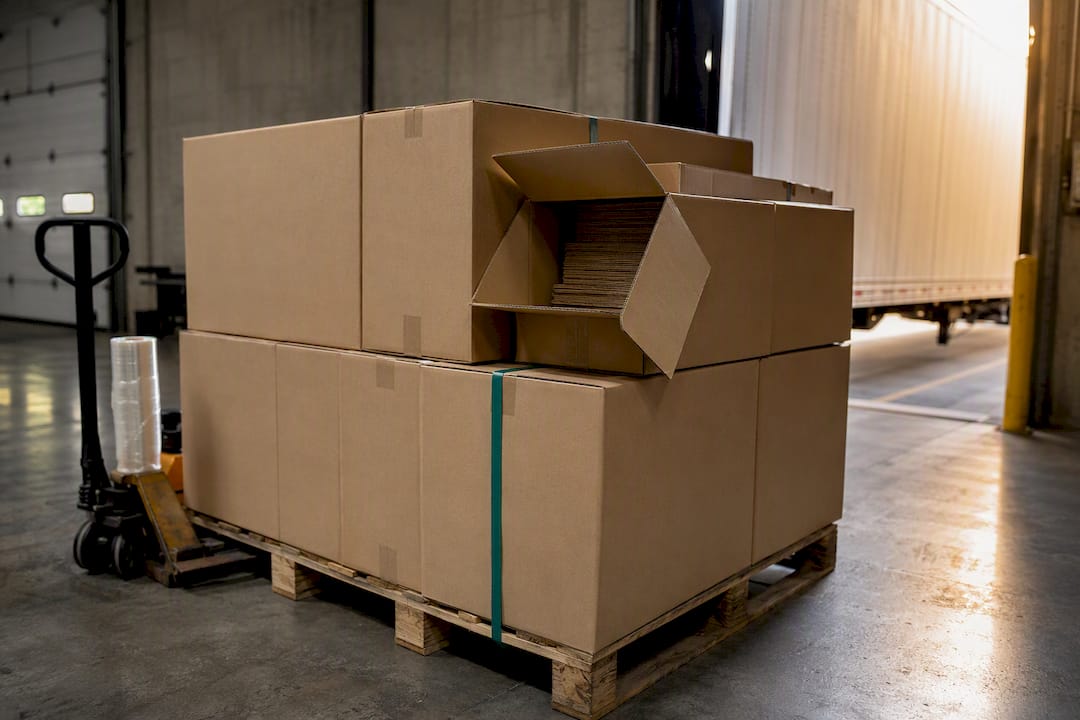
The right shipping method depends on order size and urgency: flat-packed sea freight (FCL) for bulk restocks, LCL for mid-size orders, air freight for urgent reorders, and express courier for samples or small parcels. Volumetric weight, not actual mass, usually drives the cost since paper bags take up more cube than they weigh. Confirm carton CBM and chargeable weight with your carrier before locking in a lane.
TL;DR:
- Shipping charges are heavily influenced by volumetric weight, especially for bulky paper bags, making flat-packing and tight cartonization crucial for cost savings.
- Full container load (FCL) ocean freight is most economical for bulk orders filling most of a 20 or 40-foot container, while LCL becomes cost-effective for smaller volumes below that threshold.
- Air freight is suitable for urgent reorders under about 200 kilograms, with charges based on volumetric weight, which often exceeds actual weight for low-density paper bags.
- Proper palletization, including specified carton dimensions and protective packing, prevents transit damage and maintains print quality by controlling orientation, stacking, and moisture exposure.
- Early planning with clear pack-out specifications, accurate HS codes, and selecting appropriate incoterms helps avoid delays, unexpected costs, and logistical issues.
Table of Contents
- What Are the Best Paper Bag Shipping Methods by Order Size?
- How Do You Cut Cubic Volume and Protect Print Quality?
- What Drives Shipping Cost and How Long Does Delivery Take?
- What Customs Documents Do Paper Bag Shipments Need?
- How Does Gather Packaging Prepare Orders for Reliable Shipping?
- How Should You Insure Paper Bag Shipments Against Loss or Damage?
- What Handling Rules Apply Specifically to Paper Materials?
- What Labeling Do Paper Bag Shipments Need for Smooth Customs Clearance?
- What Sustainable Shipping Options Exist for Eco-Friendly Paper Bags?
- What Do Typical Shipping Costs Look Like by Method?
- Author perspective: three rules of thumb for ordering and shipping paper bags
- How Gather Packaging Helps: Request a Shipping-Ready Sample or Quote
- Sources
- FAQ
What Are the Best Paper Bag Shipping Methods by Order Size?
Ocean freight, air freight, and express courier cover nearly every scenario a packaging buyer runs into, and each one fits a different combination of order size, deadline pressure, and budget tolerance. Matching the wrong lane to the wrong order is one of the fastest ways to blow a packaging budget without anyone noticing until the invoice lands.
Sea freight (FCL vs. LCL) is the default for bulk restocks. A Full Container Load makes sense once your order fills most of a 20 or 40 foot container’s cubic capacity. Below that threshold, Less than Container Load lets you share container space with other shippers and pay only for the cube you use. The break-even point for paper bags typically arrives sooner than buyers expect, because flat-packed bags are light but bulky. Once you are regularly filling enough of a standard container’s volume to justify a dedicated box, FCL pricing per unit almost always beats LCL. Ocean freight remains the cheapest lane per bag for bulk orders, air freight moves faster at a real premium, and express courier works best for samples or urgent orders under about 200 kilograms, according to Allen Paper Products’ shipping guidance.
Air freight earns its cost when a retailer needs mid-size reorders fast, say a seasonal SKU running low three weeks before a launch. Air pricing is especially sensitive to volumetric weight because carriers charge on whichever is higher: actual weight or dimensional weight. Bulky, low-density paper bags almost always get billed on cube, not scale weight.
Express courier suits samples, pre-production prototypes, and small emergency reorders. You get door-to-door simplicity and tracking, but per-unit cost is the highest of the three lanes.
- Sea (FCL): cheapest per unit, best for full containers, slowest transit
- Sea (LCL): flexible for mid volumes, shared container risk, moderate transit
- Air: fast, priced heavily on volumetric weight, good for urgent mid-size runs
- Express: highest cost per unit, fastest and simplest for small parcels
How Do You Cut Cubic Volume and Protect Print Quality?
Flat-packing is the single biggest lever you control before a carton ever reaches a dock. Bags packed flat and stacked in a uniform orientation take up dramatically less cube than bags packed loose or bundled unevenly, and since ocean and air freight both bill on cubic volume for lightweight goods, orientation directly affects your freight invoice.
Buyers should hand their manufacturer a specific pack-out requirement rather than leaving carton design to chance. That means treating the shipping carton as part of the product spec, not an afterthought bolted on after production, an approach export packaging guidance treats as standard for anyone shipping paper goods internationally.
A workable pack-out spec covers:
- Outer master carton dimensions (length, width, height) sized to standard pallet footprints
- Quantity per carton and bundle count within each carton
- Bag orientation inside the carton (flat, nested, or interleaved)
- Pallet configuration: cartons per layer, layers per pallet, and total cartons per pallet
- Unitization method: stretch wrap, corner boards, and banding to keep the load stable in transit
Palletizing done right keeps distribution centers happy and keeps your printed surfaces intact. Interleaving tissue or kraft sheets between stacked bags prevents ink transfer and scuffing, corner guards stop crushed edges on tall stacks, and moisture-resistant wrap matters more than most buyers assume, since humidity swings inside a shipping container can wrinkle or delaminate paper stock before it ever reaches the shelf, as explained in detail by gift box printing methods. For a closer look at how pallet loading affects container utilization, see this breakdown of palletizing paper bags for DC delivery.
Pro Tip: Ask your manufacturer for a pack-out drawing before production starts, not after. Redesigning cartons mid-run to fix a cube problem costs more than getting the spec right the first time.
What Drives Shipping Cost and How Long Does Delivery Take?
Volumetric weight is the number that decides most paper bag freight bills. Carriers calculate a package’s dimensional weight by dividing its cubic size by a standard divisor, then charge based on whichever figure is higher, actual weight or dimensional weight. Measurement Canada’s dimensional weight guidance lays out the official calculation carriers and importers use, and it’s worth reviewing before you commit to a lane, since a carton of flat paper bags almost always weighs in lighter than its cube suggests.
That gap between actual weight and volumetric weight is exactly why flat-packing and tight cartonization save real money. A carton that could theoretically hold more bags per cubic foot lowers your chargeable weight even though the physical weight barely changes.
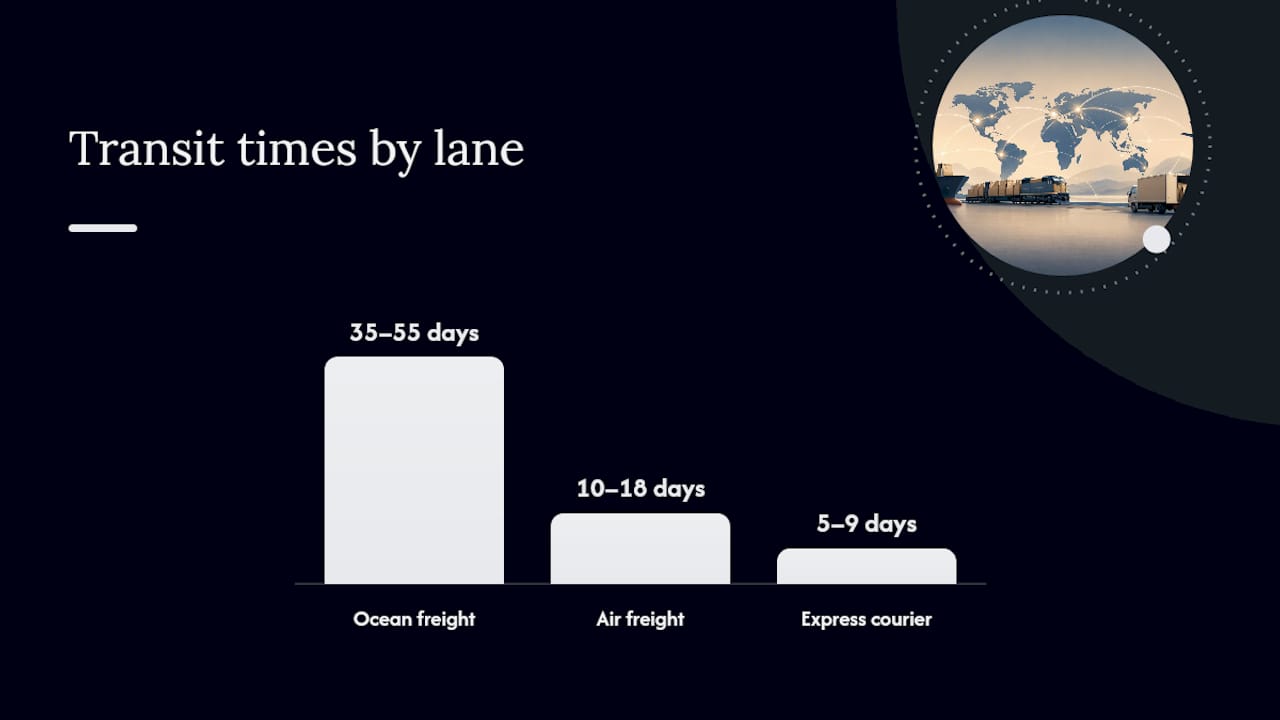
Door-to-door timelines vary widely by lane:
- Ocean freight: roughly 35 to 55 days total, including production time, port handling, and inland transit
- Air freight: roughly 10 to 18 days door-to-door
- Express courier: roughly 5 to 9 days for smaller shipments
Total procurement timeline matters more than transit time alone. Sample approval, production, and transit combined typically run 20 to 35 business days for custom paper packaging projects, and skipping that planning window is a common cause of launch delays.
Order-size guidance follows the same logic as lane selection: FCL becomes cheaper per cubic meter once your order fills enough of a container to justify the fixed cost of a dedicated box, and because paper bags are volume-heavy relative to their weight, that threshold arrives at a lower unit count than buyers moving denser goods would expect.
Incoterms shape how much visibility you get into that cost. FOB (Free on Board) hands you control of the freight leg and lets you shop carriers directly. CIF (Cost, Insurance, Freight) bundles the freight into the supplier’s quote, trading visibility for simplicity. DDP (Delivered Duty Paid) removes almost all the logistics burden from your side but usually costs more and gives you the least insight into what you’re actually paying for transit and duties.
What Customs Documents Do Paper Bag Shipments Need?
Getting the Harmonized System (HS) code right on your commercial invoice is the single most common point of failure in customs clearance. An incorrect HS code can trigger reclassification delays, incorrect duty assessments, or holds at the border, and paper bags sit in a specific tariff category that your customs broker should confirm before goods ever ship.
A complete documentation package for a paper bag shipment includes:
- Commercial invoice with accurate product description, HS code, and declared value
- Packing list matching carton counts and weights to the invoice
- Bill of lading (ocean) or airway bill (air freight)
- Certificate of origin, particularly relevant for preferential duty treatment
- Proof of eco-certification, such as FSC® chain-of-custody documentation, if you’re marketing the bags on sustainability claims
Duty gets calculated on the CIF value of the shipment, cost plus insurance plus freight, not just the factory price, which is exactly why the incoterm you negotiate changes who’s responsible for that number and when it gets paid. Confirming your HS code and expected duty rate with a customs broker before shipment, alongside requesting both FOB and CIF quotes from your supplier, keeps you from getting hit with fees you didn’t budget for, per Allen Paper Products’ import guidance.
How Does Gather Packaging Prepare Orders for Reliable Shipping?
Shipping problems usually start upstream of the dock, in production decisions nobody flagged before the cartons got sealed. Gather Packaging builds pack-out planning into the manufacturing process itself, working from its Toronto facility so buyers aren’t relying on a supplier five time zones away to catch a spec error.
The process starts with prototyping and pre-press proofing, so print registration and carton dimensions get confirmed before a full production run commits to a design. That matters because catching a color-match issue or a die-line error on a prototype costs a few days; catching it after 20,000 units have shipped costs a reorder.
QA checkpoints worth requiring from any supplier, paper bag or otherwise, include:
- Print registration checked against approved proofs, not just a first-run sample
- Handle strength tested against declared weight capacity, especially for retail bags carrying apparel or heavier goods
- Glued seam integrity checked for consistent adhesion along the full seam length
- Moisture protection verified for cartons headed through humid transit lanes
Domestic production also shortens the feedback loop when something needs adjusting mid-run, and it simplifies reorder logistics since freight doesn’t cross an ocean before it reaches a Canadian distribution center. Details on weight capacity and carton selection are covered in this guide to paper bag weight capacity.
Pro Tip: Request a pre-shipment inspection report on your first order with any new supplier. It catches seam and print issues before they turn into a distribution center rejection.
How Should You Insure Paper Bag Shipments Against Loss or Damage?
Paper bags are light, bulky, and vulnerable to crushing and moisture, three qualities that make freight insurance worth budgeting into your landed cost rather than treating it as optional. Standard carrier liability, whether under ocean bills of lading or air waybills, typically covers only a fraction of a shipment’s actual value, calculated by weight rather than replacement cost. For a container of printed retail bags, that liability cap can fall well short of what it would cost to reprint and reship the order.
Cargo insurance, purchased either through your freight forwarder or a dedicated marine cargo policy, closes that gap. Coverage is usually priced as a small percentage of the shipment’s declared value, and it protects against water damage, container crushing, handling damage during transloading, and total loss.
Risk management for paper goods specifically means paying attention to a few failure points that don’t apply the same way to denser cargo:
- Moisture exposure during ocean transit, since condensation inside a sealed container can wick into stacked paper even when cartons look intact on the outside
- Crush damage from improper palletizing or over-stacking, which shows up as bent handles or creased print
- Transloading risk, when cargo shifts from one container or truck to another and stacking discipline gets lost
Declaring accurate shipment value matters here too. Under-declaring to save a few dollars on premium costs far more if a claim gets filed and the payout is capped at that lower declared figure. For high-value custom print runs, insuring at full replacement cost, including reprint and rush production fees if a claim forces a reorder, is the more defensible approach.
What Handling Rules Apply Specifically to Paper Materials?
Paper behaves differently from plastic or metal packaging in transit, and a few handling rules specific to fibrous materials are worth building into your shipping instructions rather than assuming a general freight handler already knows them.
Moisture control tops the list. Paper absorbs ambient humidity, and a container that sits on a humid dock or crosses a tropical shipping lane can expose stacked cartons to condensation cycling as temperatures swing between day and night. That cycling is what causes warping, wrinkling, and in bad cases, mold on paper stock that looked fine at loading. Requesting moisture-resistant carton liners or desiccant packs for ocean shipments is a low-cost way to avoid a container of damaged inventory.
Stacking limits matter more for paper cartons than for denser goods. Master cartons filled with flat-packed bags can bear less top-load weight than a carton of solid product, since the internal structure is mostly air between flat sheets. Palletizing instructions should specify a maximum stack height and layer count so warehouse handlers don’t stack paper bag pallets under heavier freight by default.
Compression during transit is a related risk. Bags stored flat can develop permanent creases if pallets sit under sustained pressure for weeks in a container, which is why interleaving and correct carton fill (not overpacked, not underpacked) protects print quality as much as it protects structural integrity. None of these are exotic requirements, but they rarely make it onto a standard freight instruction sheet unless the buyer asks for them by name.
What Labeling Do Paper Bag Shipments Need for Smooth Customs Clearance?
Shipping labels do more than tell a forklift driver where to put a pallet. They carry the information customs officials, freight forwarders, and receiving warehouses all rely on to move cargo without a hold-up, and a missing or inconsistent label is a common cause of delays that have nothing to do with the product itself.
Every master carton in an international shipment should carry:
- Shipper and consignee information, matching exactly what’s listed on the commercial invoice and bill of lading
- Carton count and total shipment count (for example, “Carton 4 of 120”) so a partial delivery gets flagged immediately
- Country of origin marking, a legal requirement for goods crossing into Canada and most other markets
- HS code reference, ideally matching the code declared on the commercial invoice so customs can cross-check quickly
- Handling symbols such as “this side up,” “keep dry,” or fragile markings appropriate to paper cartons
Consistency between the carton label, packing list, and commercial invoice is what actually prevents delays. Customs officers flag shipments where the carton count on the label doesn’t match the packing list, or where a product description on the label reads differently from the invoice description, even when the discrepancy is purely clerical. Building label templates once, with your manufacturer, and reusing them for every reorder removes one more variable from the shipping equation.
What Sustainable Shipping Options Exist for Eco-Friendly Paper Bags?
Shipping an eco-friendly product through a carbon-heavy logistics chain undercuts the sustainability story a bit, so a few practical choices help close that gap without adding significant cost.
Consolidating shipments into fuller containers is the most direct lever. Every LCL shipment shares container space with cargo that may travel a different final route, adding handling steps and emissions per unit moved. Building order cadence around full or near-full containers, even if it means slightly larger reorder quantities, reduces the freight-related footprint per bag shipped.
Documentation matters for sustainability claims too. If your paper bags carry FSC® certification or recycled-content claims, that chain-of-custody documentation needs to travel with the shipment and stay consistent from mill to finished product to customs paperwork. A sustainability claim that can’t be backed by paperwork at the border isn’t just a marketing risk, it can trigger clearance questions.
Reducing packaging-within-packaging is another lever specific to paper goods: tight cartonization with minimal void space means less packing material per shipment and lower per-unit freight, which is a rare case where the cost-saving move and the sustainability move point the same direction. Choosing ocean freight over air freight whenever your timeline allows is the single biggest emissions reduction available, since ocean transport moves far more cargo per unit of fuel than air freight, even accounting for the longer transit window.
What Do Typical Shipping Costs Look Like by Method?
Cost comparisons for paper bag shipments depend heavily on order size, origin, and destination, but the relative pattern between lanes holds steady across most scenarios procurement teams face.
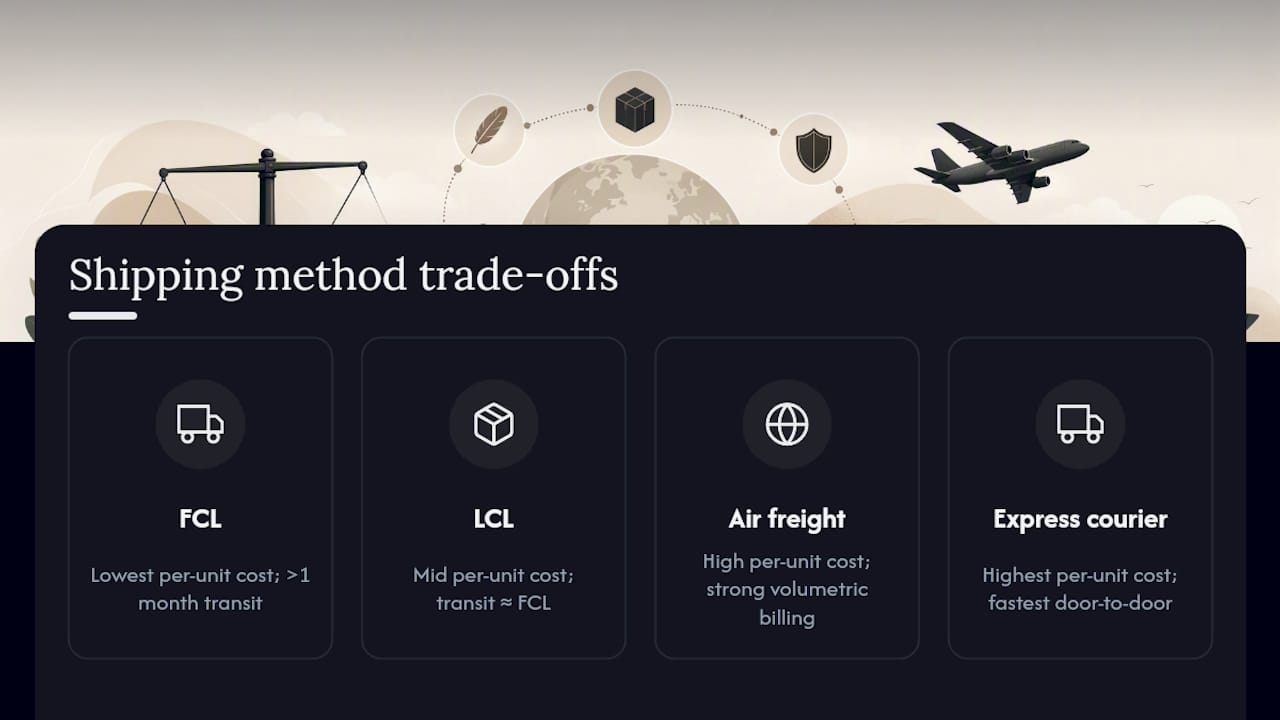
A bulk restock of flat-packed paper bags filling most of a 40 foot container will nearly always land at the lowest per-unit freight cost via FCL ocean freight, because the fixed cost of moving the container gets spread across the maximum possible unit count. The trade-off is transit time, with door-to-door delivery running well over a month once production, port handling, and inland trucking are factored in.
A mid-size order that doesn’t justify a full container, say a reorder for a handful of retail locations, typically moves more cost-effectively via LCL, sharing container space and paying only for the cube used. Per-unit cost sits higher than FCL but well below air freight, and transit time runs close to the same as a full container since the ship makes the same journey either way.
An urgent mid-size reorder, when a retailer is genuinely at risk of running out of bags before the next scheduled shipment, justifies air freight’s premium. The cost jump versus ocean freight is substantial on a per-kilogram basis, and because paper bags get billed on volumetric weight rather than actual weight, that premium compounds for bulky, low-density cargo.
Small parcels, samples, and pre-production prototypes are the one category where express courier’s higher per-unit cost is the right call, since the shipment size is small enough that the total cost stays reasonable while the speed and door-to-door simplicity solve a real logistics problem.
Author perspective: three rules of thumb for ordering and shipping paper bags
Procurement teams overcomplicate this more than they need to. Three rules cover most of what actually matters.
First, measure your carton CBM and get a chargeable-weight estimate from your carrier before you pick a lane. Guessing costs money.
Second, route samples through express and let reorders settle into air or sea based on how far ahead you can plan. Chasing express pricing for routine reorders is how logistics budgets quietly bloat.
Third, lock your HS code and incoterm early, and ask your manufacturer for a pack-out spec before production starts, not after a container arrives with a cube problem you can’t undo.
— Taylor
How Gather Packaging Helps: Request a Shipping-Ready Sample or Quote
Gather Packaging builds the pack-out plan into production from the start, so the bags that leave the Toronto facility are already sized, bundled, and palletized for the lane you’ve chosen, not redesigned after a freight quote comes back higher than expected. That’s the practical advantage of working with a domestic manufacturer instead of managing an overseas supplier and a separate freight forwarder who never talk to each other about carton dimensions.
Whether you need Turn Top, Serrated Top, or Tamper-Resistant Serrated Top bags, Gather Packaging handles prototyping, pre-press proofing, and 8-color flexo printing under one roof, then coordinates pack-out and logistics so your first shipment isn’t a guessing game. If your team is planning a bulk restock or a first order with a new supplier, browse the paper bag product lines to see sizing and customization options, or reach out through Gather Packaging’s consultation services to talk through your carton specs, lane preference, and timeline before production starts. Buyers weighing domestic sourcing against overseas suppliers can also review the Canadian manufacturing capabilities that keep lead times shorter and shipping logistics simpler. Reach out now to get a shipping-ready sample built to your pack-out spec.
Sources
- Dimensional weight (Measurement Canada)
- Export paper packaging: materials, printing & packing
- What should I consider before ordering custom paper boxes for my new product launch?
FAQ
What Is Chargeable Weight and Why Does It Matter for Paper Bags?
Chargeable weight is whichever figure is higher between a shipment’s actual weight and its dimensional (volumetric) weight. Paper bags are bulky relative to their weight, so carriers almost always bill on dimensional weight, which is exactly why flat-packing and tight cartonization lower freight costs.
When Should I Choose FCL Over LCL for a Paper Bag Order?
FCL typically becomes cheaper per unit once your order fills enough of a container’s cubic capacity to justify the fixed container cost, according to shipping lane guidance for paper bags. Below that volume, LCL lets you share container space and pay only for the cube your cartons actually use.
How Do I Protect Printed Paper Bags During Shipping?
Interleaving tissue between stacked bags, using corner guards on tall pallet stacks, and specifying moisture-resistant carton liners are the main defenses against print scuffing and paper warping. A clear pack-out spec given to your manufacturer before production, covering orientation and stacking limits, prevents most transit damage before it happens.
What Documents Do I Need to Import Paper Bags Into Canada?
A complete package includes a commercial invoice with the correct HS code, a packing list, a bill of lading or airway bill, and a certificate of origin. If you’re claiming sustainability attributes, include FSC® chain-of-custody documentation, and confirm your HS code with a customs broker before shipment.
Does Gather Packaging Help With Shipping-Ready Packing Specs?
Yes. Gather Packaging builds pack-out planning, prototyping, and pre-press proofing into its Toronto production process so cartons arrive sized and palletized for your chosen shipping lane. Reach out through the products page or the main site to request a shipping-ready sample or quote.
Share:
Canadian Buyers: Avoid 25–50% Surtax on Paper Bag Imports, Sept 8, 2026
Paper Bag Shipping Weight: 4 Supplier Numbers Procurement Teams Need