
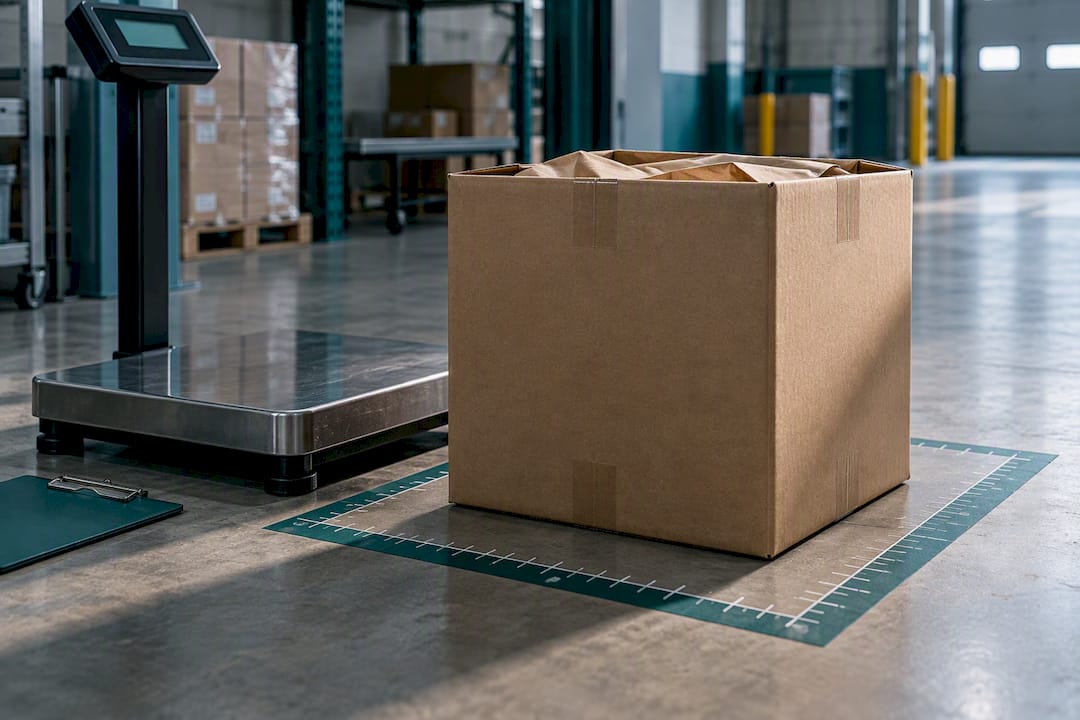
Carriers bill the greater of actual scale weight or volumetric (dimensional) weight, and paper bags almost always lose that comparison to volume. Before requesting a freight quote, get four numbers from your supplier: per-bag actual weight in grams, packed-carton external dimensions in centimeters, bags per carton, and cartons per pallet. Those four figures let you calculate real shipping cost instead of guessing from a per-unit price sheet.
TL;DR:
- Shipping costs for paper bags are usually driven by volumetric weight rather than actual weight due to their bulky nature, often resulting in higher charges.
- Calculating volumetric weight requires knowing the cartons’ dimensions and using specific divisors: 5,000 for courier shipments and 6,000 for freight forwarders or LTL.
- Accurately estimating freight costs depends on obtaining both actual and volumetric weights from suppliers, with physical samples providing the most reliable data.
- Design choices such as flat-fold gussets and low-profile handles can significantly reduce the cubic volume a shipment occupies and lower shipping costs.
- Requesting packaged sample cartons beforehand helps prevent surprises by confirming real dimensions and weights before committing to large orders.
Table of Contents
- What Is Paper Bag Shipping Weight and How Do Carriers Bill It?
- How Do You Calculate Per-Bag, Per-Carton, and Per-Pallet Weight?
- What Packing Choices Lower Volumetric Shipping Weight?
- Three Worked Examples: Courier, Air/LCL, and Sea FCL
- What Should You Ask Suppliers Before Requesting a Freight Quote?
- Gather Packaging’s Take on Freight-Ready Bag Design
- Get Freight-Ready Paper Bag Specs From Gather Packaging
- Sources
- FAQ
What Is Paper Bag Shipping Weight and How Do Carriers Bill It?
Paper bag shipping weight is not one number. It is the actual physical weight of a bag or packed carton compared against its volumetric weight, and carriers charge whichever figure is higher. This distinction catches procurement teams off guard because paper bags are light but bulky. A carton stuffed with turn-top or serrated-top bags can weigh 8 kilograms on a scale yet get billed as though it weighs 14, simply because of how much space it occupies on a truck, plane, or vessel.
The dimensional weight rule that carriers use across Canada sets standard divisors for converting a package’s cubic size into an equivalent weight. Express couriers typically apply a divisor of 5,000; freight forwarders and LTL carriers commonly use 6,000. The formula is:
Volumetric weight (kg) = (Length × Width × Height in cm) ÷ Divisor
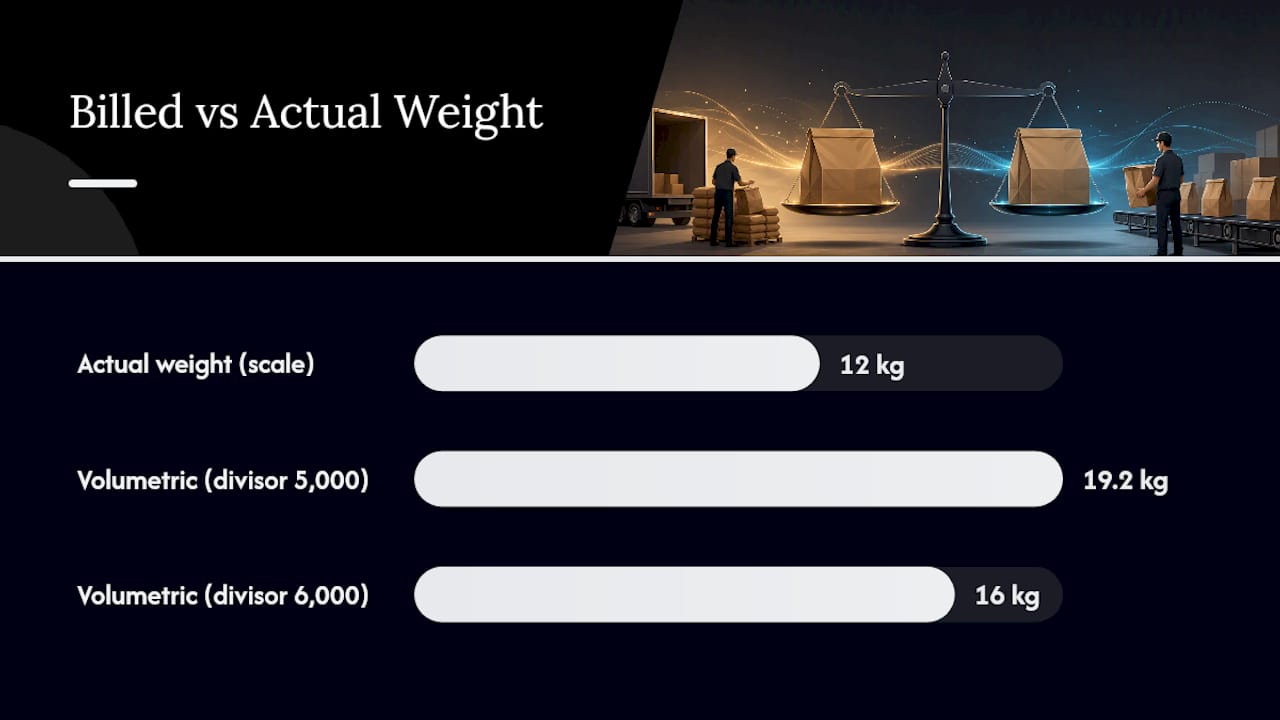
Here’s the math that trips people up. A carton measuring 60 x 40 x 40 centimeters has a volume of 96,000 cubic centimeters. Divide by 5,000 (courier divisor) and you get 19.2 kg of volumetric weight. If that same carton only weighs 12 kg on a scale, the courier bills you for 19.2 kg, not 12.
- Couriers and small parcel carriers: divisor 5,000
- Freight forwarders and LTL/FTL shipments: divisor 6,000
- Ocean freight: billed by cubic meters (CBM), not a weight divisor at all
Reality check: Most paper shopping bag shipments bill on volumetric weight, not actual weight, because bags are structurally bulky relative to their mass. Ignoring this at the quoting stage is the single most common reason freight estimates come in wrong.
How Do You Calculate Per-Bag, Per-Carton, and Per-Pallet Weight?
Calculating shipping weight for paper bags works from the bag outward to the pallet. Skipping steps is what produces freight quotes that don’t match the invoice.
- Get the bag’s flat specs. Ask your supplier for the unfolded panel dimensions and the paper’s basis weight (grams per square meter). You can approximate per-bag weight from unfolded area multiplied by paper weight, which is a standard estimation method used when physical samples aren’t yet available.
- Add the components. A finished bag isn’t just paper. Bottom boards, handle patches, rope or ribbon handles, and adhesive all add mass. A bag that looks like it should weigh 40 grams often lands at 55 to 65 grams once reinforcement is factored in.
- Confirm the finished folded size. This matters for how bags nest inside a carton and how much dead airspace remains.
- Multiply per-bag weight by bags per carton to get gross carton weight, then add the empty carton’s own weight (corrugate isn’t free either).
- Measure the packed carton’s external dimensions and run the volumetric formula against the correct divisor.
- Scale to pallet level by multiplying carton count per pallet by both actual carton weight and volumetric carton weight, then compare the two totals.
| Calculation step | What you need | Formula |
|---|---|---|
| Per-bag actual weight | Unfolded area, paper GSM, component weights | Area × GSM + components |
| Carton actual weight | Per-bag weight × bags per carton + carton tare | Sum of contents plus box |
| Carton volumetric weight | L × W × H in cm | ÷ 5,000 or ÷ 6,000 |
| Pallet gross weight | Cartons per pallet × carton actual weight | Simple multiplication |
| Pallet volumetric weight | Cartons per pallet × carton volumetric weight | Simple multiplication |
Whichever total is higher, at the pallet or carton level, is what you get billed for.
What Packing Choices Lower Volumetric Shipping Weight?
Design decisions made months before a shipment ever leaves the factory determine how much cube it occupies. A bag that won’t fold flat traps air in every carton, and construction choices like gusset width and handle style directly affect how much bulk a carton carries.
- Choose flat-fold-friendly gusset widths over rigid, boxy constructions when the design allows it.
- Favor low-profile handle attachments (flat paper handles, twisted paper handles) over bulky rope handles with plastic knots, which resist flat stacking.
- Skip unnecessary inner polybagging unless moisture protection genuinely requires it. Every layer of inner packaging adds volume without adding protection that matters for dry paper goods.
- Target realistic bags-per-carton counts rather than under-filling boxes to make them easier to lift. A half-empty carton still bills on its full external cube.
- Use double-wall or triple-wall corrugate only where stacking loads require it. Heavier board adds actual weight without buying you anything if the shipment is already volumetric-bound.
- Plan pallet height to the carrier’s max, and block-stack cartons in matching footprints to avoid wasted cube around irregular gaps.
Design work here connects directly to gusset design decisions made at the specification stage, which is worth reviewing before finalizing carton counts.
Pro Tip: Ask your supplier for photos of a fully packed, taped, and stretch-wrapped carton before you request a freight quote. Forwarders price faster and more accurately from real photos than from a spec sheet, and it exposes any air gaps you’d otherwise miss until the invoice arrives.
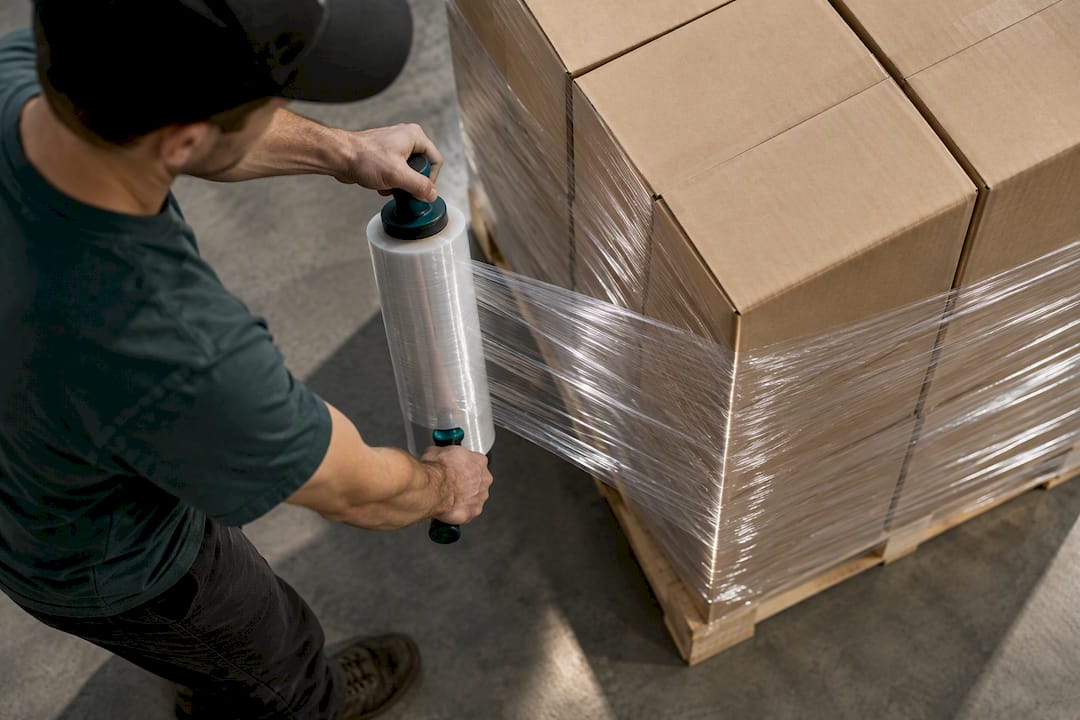
Desiccant packs are worth adding for ocean shipments crossing humid routes, and stretch-wrapping pallets tight (not loose) reduces the footprint forwarders measure for chargeable cube.
Three Worked Examples: Courier, Air/LCL, and Sea FCL
Numbers make this concrete. Here are three scenarios built on typical paper bag cartonization.
- Small courier shipment (divisor 5,000). A sample carton of turn-top bags measures 50 x 35 x 30 cm and weighs 9 kg on the scale. Volume: 52,500 cm³ ÷ 5,000 = 10.5 kg volumetric. The courier bills 10.5 kg, not 9. On a single carton that’s a small gap, but multiply it across 40 cartons in an order and the difference adds real freight cost.
- Air/LCL shipment (divisor 6,000). A pallet holds 45 cartons, each measuring 60 x 40 x 40 cm and weighing 12 kg actual. Per carton: (60×40×40) ÷ 6,000 = 16 kg volumetric versus 12 kg actual. Across 45 cartons, that’s 720 kg actual versus 960 kg volumetric, a gap of 240 kg billed on air freight rates.
- Sea FCL shipment (billed by CBM). The same 45 cartons per pallet, scaled to a full container, may reach 15 to 18 CBM, a range where consolidating into a full container load typically brings the per-unit freight cost down compared with paying LCL rates per cubic meter. If your order is approaching that threshold, ask your forwarder to model both LCL and FCL pricing before committing.
The pattern across all three: whichever number wins, actual or volumetric, is the number on your invoice. Model both every time.
What Should You Ask Suppliers Before Requesting a Freight Quote?
A freight quote is only as good as the data behind it. Before contacting a forwarder, collect these figures from your bag supplier:
- Per-bag actual weight in grams, measured or calculated from paper GSM and unfolded area
- Packed carton external dimensions (length x width x height in centimeters)
- Bags per carton and empty carton tare weight
- Carton gross weight (actual, on a scale)
- Cartons per pallet, pallet footprint, and total loaded height
| Ask for this | Why it matters |
|---|---|
| Both actual and volumetric weight quotes | Forwarders should model both and disclose which divisor they used |
| Confirmed incoterm (FOB, EXW, DDP) | Determines who pays for which leg of freight, changing landed cost per bag |
| Packed carton photos or a physical sample | Verifies real packed dimensions before you commit to a quote rather than relying on estimated specs |
Getting delivered pricing with incoterms clarified up front also protects your landed cost per bag from freight surprises that show up after the purchase order is already signed.
Gather Packaging’s Take on Freight-Ready Bag Design
Freight surprises usually trace back to one thing: nobody verified the packed carton before quoting. Domestic manufacturing shortens the loop between a design file and a physical, measurable carton. Prototyping and quality assurance happen close to the design table, not across an ocean with a six-week delay.
That proximity matters for procurement specifically because it means you can request a packed sample carton early, weigh it, measure it, and lock in a real freight quote instead of one built on estimated dimensions.
— Taylor
Get Freight-Ready Paper Bag Specs From Gather Packaging
Most suppliers hand you a per-unit price and let you discover the real freight cost later. Some manufacturers offer prototyping and production domestically, allowing clients to get a packed sample carton, weighed and measured, before committing to volume.
Gather Packaging offers packaging consultation and quotation, die-line preparation, and prototyping alongside production of turn top, serrated top, and tamper-resistant paper bags. That means procurement can request an actual packed carton, not just a spec sheet, and use it to get accurate actual and volumetric freight quotes before signing off on an order. If your team is comparing suppliers or trying to validate a freight number that looks too good to be true, start a packaging consultation and ask for a sample carton with confirmed packed dimensions and weight. It’s the fastest way to turn an estimate into a number you can actually plan freight around.
Sources
Divisor and dimensional-weight rules come from Measurement Canada. Cartonization and FCL guidance draws on Allen Boxes’ shipping overview and MaiBaoPak’s landed cost breakdown. Freight cost modeling further benefits from operational cost-control practices covered in INGENIA’s fleet cost reduction guide.
- Measurement Canada — Dimensional weight / dimensional factor guidance
- Shiporo — Volumetric weight explained
FAQ
What divisor should I use to calculate volumetric weight?
Use 5,000 for courier or small parcel shipments and 6,000 for freight forwarder or LTL shipments, following Measurement Canada’s dimensional weight guidance. Ocean freight is billed differently, by cubic meters rather than a divisor formula.
Why do paper bags almost always bill on volumetric weight?
Paper bags are structurally bulky relative to their actual mass, especially with gussets, handles, and bottom boards that resist flat stacking. That combination routinely pushes the volumetric weight calculation above the actual scale weight, which is why experts recommend requesting both figures before finalizing a freight quote.
Can I estimate per-bag weight before I have a physical sample?
Yes. Multiply the bag’s unfolded panel area by the paper’s basis weight, then add the weight of components like bottom boards and handle patches, a method suppliers commonly use to support early freight modeling. A physical prototype still gives the most accurate number for a final quote.
Does Gather Packaging help verify packed carton weight before shipping?
Yes. Domestic production supports prototyping and quality assurance early in the process, letting procurement request a packed sample carton to confirm real weight and dimensions before committing to volume. Pricing for specific product lines and consultation services is available by contacting the team directly.
What’s the difference between LCL and FCL for paper bag shipments?
LCL (less than container load) bills by cubic meter alongside other shippers’ cargo, while FCL (full container load) reserves the entire container for your shipment. When volume approaches roughly 15 to 18 CBM, consolidating into an FCL shipment typically lowers per-unit freight cost compared with paying LCL rates.
Share:
Procurement: Paper Bag Shipping and Pack Out Specs for Orders Under 200 kg
Packaging Buyers in Canada: Lock Pantone on Kraft with Gatherpackaging