
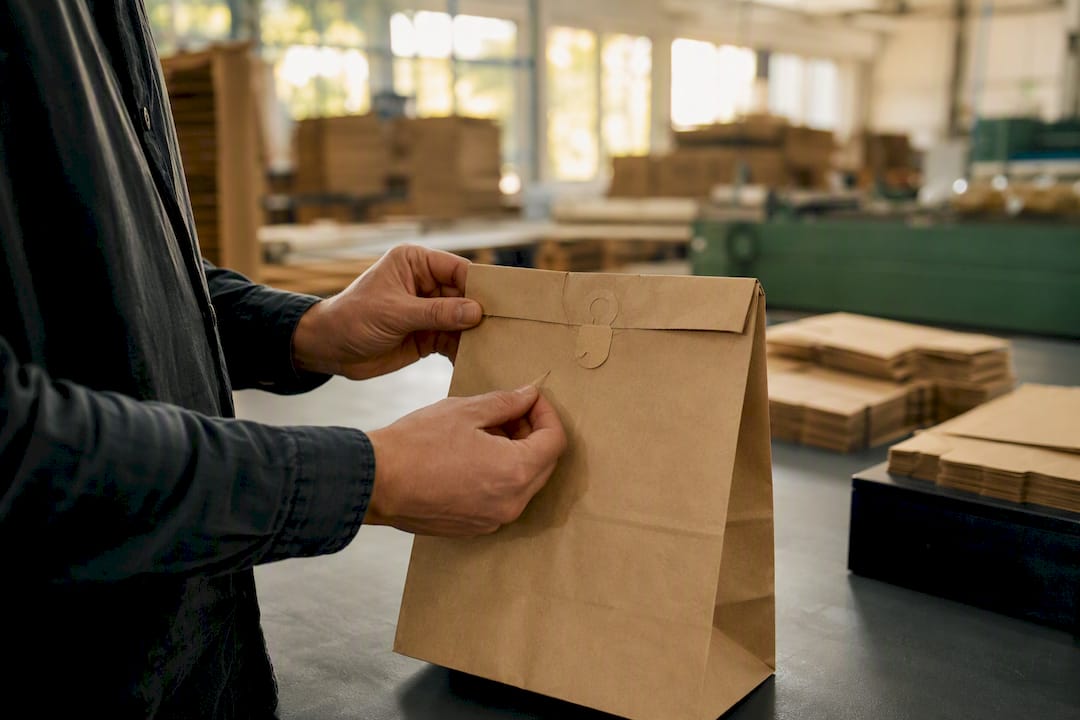
Skip the loose label. If you’re specifying tamper protection for paper shopping bags, an integrated closure built into the bag itself beats a separate sticker or staple every time, because it can’t be swapped out, forgotten at the pack station, or peeled off without leaving proof. Consumer demand backs this up: a survey covered by Food and Beverage Business found a significant portion of respondents want tamper-evident packaging on delivery orders, and California’s AB-3336 requires tamper-evident packaging for third-party food delivery in that state. Your move: request a sealed-bag prototype and QA checklist from Gatherpackaging before you write the final spec.
- Verdict: specify integrated peel-and-seal or turn-top closures, not add-on labels
- Evidence: consumer demand data, AB-3336 regulatory precedent, established QA testing protocols
- Next step: request a sample and closure test report before committing to volume
Key Takeaways
Integrated tamper-evident closures built into paper shopping bags outperform separate labels because they can’t be removed, forgotten, or misapplied at the pack station.
| Point | Details |
|---|---|
| Choose integrated closures | Peel-and-seal or serrated turn-top formats built into the bag beat loose labels for consistency and evidence. |
| Match paper weight to product | Specify GSM based on actual product load, not a default heavy-weight choice, to control cost and sustainability. |
| Require documented QA testing | Ask for peel-force data, transit simulation results, and print match reports before production sign-off. |
| Pilot before full rollout | Test on high-risk SKUs or delivery channels first, with operations and customer service feedback included. |
| Work with a domestic manufacturer | Gatherpackaging’s Toronto production offers customizable closures, FSC® materials, and faster sample-to-delivery timelines. |
Table of Contents
- What Are Tamper-Evident Paper Shopping Bags?
- Why Integrated Closures Protect Your Brand and Your Margins
- What Should You Specify When Ordering Tamper-Evident Bags?
- How Do You Balance Security With Easy Opening?
- What Quality Assurance Testing Should You Require?
- How Long Does It Take to Get Tamper-Evident Bags Made?
- How Does Gatherpackaging Support Tamper-Evident Bag Orders?
- A Procurement Note on Piloting Before You Commit
- Ready to Spec Your Tamper-Evident Bags?
- Frequently Asked Questions
- Sources
What Are Tamper-Evident Paper Shopping Bags?
A tamper-evident paper shopping bag has its security closure built into the bag structure at the manufacturing stage, not stuck on afterward. The most common mechanisms are peel-and-seal adhesive strips that bond the top flap shut and tear visibly if opened, and serrated turn-top seals that fold and lock the bag closed with a break line that shows if someone has tampered with it. Some formats use score-and-break features: a perforated line that snaps cleanly once and can’t be reset.
The operational difference from loose labels matters more than it sounds. A tamper-evident paper bag with a built-in closure gets sealed in one motion at the pack station. Compare that to a two-step process: bag the order, then find and apply a separate tamper label.
- Peel-and-seal strips: adhesive closure that tears or delaminates visibly on opening
- Serrated turn-top: folded closure with a perforated tear line
- Score-and-break: a scored edge that snaps once and can’t be reglued
- All three eliminate the need for staples or add-on labels, per TamperTech’s product documentation
Why Integrated Closures Protect Your Brand and Your Margins
Fewer disputes start with clearer evidence. When a customer opens a bag and sees an intact seal, that’s the end of the “was this tampered with” question before it starts. When the seal is broken, that’s evidence too, just in the other direction, and it shifts liability conversations away from your staff.
The trust signal lands before the customer even opens the bag. A sealed closure at handover, whether it’s a third-party delivery driver passing off a food order or a retail associate closing out a curbside pickup, reads as a deliberate quality decision. Inline Plastics notes that tamper-evidence works specifically because the visual cue is what builds confidence, not the mechanism behind it.
- Fewer disputes over missing or altered items at collection or delivery
- One less manual step for staff (no hunting for a label roll)
- Consistent presentation across every location and every shift
Pro Tip: Don’t seal everything. Deploy integrated tamper-evident bags selectively for third-party delivery orders and high-value or high-risk SKUs, and use standard bags for straightforward in-store purchases. It keeps cost proportional to actual risk.
What Should You Specify When Ordering Tamper-Evident Bags?
A supplier can’t quote accurately on a vague brief. Nail down these specs before you send an RFQ:
- Closure type. Peel-and-seal, serrated turn-top, or score-and-break, matched to how the bag will be handled downstream.
- Paper weight and structure. GSM should match product weight, not default to the heaviest option. Cankos Packaging’s buyer guide recommends testing bag strength against actual product loads rather than guessing.
- Bag style. Flat, gusseted, or handled, sized to your typical order volume.
- Print requirements. Color count, bleed, and any special finishes you need for brand consistency.
- Sustainability certifications. FSC®-certified stock, recycled content percentage, and water-based ink confirmation.
- Food-contact requirements. Grease resistance and food-safe coatings if the bag carries takeout or prepared food.
- Seal application method. Confirm whether the closure applies automatically in-line during manufacturing or requires a manual step at your pack station.
- Traceability space. Room on the bag for order IDs or batch codes if you need return tracking.
Ask for a sample-request package alongside your spec: a defined sample count (five to ten units is typical for initial review), test criteria covering closure integrity, print match, and recyclability, and a stated turnaround for feedback.
Pro Tip: Resist the urge to spec the heaviest paper available “to be safe.” Matching GSM to actual product weight keeps cost and sustainability goals aligned, and a supplier who pushes back on over-spec’ing usually knows their material.
How Do You Balance Security With Easy Opening?
Here’s the tension every packaging designer runs into: a seal strong enough to show tampering can also be strong enough to frustrate a customer trying to open their order one-handed in a car. The goal is security at first sight, not security that requires scissors.
Placement and messaging do a lot of the work. A visible seal across the fold, paired with clear wording like “Sealed for Your Safety,” tells the customer what they’re looking at before they even touch it. Perforation scoring controls peel force, so the seal breaks cleanly without excessive resistance. Accessible tear strips solve the same problem for repeat customers who open dozens of bags a week.
- Position the seal where it’s immediately visible, not tucked into a fold
- Add branded security language directly on the closure
- Test peel force with real staff and real customers before full rollout
- Include a visible breaker cue so anyone can confirm integrity at a glance
Pro Tip: Run an unboxing test with five to ten actual staff members before you commit to a closure design. If more than one person struggles to open it without a tool, the peel force is too high.
What Quality Assurance Testing Should You Require?
A closure that looks secure in a sample pack and one that survives a delivery van are two different things. Require documented testing before signing off on any production run.
| Test type | What it verifies |
|---|---|
| Peel-force testing | Seal opens within an acceptable resistance range, neither too loose nor too stiff |
| Transit simulation | Drop, vibration, and compression tolerance during handling and delivery |
| Humidity and grease exposure | Seal integrity holds up for foodservice and takeout applications |
| Opening-evidence verification | Closure shows unmistakable, irreversible signs once broken |
| Print and color match | Production run matches approved proof across the full order |
Prototype approval should move through three stages: a small-batch pilot for internal review, a customer-facing trial on a limited order volume, and formal sign-off against defined criteria for peel force, visual evidence, and color match. Request test reports, material certifications for any FSC® claims, and sample lot tracking so you can trace a batch back if a problem surfaces after delivery.
- Ask for peel-force numbers, not just a pass/fail statement
- Confirm humidity testing if bags will hold food or refrigerated items
- Keep signed-off samples on file for comparison against future production runs
How Long Does It Take to Get Tamper-Evident Bags Made?
Budget and timeline both hinge on a handful of variables, and knowing them upfront prevents surprises mid-order.
Paper GSM, print complexity (more colors and special finishes cost more), whether you’re using a stock closure or a bespoke one, and your minimum order quantity all drive final cost. Custom closures and low print runs push unit price up; standardizing on a stock peel-and-seal format at higher volume brings it down.
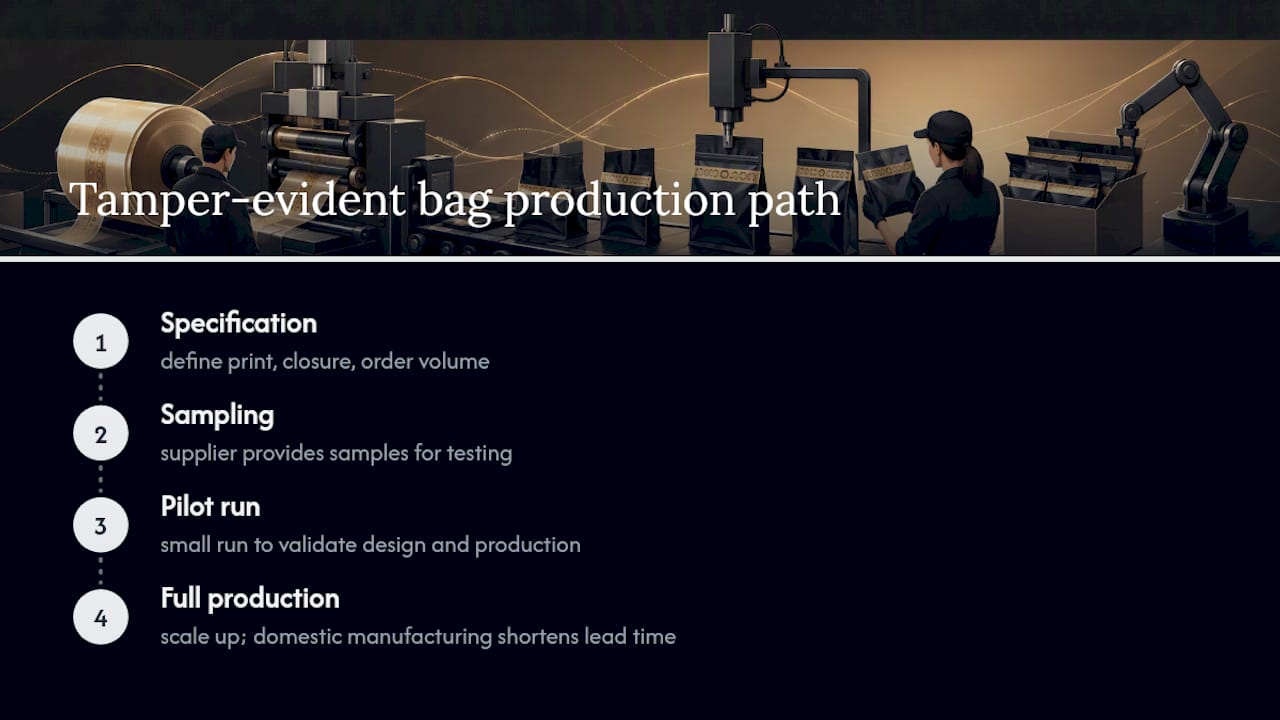
The typical path runs specification, sample and prototype, pilot run, full production, then delivery. Each stage takes real time. Specification and initial sampling often run one to two weeks. A pilot run adds another stretch before you commit to full volume. Domestic manufacturing tends to compress the production and delivery stages compared with overseas sourcing, since it cuts out ocean freight and customs delays.
- Higher print complexity and bespoke closures raise both cost and lead time
- Low MOQs are available but usually carry a per-unit price premium
- Domestic production, like Gatherpackaging’s Toronto facility, shortens the sample-to-delivery window and simplifies QA communication
According to Food and Beverage Business, regulatory pressure like AB-3336 is pushing more foodservice operators to lock in tamper-evident specs earlier in their planning cycle rather than treating it as a late add-on.
How Does Gatherpackaging Support Tamper-Evident Bag Orders?
Gatherpackaging manufactures customizable turn-top, serrated-top, and peel-and-seal tamper-resistant bag formats domestically in Toronto, which shortens the distance between a sample request and a finished order. Production runs on 8-color flexo printing for full brand customization, and materials draw from FSC®-certified stock, recycled content, and water-based inks for buyers working toward sustainability targets.
The workflow is straightforward: you request samples, we run closure and print testing against your spec, you approve a pilot batch, and production scales from there. Design assistance is available throughout, so you’re not left guessing whether a closure design will hold up in transit.
A tamper-evident closure only earns its cost if it survives the actual handoff, whether that’s a delivery driver, a curbside pickup, or a retail counter. Testing that scenario before full production is what separates a good spec from an expensive guess.
- Turn-top, serrated-top, and peel-and-seal formats, all customizable in size
- 8-color flexo printing with design assistance from concept to proof
- FSC® materials, recycled content, and water-based inks documented on request
- Domestic manufacturing and QA testing built into the standard product workflow
A Procurement Note on Piloting Before You Commit
My honest recommendation: don’t roll tamper-evident closures out across every SKU on day one. Pilot on your highest-risk category first, whether that’s third-party delivery orders or high-value retail items, and pull in operations, customer service, and marketing before you lock the design. Usability complaints and brand-fit issues surface fast in a small pilot and are expensive to fix after a full production run.
Ready to Spec Your Tamper-Evident Bags?
Most suppliers ask you to choose between low cost and fast turnaround. Domestic manufacturing removes that trade-off: Gatherpackaging produces out of Toronto, so sample requests and production runs move faster than overseas sourcing without a markup for rush service.
If you’re ready to move from spec sheet to sample, here’s the path: request a sealed-bag sample built to your closure and print requirements, confirm your GSM, size, and sustainability specs against that sample, then run a small pilot batch before committing to full volume. Every step includes design assistance and QA documentation, so you’re not troubleshooting alone.
Start by requesting a sample from Gatherpackaging and get your specs, closure type, and timeline confirmed before your next order deadline.
Frequently Asked Questions
Are tamper seals for bags required by law? Requirements vary by jurisdiction. California’s AB-3336 mandates tamper-evident packaging for third-party food deliveries in that state, and other regions are moving in a similar direction, but there’s no single blanket standard covering all bag types everywhere. Check your local and industry-specific rules before finalizing a spec.
What’s the difference between tamper-evident and tamper-resistant bags? Tamper-evident closures make any opening visible after the fact. Tamper-resistant designs focus on making unauthorized access physically harder in the first place. Inline Plastics recommends tamper-evidence when a visible cue is sufficient, reserving tamper-resistance for higher-security needs.
How do I know what paper weight to specify? Match GSM to your actual product weight and handling conditions rather than defaulting to the heaviest stock. A supplier should test bag strength against your real product load, not a generic benchmark.
How long does it take to get a custom tamper-evident bag order produced? Timelines depend on print complexity, closure type, and order volume, but the path runs through specification, sampling, a pilot run, then full production. Domestic manufacturing generally shortens this window compared to overseas sourcing.
Can tamper-evident bags still be recycled? Paper-based integrated closures are generally designed to remain compatible with standard paper recycling streams, especially when they avoid plastic laminates. Confirm the specific material composition with your supplier if recyclability is a compliance requirement for your brand.
Share:
Avoid Import Packaging Delays: An Importer's Checklist
Custom Bag Pricing for Buyers: CAD Ranges and Quote Checklist