

The single most reliable way to avoid import packaging delays is to combine three things before your shipment ever leaves the dock: a verified pre-shipment data packet, early pre-arrival filing, and packaging built for fast inspection. The Canada Border Services Agency (CBSA) allows brokers to submit release documentation up to 45 days before arrival for PARS, and importers who file that early, with clean paperwork and a completed CARM Client Portal setup, rarely see their cargo sit past its scheduled release window.
Packaging plays a bigger role in this than most importers assume. Cartons that map clearly to invoice line items let an examiner clear a container in minutes instead of hours.
Before you book your next shipment, confirm:
- Your commercial invoice, packing list, and certificate of origin match line for line
- HS codes and declared values are locked in with the broker, not guessed at
- Any permits or licenses for regulated goods are on file, not “in progress”
- Cartons and pallets are labeled so an inspector can match contents to paperwork in seconds
Pro Tip: Pack a spare roll of tamper-evident tape and a printed copy of your document packet inside the container door. If an inspector opens a carton, you want resealing materials on hand, not on order.
Key Takeaways
Preventing import packaging delays comes down to filing early, matching your paperwork exactly, and building cartons that let an inspector verify contents without opening every box.
| Point | Details |
|---|---|
| File early, not just on time | Submit PARS up to 45 days ahead or IID up to 90 days ahead per CBSA rules. |
| Match every document | Invoice, packing list, and CO must reconcile line by line before submission. |
| Lock in classification early | Confirm HS codes and declared value with your broker before shipping, not after a hold. |
| Fund CARM before departure | Payment readiness in the CARM Client Portal prevents release stalls even with clean paperwork. |
| Build inspection-ready cartons | Gatherpackaging maps SKUs, coordinates print marks, and photographs pallets before sealing every order. |
Table of Contents
- How to Build a Pre-Departure Checklist That Prevents Delays
- Get the Documentation Right: Invoice, Packing List, and Certificate of Origin
- Why HS Codes and Declared Value Trigger the Most Delays
- Permits and Restricted Items That Cause Inspection Holds
- Packaging and Labeling Specs That Speed Up Customs Exams
- When to File PARS, IID, or ACI/eManifest Paperwork
- Who’s Responsible: Importer, Broker, and Carrier Roles
- What to Do the Moment a Shipment Gets Held
- Planning for Delay-Related Costs: Demurrage, Detention, and AMPS
- Frequently Asked Questions
- Sources
How to Build a Pre-Departure Checklist That Prevents Delays
Ten actions, done before booking and before arrival, catch the overwhelming majority of packaging- and customs-related holds. Run through this list with your broker before every shipment, not just the first one.
- Standardized data packet — Invoice, packing list, and CO drafted and cross-checked against the purchase order.
- HS code confirmation — Broker has confirmed the 10-digit tariff classification for every SKU, not a prior-shipment guess.
- Declared value support — PO, invoice, and payment proof all show the same transaction value.
- Permit check — Any regulated item has its permit or certificate attached, not pending.
- Packaging and carton labeling — Every carton mark matches the invoice description and SKU.
- Pre-arrival filing scheduled — PARS or IID submission dated against your actual sailing or flight.
- Payment readiness — CARM account funded or bonded so release isn’t stalled on unpaid duties.
- Carrier confirmation — ACI/eManifest acceptance confirmed, with the cargo control number matched to your PARS number.
- Broker sign-off — A named person at your broker has reviewed and approved the full file.
- Inspection response plan — Someone on your team knows who to call and what to send if the shipment is selected for exam.
Pro Tip: Assign one internal owner per shipment, with a named backup. Holds get longer, not shorter, when three people think someone else is handling the response.
Get the Documentation Right: Invoice, Packing List, and Certificate of Origin
Most holds trace back to paperwork that doesn’t match itself. The CBSA notes that missing paperwork, incorrect classification, and poor packaging or labeling sit at the top of the delay list, and all three are preventable weeks before the container ships.
Your commercial invoice needs the seller and buyer’s full legal names, an exact product description (not a generic category), unit value, currency, Incoterm, country of origin, and HS code. Your packing list needs carton counts, net and gross weights, and pallet or unit counts that add up to the invoice quantities exactly. When these two documents disagree, even by a few kilograms, CBSA can issue a documentation request that adds days to clearance.
Before you submit anything, verify:
- Invoice and packing list totals reconcile line by line
- Country of origin is stated the same way on the invoice, packing list, and CO
- Unit values match the purchase order, not a rounded estimate
Under CBSA Memorandum D17-1-1, the importer or broker is responsible for presenting acceptable accounting documents, including Form B3-3. CBSA staff can advise, but the file itself is on you.
Pro Tip: Assign one person, by name, to sign off on documentation accuracy before it’s transmitted. A shared inbox is not an accountability structure.
Why HS Codes and Declared Value Trigger the Most Delays
A wrong tariff classification doesn’t just risk the wrong duty rate. It can trigger a Participating Government Agency (PGA) review that a correctly classified shipment would never see, because different 10-digit codes carry different regulatory flags.
Keep a SKU-level tariff file that your broker reviews and updates, rather than reclassifying from memory on every shipment. For declared value, keep your purchase order, commercial invoice, and proof of payment aligned. If you’ve made a valuation adjustment, such as a rebate or assist, document it in writing before the shipment departs, not after CBSA asks.
- Maintain one master tariff file per SKU, reviewed with your broker annually
- Attach PO and payment records to every new supplier’s first shipment
- Flag any price change, discount, or non-standard payment term for broker review before booking
Pro Tip: Run a pre-shipment classification dry run with your broker on any new product or new supplier. Catching a misclassification on paper costs nothing; catching it at the port costs days.
Permits and Restricted Items That Cause Inspection Holds
Certain product categories, food-adjacent packaging, cosmetics, electronics, and anything requiring a health or safety certificate, automatically draw a PGA review unless the permit paperwork is already on file. If your packaging includes printed claims (recyclable, compostable, food-safe), keep the supporting lab reports or certifications ready, since customs can request them alongside the shipment’s regulatory documents.
Missing permit documentation usually means one of two outcomes: a hold for further review, or in rarer cases, refusal of entry. Both cost more than the ten minutes it takes to confirm the permit before booking.
- Identify every SKU that falls under a PGA category before your supplier ships
- Keep a permit master file per SKU, not per shipment
- Confirm certificate validity dates before each order, not just at first sourcing
Pro Tip: Flag regulated SKUs in your procurement system so a missing permit blocks the purchase order, not the shipment.
Packaging and Labeling Specs That Speed Up Customs Exams
Paper shopping bags move through customs faster when the outer carton tells the whole story without anyone opening it. Every carton should carry a plain-English SKU description, the HS code for that item, country of origin, the PO number, pack count, and its position on the pallet map. An inspector who can match carton marks to your invoice at a glance has no reason to dig further.
At Gatherpackaging, pre-shipment QA includes verifying carton counts against the packing list, confirming inner packing prevents bag creasing or crushing in transit, and keeping resealable outer packaging on hand for any carton an inspector opens. We also recommend capturing three photos before the container closes: a top-down shot of the palletized load, a side shot showing carton marks clearly, and a close-up of a sample bag. Those images, attached to your document packet, let a broker resolve a remote query without waiting on a physical re-exam.
Packaging isn’t designed to pass inspection. It’s designed to make traceability instant, so an inspection, if it happens, takes minutes instead of a full workday.
- Match SKU codes on cartons exactly to the commercial invoice and packing list
- Keep spare reseal tape and printed document copies inside the container
- Photograph pallets, carton marks, and sample product before sealing
Pro Tip: For custom-printed bags, confirm your print run’s batch codes and SKU IDs with your broker before shipping, so the outward marks match the paperwork exactly. Read more on packaging compliance and labeling standards.
When to File PARS, IID, or ACI/eManifest Paperwork
Filing early is one of the few levers you fully control. CBSA allows PARS submissions up to 45 days before arrival, and IID release requests up to 90 days for eligible shipments. Carriers, separately, must transmit ACI/eManifest data within prescribed timeframes under Memorandum D3-1-1, and the cargo report isn’t legally complete until the conveyance actually reaches its first Canadian port.
That distinction matters operationally. A carrier’s electronic transmission and the physical arrival report are two separate events, and a gap between them, or a rejected transmission, can trigger AMPS penalties and delay release even when your paperwork is flawless.
- Pre-booking data QC: finalize invoice, packing list, and CO
- Manifest inputs: confirm ACI/eManifest data with your carrier
- PARS/IID submission: file at the earliest allowable window for your mode
- Arrival-day check: confirm release status before the truck or vessel actually arrives
- Air shipments typically allow less lead time than ocean; file as soon as your carrier accepts data
- LCL shipments face extra risk from consolidator handling delays before manifest submission
Who’s Responsible: Importer, Broker, and Carrier Roles
Delays often come from handoff gaps, not missing information. Under CBSA rules, the carrier is responsible for reporting arrival and transmitting ACI/eManifest data, while the importer or broker files the release and accounting documents. When nobody confirms who did what, a shipment can sit fully documented but unreleased simply because no one filed the final piece.
Before departure, confirm in writing:
- ACI/eManifest acceptance from your carrier, with the cargo control number
- Broker acknowledgment of your final document packet
- Arrival port and expected transmission timing from your carrier
Pro Tip: Require a broker sign-off on a final pre-arrival checklist and confirm your CARM account is funded before the vessel sails. A documentation gap and a payment gap create the exact same delay.
What to Do the Moment a Shipment Gets Held
Move fast and in this order: for precise details on container inspections and port handling, see the container customs examination port process
- Identify the exact hold issuer and get the release requirement in writing
- Send your document packet (invoice, packing list, CO, test reports, photos) digitally, immediately
- Schedule exam-site drayage if a physical exam is required
- Confirm who’s approving exam or repack charges before they’re incurred
Keep this packet ready at all times, not assembled after the fact: commercial invoice, packing list, certificate of origin, any test reports, purchase orders, and your pre-shipment photos. Name a decision-maker for cost approvals in advance, so a hold doesn’t stall further while someone hunts for sign-off authority.
Planning for Delay-Related Costs: Demurrage, Detention, and AMPS
Build buffer time by mode. Ocean freight, especially LCL through a CFS, carries more handling risk than FCL or air, so plan accordingly for transit time on consolidated shipments. Practitioners increasingly recommend transloading strategies to reduce port dwell and demurrage exposure once cargo clears.
Common cost exposures include demurrage, detention, storage, exam drayage, and AMPS penalties, each typically authorized by a different internal team depending on your organization’s structure.
- Air: build in 1 to 2 days of buffer beyond quoted transit
- Ocean FCL: build in 3 to 5 days; LCL/CFS: build in 5 to 7 days
- Confirm CARM financial security is active before shipping, not during a hold
Pro Tip: A held shipment with no CARM security on file often waits longer than one with a documentation issue. Payment readiness is a release requirement, not paperwork.
A Packaging Manufacturer’s View on Clearance-Ready Cartons
Every order Gatherpackaging ships gets SKU-mapped cartons, pre-shipment photos, and print marks checked against the customer’s invoice before sealing. It’s a habit built from watching how much time clean packaging saves at the border. If you’re building a supply chain around paper shopping bags, our design and QA team can walk through your packaging spec before your next order ships.

Packaging Built for Fast Clearance and Reliable Delivery
Gatherpackaging manufactures paper shopping bags domestically in Toronto, which means your carton marks, SKU IDs, and print details get coordinated at the source, not translated through a supplier three time zones away. That is the practical advantage: shorter feedback loops on packaging specs, and a manufacturing partner who can confirm exactly what’s inside every carton before it ships.

Our team handles pre-shipment QA, print mark alignment, and packaging documentation as part of every custom order, whether you need turn top, serrated top, or tamper-resistant bags. We also work in FSC-certified and recycled materials if sustainability claims are part of your packaging story. Browse our custom printed bag options or contact Gatherpackaging directly to walk through your specs, lead times, and next order.
Frequently Asked Questions
What’s the fastest way to avoid import packaging delays? File your release documentation early through PARS or IID, keep your invoice and packing list matched exactly, and label cartons so an inspector can verify contents against your paperwork without opening every box.
How early can I file pre-arrival paperwork with CBSA? Up to 45 days before arrival for PARS and up to 90 days for IID, depending on your shipment type and eligibility.
Does poor packaging really cause customs delays? Yes. Cartons that don’t clearly match invoice descriptions or SKU counts often trigger further documentation requests, according to customs broker guidance on common delay causes.
What should I do if my shipment gets held? Get the exact release requirement in writing from the hold issuer, send your full document packet digitally right away, and confirm who’s approving any exam or drayage charges before they’re incurred.
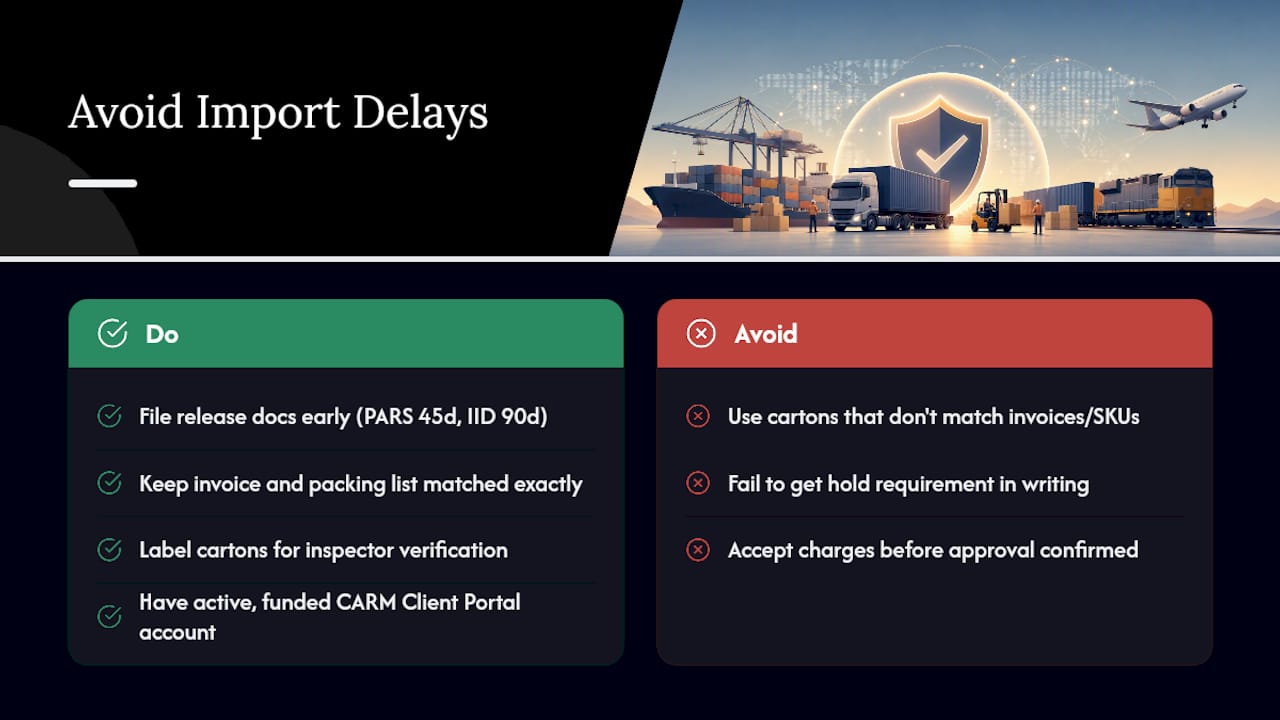
Is CARM registration required to avoid delays? An active, funded CARM Client Portal account is a practical requirement for release. Even flawless paperwork can stall if your financial security isn’t confirmed in advance.
Share:
Ship Bags to Stores: A Retailer Checklist for Reliable Delivery
Tamper Seals for Bags: A Procurement Guide for Retail Buyers