
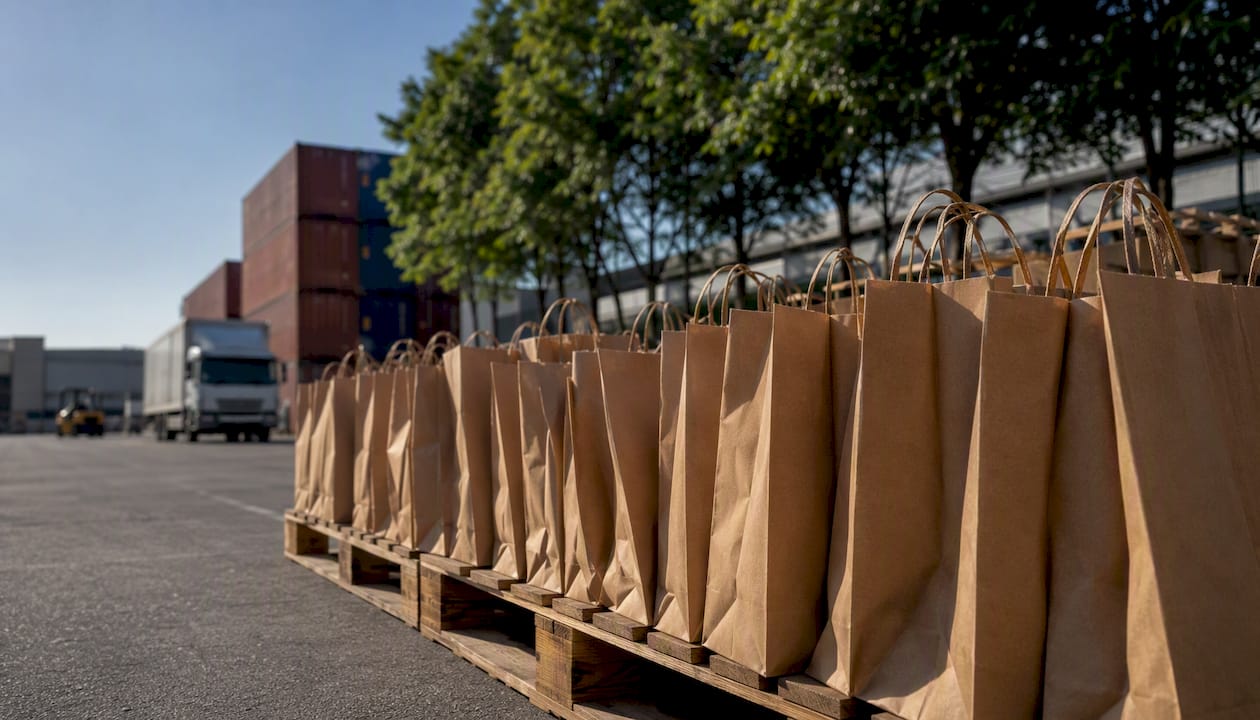
A five-stage workflow—plan, make, prepare, ship, replenish—is the fastest reliable way to get eco-friendly paper shopping bags from a production line to a store shelf. Three things make that workflow hold up under pressure: SKU rationalization so you’re not juggling near-duplicate bag specs, rolling 12-week forecasts tied to real reorder points, and a manufacturer whose lead times you can actually plan around. Gatherpackaging builds these bags domestically in Toronto with FSC options built in, which shortens the variable that trips up most retail launches.
If you’re planning an order right now, the short version is this:
- Confirm specs and lead time with your manufacturer before you commit to a launch date.
- Build safety stock around measured lead-time variability, not a guess.
- Treat pallet build and labeling as a retailer compliance step, not an afterthought.
- Contact Gatherpackaging early to lock a production-to-store timeline.
Key Takeaways
Shipping eco-friendly paper bags to stores reliably depends on treating packaging as a lead-time item, using rolling forecasts, and working with a manufacturer built for retail-ready delivery.
| Point | Details |
|---|---|
| Follow the five-stage workflow | Move each order through plan, make, prepare, ship, and replenish stages in sequence. |
| Rationalize SKUs first | Cut overlapping bag specs before setting forecasts and reorder points. |
| Treat custom print as long-lead | Build dedicated safety stock for custom-printed bags; use JIT for standard stock. |
| Lock pallet specs before production | Confirm carton counts and pallet templates early to avoid repacking delays. |
| Work with a domestic manufacturer | Gatherpackaging’s Toronto production shortens lead times and skips import customs clearance entirely. |
Table of Contents
- How Do You Ship Bags to Stores Without Delays?
- Planning Bag Orders: Forecasting and Reorder Rules
- What Specs and Samples Should You Require From a Manufacturer?
- Packing and Palletizing Bags for Retail Delivery
- Which Carriers and Fulfillment Models Fit Your Order Size?
- Setting Reorder Points So Stores Never Run Out
- Which Sustainability Credentials Should You Verify Before Shipping?
- A Sample Timeline and Packing Spec You Can Reuse
- Handling Returns and Damaged Goods for Store Shipments
- Planning for Shipment Delays and Supply Disruptions
- Customs Clearance for Eco-Friendly Bags Entering Canada
- Keeping Manufacturer, 3PL, and Retailer Communication on Track
- Managing Bag Inventory at the Store Level
- How Gatherpackaging Handles the Entire Bag-to-Store Workflow
- Frequently Asked Questions
- Sources
How Do You Ship Bags to Stores Without Delays?
Getting bags to stores on schedule comes down to sequencing, not speed. Each step below has its own failure points, and most delays trace back to skipping one.
- Specify and forecast (1 to 3 days). Lock the bag style, size, paper stock, and print colors, then attach a quantity based on your rolling forecast, not last season’s number.
- Approve proofs and samples (a few business days). A digital proof catches color and layout errors; a physical pre-production sample catches everything else, handle strength, bottom pad integrity, print registration on the actual stock.
- Schedule production (2 to 6 weeks depending on complexity). Custom 8-color flexo runs with unique dies take longer than a stock kraft bag with a one-color logo. Confirm this window in writing.
- Pack and build pallets (concurrent with the tail end of production). Carton counts, inner packing, and pallet configuration should already be templated before the presses run, not decided after.
- Book carriers and DC/store appointments (1 to 2 weeks lead). Retail distribution centers often require scheduled appointments; booking late is one of the most common causes of missed delivery windows.
- Track and confirm delivery. An advance shipping notice (ASN), transport labels, and proof of delivery close the loop, giving you a documented record if a claim comes up later.
Pro Tip: Lock your carton counts and pallet build template before production starts, not after. Changing case pack sizes mid-run forces a repack and can add a week to your timeline for no good reason.
Simple reorders on established SKUs can move through this whole sequence in a few weeks. Custom print jobs with new dies, new proofs, or first-time retailer compliance requirements often take multiple weeks. Treat packaging as a lead-time item on your project calendar the same way you’d treat a long-lead component in manufacturing, because that’s functionally what it is.
Planning Bag Orders: Forecasting and Reorder Rules
SKU rationalization sounds like a procurement buzzword until you’re the one reconciling twelve nearly identical bag sizes across three vendors. Cutting overlapping specs down to a manageable core makes buying, packing, and forecasting dramatically simpler, and GEP’s guidance on packaging frames this correctly: packaging deserves the same strategic treatment as any other input with real lead time and cost exposure.
Rolling 12-week forecasts work better than static seasonal projections because they update as actual sell-through comes in. Convert that forecast into a reorder point using your measured lead time, not the number your supplier quoted you once. A packaging supply chain planning guide from Packaura makes the same point: standardizing sizes and case counts, then feeding rolling forecasts with real data, is what actually prevents stockouts.
Pro Tip: Run a hybrid model. Use just-in-time ordering for standard off-the-shelf bag sizes, and hold dedicated safety stock for custom-printed, long-lead SKUs. Standard stock can flex with short reorder cycles; a custom die and color match cannot.
| Decision | Standard SKU | Custom-printed SKU |
|---|---|---|
| Forecast horizon | 12-week rolling, light buffer | 12-week rolling, wider buffer for print lead time |
| Safety stock | Minimal, JIT-friendly | Built around measured lead-time variability |
What Specs and Samples Should You Require From a Manufacturer?
Before you approve a production run, put these on paper: paper grade and FSC claim, grammage (gsm), handle type and attachment method, any lamination or matte/gloss finish, print method and Pantone color proofs, and exact carton pack counts. A buyer’s guide to bulk paper bag orders makes the case for confirming carton quantity and export carton quality before mass production starts, and that advice holds whether your bags are coming from overseas or from a domestic Canadian plant.
The sample workflow should move through four stages: a digital mockup, a printed color proof, a pre-production physical sample, and a sign-off sample pulled from the actual production run. Each stage catches something the last one couldn’t. QA checks on that physical sample should include a handle pull test, a bottom pad load test, and a print registration check under normal store lighting.
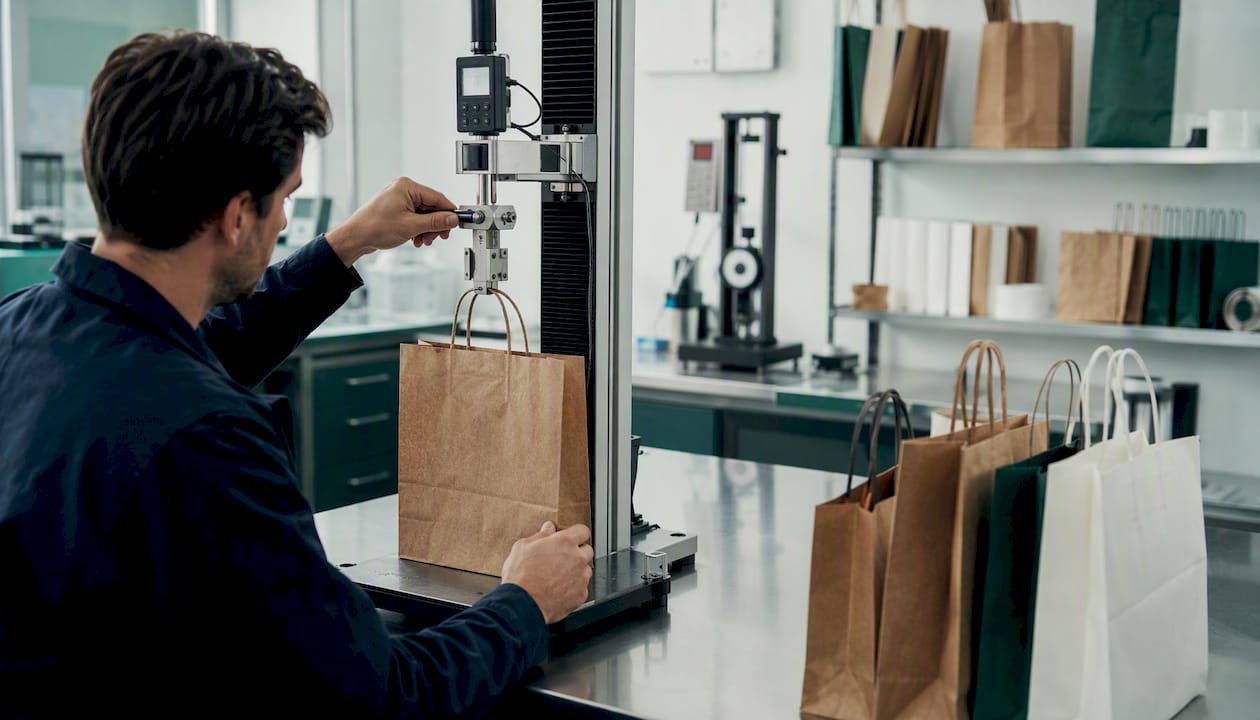
A short email to your manufacturer covering paper stock, gsm, handle type, print method, Pantone references, carton count, and requested sample turnaround gets you a faster, more accurate quote. Put the same checklist on your PO so quality assurance isn’t left to memory.
Pro Tip: Ask for your pre-production sample from the actual print plates and paper stock, not a generic mockup. A color proof on the wrong stock will not tell you how your ink looks on real kraft paper.
Packing and Palletizing Bags for Retail Delivery
Retail-ready packaging that arrives pre-configured for the shelf or backroom cuts handling time and damage risk because it skips repacking at the distribution center, a point MacMillan’s retail-ready packaging guidance backs up directly. Flat packing with consistent carton counts and adequate export carton strength matters more than most buyers expect. A guide to export carton packing for paper bag orders notes that clear carton marks and early palletization discussions cut receiving delays significantly.
Before your pallet leaves the dock, confirm:
- Case count per layer matches your retailer’s routing guide, not just what fits.
- Labels sit in the position your DC specifies, usually the short side, facing out.
- Pallets use slip sheets or stretch wrap appropriate for the transit distance.
- Pallet height and weight fall within your carrier’s and retailer’s limits.
Documentation travels with the freight. An ASN, the original PO number, transport labels, and a pallet ID number all need to match before the truck leaves. Odette’s LG14 packaging management guidelines lay out despatch advice and tracking message standards that many retail supply chains model their own documentation requirements on, even outside the automotive sector where the standard originated. Getting these details right the first time is the difference between a pallet that clears receiving in ten minutes and one that sits in a dock queue for a day.
Which Carriers and Fulfillment Models Fit Your Order Size?
Parcel shipping works for small or sample orders. Less-than-truckload (LTL) freight fits mid-size orders spread across a few pallets. Full truckload (FTL) makes sense once you’re filling most or all of a trailer, and dropship arrangements suit direct-to-store programs with frequent, smaller drops. Choosing wrong on volume and cube costs you either wasted trailer space or split shipments that arrive on different days.
Third-party logistics (3PL) providers and retail distribution partners handle inbound receiving, pallet building, and scheduled outbound delivery to store DCs. Transnova Logistics runs this exact model for Canadian brands: inbound receiving, palletized outbound prep, and LTL/FTL routing timed to retailer appointment windows. Larger national retail networks often work with established carriers like Ryder for scheduled distribution, which shows how much appointment-based delivery has become the standard rather than the exception at big-box DCs.
Before you book:
- Confirm your carrier can meet the retailer’s specific appointment window, not just a delivery date.
- Prepare a bill of lading and transport labels ahead of pickup.
- Request proof of delivery (POD) as a standard part of the booking, not an afterthought.
Setting Reorder Points So Stores Never Run Out
A workable reorder point starts with your average daily usage across stores, multiplied by lead time in days, plus a safety stock buffer. Convert your days-of-supply target into an actual reorder quantity per store or per distribution hub, and update it as sell-through data comes in rather than once a season.
Safety stock should scale with how unpredictable your lead time actually is, not a flat percentage rule. A StatCan reference on inventory practices supports the logic of pairing tighter, just-in-time ordering for standard items with dedicated buffer stock for anything with longer, less predictable lead time, which is exactly the position custom-printed bags sit in.
Pro Tip: Schedule a full physical inventory count quarterly, with lighter cycle counts monthly or weekly for your highest-velocity bag SKUs. GEP’s guidance on packaging inventory management recommends this exact cadence, and it catches shrinkage and miscounts long before they show up as an unexpected stockout at a store.
Which Sustainability Credentials Should You Verify Before Shipping?
Before you approve a shipment, confirm FSC® chain-of-custody documentation, any recycled content claims, water-based ink usage, and compostable labeling where your retailer requires it. Retailers increasingly check for accurate material callouts and disposal instructions printed on the bag itself.
- Confirm FSC chain-of-custody paperwork matches the claim printed on the bag.
- Verify recycled content percentages against your supplier’s actual documentation, not marketing copy.
- Check that compostable or recyclability language on the bag matches local disposal guidance.
Pro Tip: Bundle sustainability documentation with each ASN. Retailer compliance teams move faster when the paperwork arrives with the shipment instead of being requested after the fact.
A Sample Timeline and Packing Spec You Can Reuse
A simple reorder on an existing die can move from proof to store delivery in three to four weeks. A new custom print with a first-time retailer compliance review often needs six to ten weeks, factoring in customs or peak-season port delays.
- Proof to production: 5 to 10 business days.
- Production to packed cartons: 2 to 6 weeks depending on run complexity.
- Inbound to store delivery: 1 to 2 weeks including appointment scheduling.
Your packing spec checklist should always include carton count per case, pallet configuration, label placement, and the paperwork set: ASN, PO number, and transport label. Add buffer days for customs clearance or seasonal carrier congestion, especially around major retail peaks.
Handling Returns and Damaged Goods for Store Shipments
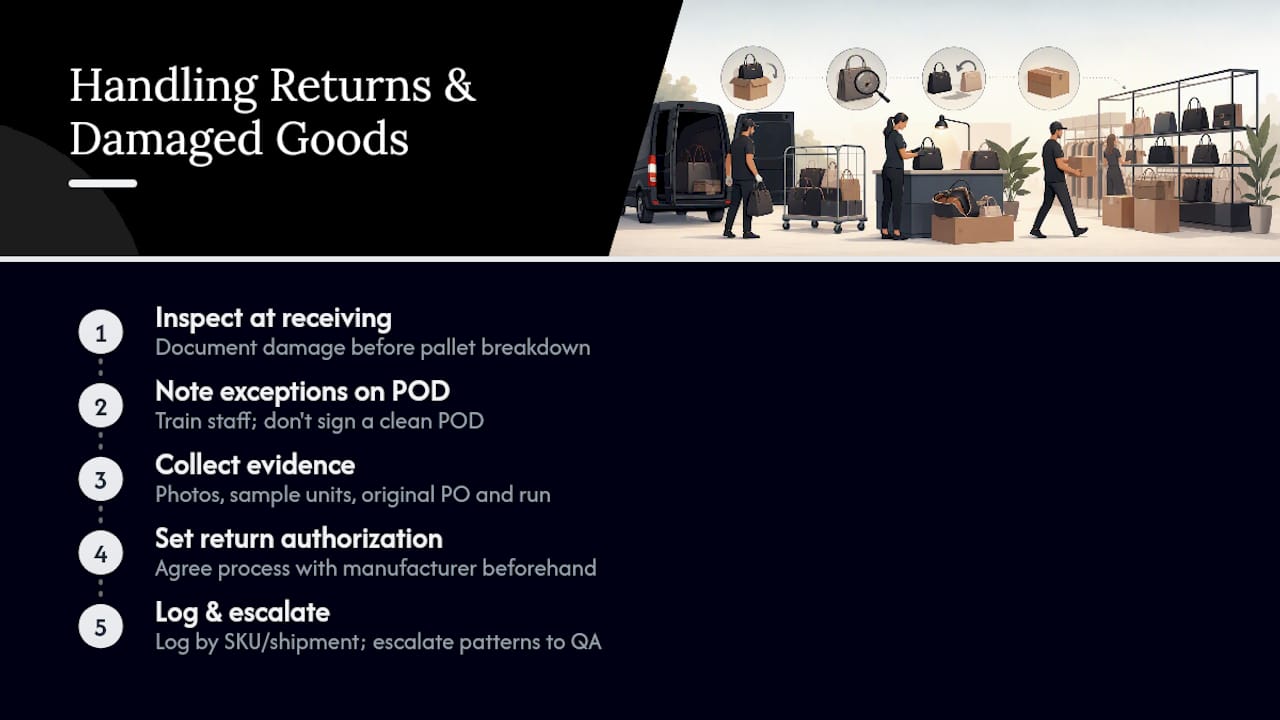
Freight damage on paper bag shipments usually shows up as crushed cartons, torn handles from rough handling, or moisture damage from an uncovered dock. Document damage at receiving, before the pallet is broken down and distributed to shelves, because that photo and note is what supports any freight claim later.
Set a clear return authorization process with your manufacturer before you need one. A defective batch, wrong print color, or handle failure caught after delivery should have a documented path: photos, a sample of the defective units, and a reference to the original PO and production run number. Manufacturers running proper QA, including handle pull tests and print registration checks at the plant, catch most defects before shipment, which is exactly why those checks belong on your PO in the first place.
For freight-related damage specifically, your carrier’s proof of delivery record matters. If a pallet arrives with visible carton crush and no exception noted on the POD, your claim gets harder to support. Train receiving staff to inspect and note exceptions on the spot rather than signing a clean POD and sorting it out later.
Keep a simple log of return and damage incidents by SKU and by shipment. Patterns matter more than isolated incidents. A single crushed carton is a handling problem. A repeated bottom-pad failure on the same SKU is a specification or production issue that needs to go back to your manufacturer’s QA team, not just a swapped carton.
Planning for Shipment Delays and Supply Disruptions
Delays happen for predictable reasons: port congestion, carrier capacity crunches during peak season, a production hiccup, or a customs hold. The retailers who handle this well aren’t the ones who never face delays, they’re the ones with a plan already built before the delay hits.
Start by identifying single-source dependencies. If one plate, one paper mill, or one carrier lane is the only path for a critical SKU, you have a risk you haven’t priced in. Mapping those dependencies, even informally, tells you where a backup plan actually needs to exist.
Build buffer time into your calendar for known risk windows: customs clearance, peak holiday freight capacity, and any first-time production run with a new die or new print color. A custom SKU with no production history deserves more buffer than a reorder on an established bag your manufacturer has run a dozen times.
Keep a shortlist of contingency options ready before you need them: an alternate carrier lane, a secondary carton supplier if your pallet materials run short, and a clear internal decision-maker for expediting a shipment when a delay threatens a store launch date. Domestic manufacturing shortens the physical distance a delay has to travel through, which is one practical reason Canadian retailers increasingly favor a Toronto-based production run over an overseas order with a six-week ocean transit buried in the schedule.
Customs Clearance for Eco-Friendly Bags Entering Canada
Bags manufactured domestically in Canada and shipped to Canadian stores skip import customs clearance entirely, one of the practical advantages of working with a domestic manufacturer instead of an overseas supplier. If you’re importing bags from outside Canada, you’ll need accurate tariff classification, a commercial invoice with correct valuation, and country-of-origin documentation before the shipment clears the border.
Recycled content, FSC certification claims, and any compostable material claims should be documented and ready if a customs broker or the Canada Border Services Agency requests substantiation. Mislabeled environmental claims can trigger additional review, so keep your certification paperwork current and matched to what’s printed on the bag.
Import timelines should always include a customs buffer, typically several business days for standard shipments, longer during peak season or if a shipment gets flagged for inspection. Factor this into your production-to-store timeline as a separate line item, not folded into general transit time. A shipment that clears customs a week late doesn’t just delay itself, it can cascade into a missed DC appointment window that pushes delivery even further.
Working with a domestic manufacturer removes this entire step from your calendar. That’s not a minor convenience when a launch date is already tight.
Keeping Manufacturer, 3PL, and Retailer Communication on Track
Most shipment delays trace back to a communication gap, not a production failure. The manufacturer doesn’t know the retailer moved up an appointment window; the 3PL doesn’t know a carton count changed after the pallet template was built; the retailer’s DC doesn’t know a shipment is arriving a day early.
Set a single point of contact on each side, your procurement lead, the manufacturer’s account manager, and the 3PL’s operations coordinator, and route all schedule changes through that channel. Splitting communication across multiple people on each side is how a pallet count change gets lost between an email and a phone call.
Share your production schedule and any changes to it as soon as they happen, not at the weekly check-in. A two-day slip in production matters most to your carrier and DC appointment, and they need that information immediately, not after the truck is already booked.
Confirm carton counts and pallet configuration in writing before production locks in, and again before the carrier books the appointment. This single step prevents the most common and most avoidable delay in the entire process, a mismatch between what was packed and what the DC expects to receive.
Managing Bag Inventory at the Store Level
Once bags reach the store, the job isn’t finished. Store-level teams need a simple rule for when to pull backroom stock to the front, ideally tied to a visible trigger like “reorder when the display box drops below a quarter full” rather than a vague instruction to “check periodically.”
Track usage by store, not just by region or chain-wide average. A downtown flagship location burns through bags at a completely different rate than a smaller suburban store, and a single reorder point applied across every location either overstocks the slow stores or stocks out the busy ones.
Rotate stock so older cartons get used first, especially with printed bags tied to a seasonal promotion or design refresh. A backroom full of last quarter’s print design sitting behind this quarter’s stock wastes both space and the printed inventory itself.
Feed store-level usage data back into your central forecast on a regular cycle. The GEP guidance on packaging inventory and a related SupplyOne inventory optimization guide both point to the same conclusion: consolidating SKUs and using real usage data, rather than static assumptions, is what keeps packaging inventory lean without triggering stockouts at individual locations.
A Publisher’s Note on the Mistakes We See Most
The two problems we see most often at Gatherpackaging are late packing specs and inconsistent carton counts submitted after production has already started. Locking these early, and manufacturing domestically with QA built in, is how we help retail buyers avoid both.
How Gatherpackaging Handles the Entire Bag-to-Store Workflow
Most of this workflow depends on one variable you can actually control: who makes your bags. Gatherpackaging manufactures paper shopping bags domestically in Toronto, which means your lead-time conversation is measured in weeks, not the extended ocean transit and customs clearance timeline an overseas order carries.
Our capabilities cover the full checklist above: FSC-certified and recycled paper options, water-based inks, 8-color flexo printing, and a prototyping and QA process that checks handle strength and print registration before your production run ships. We also help buyers plan carton counts and pallet build templates ahead of production, so your 3PL or retail distribution partner receives a shipment that’s already configured for the DC, not one that needs to be repacked on arrival.
If you have a launch date on the calendar, the next step is straightforward: contact Gatherpackaging to review lead times for your bag specification, request pre-production samples, or work through a packing spec before you place your order.
Frequently Asked Questions
What’s the fastest way to ship bags to stores without missing a launch date? Lock your specs, forecast, and pallet template before production starts. Most delays come from packing details decided too late, not from the shipping leg itself.
How far in advance should I order custom printed bags for a store launch? Plan for six to ten weeks on a new custom print with proofs and first-time compliance review. An established SKU reorder can move in three to four weeks.
Do I need a customs broker to ship bags to stores in Canada? Only if you’re importing from outside Canada. Bags manufactured domestically and shipped to Canadian stores skip import clearance entirely.
What’s the difference between LTL and FTL for shipping bags to stores? LTL suits mid-size orders that don’t fill a trailer; FTL makes sense once your pallet count fills most or all of one. Choosing based on cube and weight, not just order value, avoids paying for wasted trailer space.
How do I set a reorder point for bag inventory across multiple stores? Base it on average daily usage per store multiplied by measured lead time, plus a safety stock buffer sized to your lead-time variability, updated from a rolling 12-week forecast.
Share:
Vector vs Raster Printing: What Actually Prints Cleanly
Avoid Import Packaging Delays: An Importer's Checklist