

You’ve probably noticed the zigzag edge on paper shopping bags and wondered if it’s purely decorative. The serrated top serves critical functions beyond aesthetics: it prevents painful paper cuts, ensures consistent manufacturing quality, and adds visual appeal without increasing production costs. For retail brand owners seeking sustainable packaging solutions, understanding this design feature helps you make informed decisions about custom paper bags. This guide explains what serrated tops are, why they matter for safety and manufacturing, and how they fit into your eco-friendly packaging strategy.
Table of Contents
- What Is A Serrated Top In Paper Bags?
- Why Serrated Tops Matter: Safety And Manufacturing Benefits
- Serrated Tops In North American Retail: Customization And Eco-Friendly Packaging
- Comparing Serrated Tops With Straight Cut Paper Bags
- Explore Custom Serrated Top Paper Bags With Gather Packaging
- Frequently Asked Questions About Serrated Top Paper Bags
Key takeaways
| Point | Details |
|---|---|
| Safety feature | Serrated tops reduce sharp edges that cause paper cuts for customers handling bags. |
| Manufacturing quality | Zigzag cuts prevent premature tearing and ensure uniform edges across production runs. |
| Cost neutral design | Adding serrated tops requires no extra production expense compared to straight cuts. |
| Customization ready | Works perfectly with kraft paper weights from 70-130gsm and flexo printing options. |
| Eco-friendly standard | Supports sustainable retail packaging with recyclable and compostable materials. |
What is a serrated top in paper bags?
A serrated top refers to a zigzag or notched cut at the top edge of paper shopping bags, creating a distinctive wavy pattern rather than a straight line. This design choice goes by several names in the packaging industry, including pinking cut, zigzag edge, or sawtooth trim. The visual effect resembles the teeth of a saw blade, with alternating peaks and valleys running along the bag’s opening.
You’ll encounter this feature across multiple bag styles, from grocery carriers to boutique shopping bags. The zigzag pattern typically measures between 3-5mm in depth, though manufacturers can adjust this based on bag size and material thickness. When you examine a serrated top closely, you’ll notice each triangular point is evenly spaced, creating a consistent rhythm across the entire opening.
The industry uses several terms interchangeably:
- Serrated top or serrated edge
- Pinking cut or pinked edge
- Zigzag top or sawtooth edge
- Notched rim or scalloped edge
This cutting style serves three main functions that benefit both manufacturers and end users. First, it dramatically reduces the risk of paper cuts when customers reach into bags or handle the opening. Second, it ensures manufacturing uniformity by preventing uneven tears during the cutting process. Third, it adds a decorative element that elevates the perceived quality of your packaging without requiring additional investment.
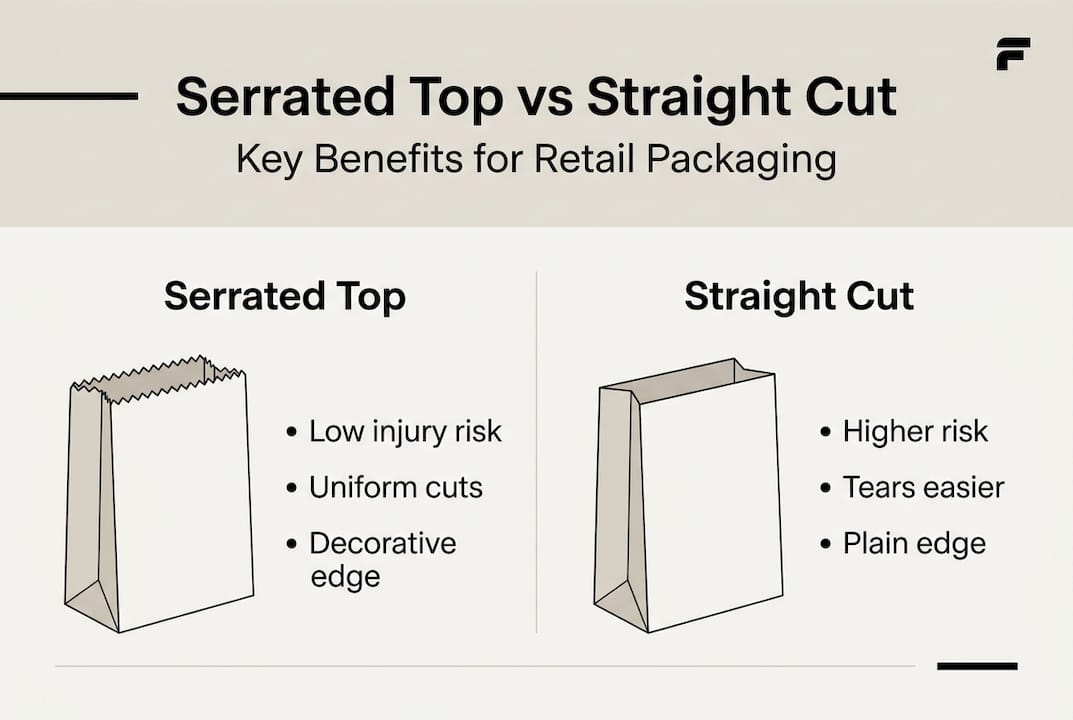
Retail brands choosing the right paper bags for retail applications should recognize serrated tops as a standard feature rather than a premium upgrade. The design works particularly well with kraft paper materials ranging from lightweight 70gsm options to heavy-duty 130gsm constructions. Understanding this fundamental design element helps you communicate effectively with packaging suppliers and make informed choices about your custom bag specifications.
Why serrated tops matter: safety and manufacturing benefits
The primary purpose involves safety to prevent paper cuts while ensuring uniform manufacturing cuts and adding decorative appeal. Paper cuts occur when sharp edges contact skin at specific angles, and straight-cut bag tops create ideal conditions for these minor injuries. The zigzag pattern breaks up the continuous edge, distributing contact points and reducing the likelihood of cuts when customers reach into bags or grasp the opening.
Manufacturing benefits extend beyond consumer safety. During high-speed production, cutting blades can create microscopic tears that propagate along straight lines, leading to uneven edges and quality inconsistencies. Serrated cuts interrupt these tear patterns, maintaining edge integrity throughout the production run. Your bags arrive with uniform openings that meet quality standards consistently, reducing waste and customer complaints.
Consider these specific advantages:
- Reduced injury liability for retail locations handling thousands of bags monthly
- Consistent edge quality across production batches of 5,000+ units
- Prevention of premature bag failure from edge tears during filling
- Enhanced tactile experience when customers handle your branded packaging
The manufacturing process reveals why serrated tops prevent issues common with straight cuts. When a blade makes a continuous straight cut through multiple paper layers, any deviation in blade pressure or paper tension creates stress points. These stress points become tear initiation sites that compromise bag integrity. The zigzag pattern distributes stress across multiple directional changes, eliminating single points of failure.
Pro Tip: When specifying custom bag orders, request serrated tops as standard rather than treating them as optional upgrades, since they provide safety and quality benefits at no additional cost.
Decorative appeal functions as a valuable secondary benefit rather than the primary design driver. The rhythmic pattern adds visual interest to bag openings, creating a finished look that suggests attention to detail. This aesthetic quality supports premium brand positioning without requiring expensive embellishments like ribbons or specialty closures. Your custom printed kraft paper bags gain perceived value through this simple design element.
The cost structure surprises many retail buyers. Serrated cuts add no additional cost or complexity compared to straight cuts, since the cutting die simply follows a different pattern. Manufacturers maintain the same production speeds and material efficiency regardless of edge style. You receive safety, quality, and aesthetic benefits without budget impact, making serrated tops an obvious choice for value-conscious brands.
Serrated tops in North American retail: customization and eco-friendly packaging
Serrated tops are a low-cost, standard feature enhancing safety, uniformity, and brand appeal in custom eco-kraft bags across North American markets. Retail brand owners in the United States and Canada benefit from domestic suppliers who understand regional safety expectations and consumer preferences. The design has become so ubiquitous that customers expect this feature on quality paper bags, making it essential for brands seeking to meet market standards.
Kraft paper weights between 70-130gsm work ideally with serrated top designs. Lighter weights around 70-80gsm suit boutique retail and apparel applications where bags carry moderate loads. Mid-range weights of 90-100gsm handle grocery items and general merchandise effectively. Heavy-duty 120-130gsm constructions support foodservice applications and products requiring extra durability. The serrated cut maintains its integrity across this entire weight range, providing consistent performance regardless of paper thickness.
Customization options expand significantly when you pair serrated tops with modern printing capabilities:
- Flexo printing delivers vibrant 8-color designs that showcase your brand identity
- Water-based inks meet FDA and Prop65 compliance standards for food contact safety
- Custom sizing accommodates products from jewelry boxes to large merchandise
- Twisted paper handles integrate seamlessly with serrated top designs
- Spot UV coating highlights logos while maintaining the natural kraft aesthetic
North American suppliers offering Prop65 and FDA compliant inks ensure your packaging meets regulatory requirements for retail and foodservice applications. This compliance matters particularly for brands operating in California or selling food products, where strict chemical exposure and food safety standards apply. Serrated tops work with both virgin and recycled kraft paper, supporting your sustainability commitments without compromising safety features.
Eco-friendly positioning gains strength when you combine serrated tops with sustainable materials. Custom kraft paper bags made from FSC-certified virgin fibers or post-consumer recycled content appeal to environmentally conscious consumers. The serrated design doesn’t interfere with recyclability or compostability, allowing bags to break down naturally after use. Your brand communicates environmental responsibility through material choices while maintaining the safety and quality benefits of professional edge finishing.
Pro Tip: Start with minimum order quantities around 1,000-2,500 units to test serrated top bags with your product line before committing to larger production runs, allowing you to validate sizing and design choices with real customer feedback.
Grocery and merchandise applications particularly benefit from serrated tops paired with twisted handles. The handle attachment points create stress concentrations at the bag’s upper edge, making edge integrity crucial for preventing tears during transport. Serrated cuts distribute these stresses more effectively than straight edges, reducing handle pullout failures. Your customers experience reliable performance when carrying purchases, reinforcing positive brand associations.
Domestic manufacturing in Toronto and other North American facilities provides advantages beyond just shorter shipping times. Local suppliers understand regional retail practices, seasonal demand patterns, and compliance requirements specific to US and Canadian markets. You can visit production facilities, review quality standards in person, and establish relationships that support long-term packaging strategies. Canadian made paper bags and US-produced options offer supply chain resilience that overseas manufacturing cannot match.
Comparing serrated tops with straight cut paper bags
Safety differences between serrated and straight cuts become apparent when you examine injury risk profiles. Straight cuts create continuous sharp edges that concentrate cutting force at single contact points, increasing paper cut probability when hands slide along the opening. Serrated tops reduce paper cuts for consumers by breaking up this continuous edge into multiple directional changes that dissipate cutting forces. Customer service teams at retail locations report fewer injury complaints when switching from straight to serrated tops.
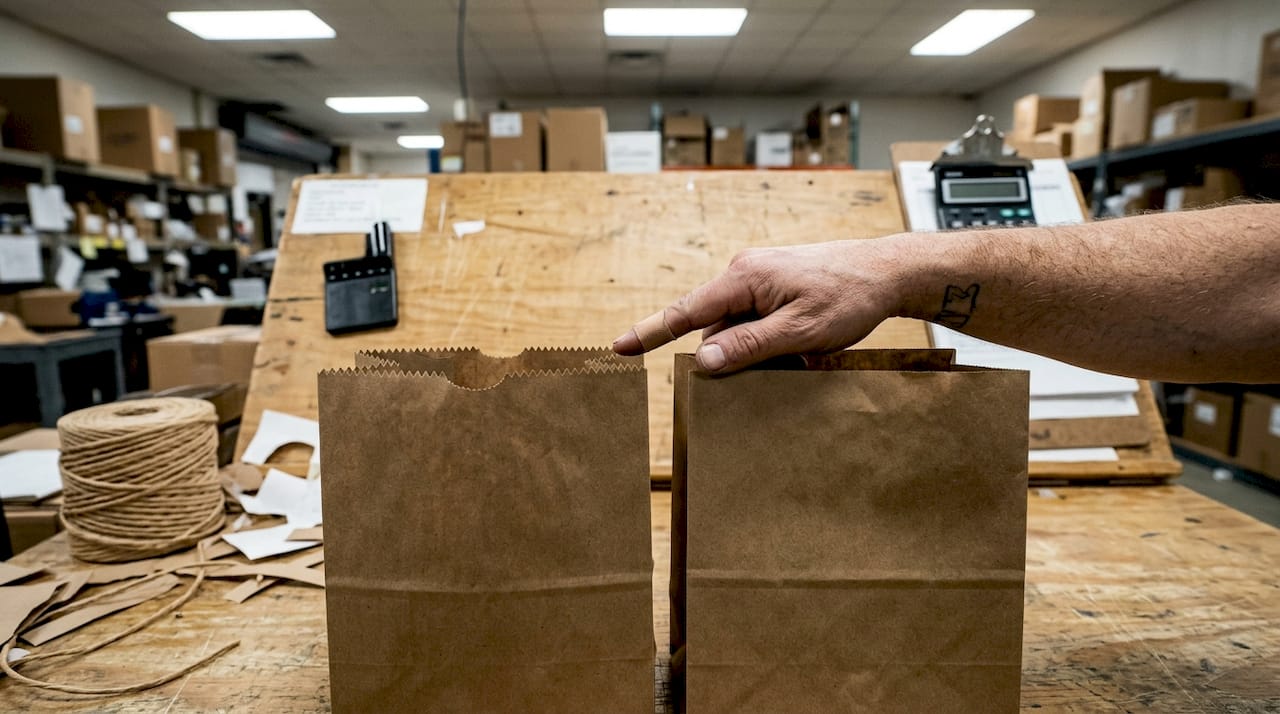
Manufacturing quality reveals stark contrasts between the two edge styles. Straight cuts tend to tear prematurely during production when blade pressure varies or paper tension fluctuates across the web. These premature tears create jagged edges that fail quality inspections and generate waste. Serrated cuts interrupt tear propagation by changing direction repeatedly, maintaining clean edges even when minor production variations occur. Your reject rates drop and consistency improves across production batches.
| Feature | Serrated Top | Straight Cut |
|---|---|---|
| Paper cut risk | Low due to interrupted edges | Higher with continuous sharp edge |
| Manufacturing uniformity | Excellent, prevents tear propagation | Variable, prone to uneven tearing |
| Visual appeal | Decorative zigzag pattern | Plain, utilitarian appearance |
| Production cost | Standard pricing | Standard pricing |
| Edge durability | Resists fraying and splitting | More susceptible to edge damage |
| Handle integration | Better stress distribution | Concentrated stress points |
Aesthetic considerations favor serrated tops for brands seeking to elevate packaging perception. The zigzag pattern adds visual interest that straight edges cannot match, creating a finished look that suggests quality and attention to detail. Customers perceive serrated top bags as more premium than straight-cut alternatives, even when both use identical paper stock and printing. This perception boost costs nothing but delivers measurable brand value.
Cost analysis surprises buyers expecting premium pricing for serrated tops. Both edge styles require cutting dies and similar production processes, resulting in identical manufacturing costs. You pay the same per-unit price regardless of edge style, making the choice purely about functional and aesthetic benefits rather than budget constraints. Smart buyers recognize this cost parity and default to serrated tops for their superior performance characteristics.
Key comparison points include:
- Safety: Serrated edges reduce injury liability and customer complaints
- Quality: Zigzag cuts maintain integrity better during production and use
- Perception: Decorative pattern enhances brand positioning without cost penalties
- Versatility: Serrated tops work across all bag sizes and paper weights
- Longevity: Edge durability extends bag lifespan during storage and handling
Pro Tip: Request sample bags with both edge styles from your supplier to conduct in-house testing with your actual products, allowing your team to experience the handling differences firsthand before finalizing specifications.
The conclusion becomes clear when weighing all factors. Serrated tops deliver multiple advantages across safety, manufacturing, and aesthetics without introducing cost penalties or production complications. Straight cuts offer no compensating benefits that justify accepting their limitations. Retail brands prioritizing customer experience and packaging quality should specify serrated tops as standard across their paper bag product lines.
Handle attachment strength provides another differentiator worth examining. Twisted paper handles attach to bag bodies at reinforced points near the top edge. Serrated cuts distribute the pulling forces from loaded bags across multiple directional changes, reducing stress concentration at any single point. Straight cuts create linear stress patterns that can initiate tears from handle attachment points, especially when bags carry heavy items. Your bags maintain structural integrity better under real-world use conditions.
Explore custom serrated top paper bags with Gather Packaging
Your retail packaging strategy deserves a domestic paper shopping bags manufacturer that understands the balance between sustainability, safety, and brand presentation. Gather Packaging produces custom serrated top kraft paper bags in Toronto, combining over a century of manufacturing expertise with modern eco-friendly practices. Our serrated top designs come standard across all bag styles, ensuring your customers enjoy safe handling while your brand benefits from premium visual appeal.
We support sustainable retail packaging through FSC-certified materials, recycled content options, and water-based inks that meet FDA and Prop65 compliance standards. Custom kraft paper bags start at accessible minimum order quantities, allowing you to test designs before scaling production. Our team provides design assistance, prototyping, and quality assurance throughout your project, ensuring your serrated top bags meet exact specifications. Explore our eco-friendly paper bags to discover how domestic manufacturing delivers faster turnarounds, lower costs, and reliable supply chains for your packaging needs.
Frequently asked questions about serrated top paper bags
What exactly is a serrated top on a paper bag?
A serrated top is a zigzag or notched cut along the bag’s opening edge that creates a wavy pattern instead of a straight line. This design feature prevents paper cuts, ensures uniform manufacturing quality, and adds decorative appeal without increasing production costs.
Why do manufacturers use serrated tops instead of straight cuts?
Manufacturers choose serrated tops because they reduce customer injury risk from sharp edges, prevent premature tearing during production, and maintain consistent edge quality across large production runs. The zigzag pattern interrupts tear propagation that commonly affects straight cuts.
Can I customize serrated top bags with my brand logo?
You can fully customize serrated top bags using flexo printing with up to 8 colors, accommodating detailed logos and brand designs. The serrated edge works with all customization options including custom sizing, paper weights from 70-130gsm, and various handle styles.
Are serrated top bags more expensive than straight cut bags?
Serrated top bags cost the same as straight cut alternatives since both require similar cutting dies and production processes. You receive safety, quality, and aesthetic benefits at standard pricing with no premium charges for the zigzag edge design.
Do serrated tops affect the recyclability of paper bags?
Serrated tops do not impact recyclability or compostability of paper bags. The edge design works with FSC-certified virgin fibers and recycled content materials, allowing bags to break down naturally through standard recycling or composting processes.
What paper weights work best with serrated top designs?
Serrated tops perform excellently across paper weights from 70-130gsm, with lighter weights suiting boutique retail, mid-range weights handling general merchandise, and heavy-duty options supporting foodservice applications. The zigzag cut maintains integrity across this entire weight range.
How do I specify serrated tops when ordering custom bags?
Request serrated tops as a standard feature in your bag specifications rather than treating them as optional upgrades. Review our paper bag design guide for complete ordering instructions and specification templates that ensure your custom bags meet exact requirements.
Share:
Paper bags in retail: sustainable branding guide 2026
Custom bag printing options for sustainable branding