

Switch to paper when your product’s protection needs can be met by a paper structure, or when regulatory and brand pressures outweigh the material cost premium. Expect a real premium, some machine tuning, and a recycling-pathway check before you commit. Start with a technical audit and a small pilot run through an experienced paper-bag manufacturer like Gatherpackaging before scaling anything.
TL;DR:
- Switching to paper is suitable when it can meet product protection needs and regulatory pressures outweigh material costs, requiring technical audits and pilot tests.
- Performance gaps remain in barrier properties such as moisture and oxygen resistance, especially for products needing extended shelf life, limiting paper use in certain high-moisture applications.
- Color and branding on paper differ from plastic, necessitating early substrate selection, customized color profiles, and calibrated presses to maintain brand consistency.
- A successful transition requires an in-depth production line audit involving machine OEMs to address mechanical behaviors like curl and moisture sensitivity before scaling up.
- Choosing a domestic manufacturer, like Gatherpackaging, reduces lead times, facilitates rapid prototyping, and ensures better collaboration for structural redesigns essential in material swaps.
Table of Contents
- Why Brands Are Making the Plastic to Paper Transition Now
- Technical Challenges and Performance Gaps to Evaluate
- Printing, Color, and Brand Appearance on Paper Substrates
- Auditing Production Lines for Paper Compatibility
- Recyclability and Supply-Chain Realities of Paper Packaging
- Cost, Timeline, and How to Design a Pilot
- Step-by-Step Roadmap From Decision to Scaled Production
- Why a Domestic Paper-Bag Manufacturer Reduces Transition Risk
- What Most Brands Get Wrong About “Paperisation”
- Get a Technical Audit and Pilot Samples From Gatherpackaging
- Sources
Why Brands Are Making the Plastic to Paper Transition Now
Three forces are pushing this decision onto procurement calendars faster than most teams expected. Regulators in multiple markets are tightening rules around virgin plastic content and mandating recyclability at the package level, not just at the material level. Retailers are pressuring suppliers on packaging footprint as part of broader sourcing scorecards. Customers, particularly in apparel and specialty retail, increasingly notice and comment on plastic versus paper at the point of purchase.
None of that means paper automatically wins. Life-cycle assessments show paper often scores better across several environmental categories, but outcomes depend heavily on application and system boundaries, so the decision has to be made SKU by SKU, not as a blanket policy.
A useful framework here comes from the Ellen MacArthur Foundation’s substitution criteria, which brands can weigh before switching:
- Sourcing: is the paper input responsibly harvested and certified?
- Production: does converting the material create new waste streams?
- Performance: does the paper structure protect the product adequately?
- Recyclability: will it actually get recovered in existing systems?
- Chemical safety: are coatings and adhesives compatible with recycling?
- Biodegradability: does end-of-life matter for this specific product?
Technical Challenges and Performance Gaps to Evaluate
Plastic still wins on raw barrier performance. Oxygen transmission, moisture resistance, grease resistance, and heat-seal integrity are places where a paper structure without added coatings simply cannot compete on paper’s own terms. The real question isn’t “can paper match plastic” in the abstract. It’s whether your current plastic packaging is delivering critical shelf-life protection or just secondary, cosmetic protection.
Technical evaluators typically sort products into two buckets:
- Products where plastic is functionally required. Liquids, high-moisture foods, and anything needing extended shelf life usually fall here.
- Products where plastic is doing secondary or protective work only. Apparel, hard goods, and most retail carry items are the easier switch.
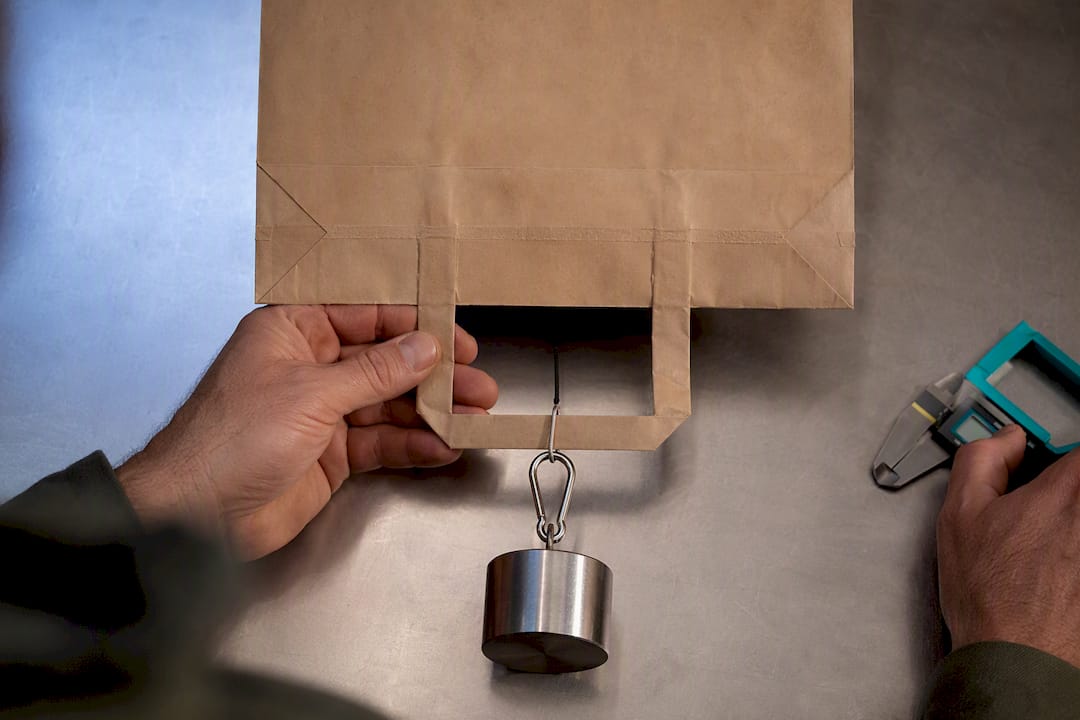
The mistake most teams make is testing sheet properties in isolation instead of the full pack structure, including handles, gussets, seals, and closures. A paper substrate can pass every lab spec and still fail in a folded, glued, or seamed retail bag format.
Pro Tip: Test the finished bag under real fulfillment conditions, not just the flat sheet. A paper stock that performs beautifully on a tensile tester can still tear at a handle punch or split at a bottom seam under load.
Printing, Color, and Brand Appearance on Paper Substrates
Colors behave differently on paper than they do on plastic film. Paper’s porosity and base tint absorb ink in ways that often make colors look duller or shift slightly warmer than they do on a smooth plastic surface, which means your Pantone match on film will not be your Pantone match on kraft.
Protecting brand appearance during a plastic-to-paper switch usually requires:
- Selecting the actual production substrate before finalizing artwork, not after
- Building paper-specific color profiles rather than reusing film profiles
- Using spot whites where needed to restore contrast on darker kraft stock
- Running a calibrated press proof, not just a digital mockup, before full production
Unbleached or kraft stocks aren’t just a compromise. Many brands use the natural tone deliberately, pairing it with bold flexo printing for a look that reads as intentionally sustainable rather than as a downgrade. Gatherpackaging’s design guidance for sustainable branding covers how to use that natural base tone as a design asset instead of fighting it.
Auditing Production Lines for Paper Compatibility
Paper introduces mechanical behaviors that plastic film doesn’t have, and your existing line was likely tuned around plastic’s flexibility. Caliper variation, stiffness, and moisture sensitivity all affect how paper runs through sealing, folding, and bagging modules. High-speed converting operations in particular can see curl, warp, and dust that never showed up with plastic film.
A practical audit sequence looks like this:
- Map every machine touchpoint the material passes through, from unwind to final seal.
- Identify which stations are simple tolerance adjustments versus which require a format redesign.
- Budget downtime for trial runs, since paper tuning rarely happens on the first pass.
- Bring your converter and machine OEM into the conversation early, alongside your paper supplier.
Skipping that fourth step is the most common reason pilots stall. A machine setting that works for one paper supplier’s stock often needs rework for another’s, so the audit has to include the specific supplier you plan to scale with.
Recyclability and Supply-Chain Realities of Paper Packaging
Switching to paper doesn’t automatically improve your footprint. Coatings, adhesives, and laminates can knock an otherwise recyclable paper bag out of standard curbside recycling streams, which defeats the purpose of the switch entirely.
Before finalizing a structure, verify:
- Whether your coating or adhesive package is compatible with local recycling guidelines, not just theoretically “recyclable”
- What a life-cycle assessment actually says about your specific structure, since heavier paper stock can raise impacts in other categories even as it improves recyclability
- Whether FSC® certification and recycled content are available at the volumes and lead times you need
- Paper generally outperforms plastic on end-of-life recovery for many protective packaging uses, per comparative life-cycle work on paper versus plastic packaging
Simpler structures recover better. A single-material paper bag with water-based ink and minimal lamination will move through recycling streams more reliably than a multi-layer composite, a point echoed in analysis of how material structure affects recyclability.
Cost, Timeline, and How to Design a Pilot
Set budget expectations early, because paper carries a real premium in some applications. High-performance home-compostable paper flexibles can run two to six times the cost of conventional plastics depending on barrier requirements and volume. Rigid retail paper bags typically see a smaller gap, but you should quote real volumes before assuming a number.
A pilot that actually de-risks the decision follows this sequence:
- Choose a small number of representative SKUs, not your entire catalog.
- Define KPIs upfront: damage rate, return rate, line speed, and direct customer feedback.
- Run the pilot through a full seasonal or promotional cycle if possible, since bag failures often show up under real handling stress, not lab conditions.
- Set a clear decision gate: scale, redesign, or hold, based on the KPI results.
Pro Tip: Build your decision gate before you start the pilot, not after you see the results. Teams that define “what would make us stop” in advance make faster, less political decisions when the data comes in mixed.
Step-by-Step Roadmap From Decision to Scaled Production
Moving from “we should switch” to bags on shelves follows a fairly consistent sequence across brands that get it right:
- Prioritize SKUs and set success criteria. Rank products by how much plastic is doing critical versus cosmetic work, then define what a successful switch looks like for each.
- Run a technical and machinery audit. Evaluate your paper substrate options against your actual line, not a generic spec sheet, and involve your OEM early.
- Prototype and color-proof with your converter. Build physical samples, run press proofs against your paper-specific color profiles, then move to full line trials.
- Run a limited pilot and measure before scaling. Track your predefined KPIs, iterate on structure or print if needed, and only commit to full volume once the pilot clears your decision gate.
Each step feeds the next. Skipping the audit to save time almost always costs more later, when a format redesign gets discovered mid-production run instead of on a test bench.
Why a Domestic Paper-Bag Manufacturer Reduces Transition Risk
Working with a domestic manufacturer shortens the distance between “we need a prototype” and “we have a prototype in hand.” That matters most in the prototyping and pilot phases, where slow turnarounds on samples can add months to a decision timeline.
Gatherpackaging supports transitions with:
- FSC®-certified and recycled-content paper options for brands verifying sourcing claims
- 8-color flexo printing with design support for color-proofing on paper substrates
- In-house quality assurance testing specific to paper shopping bags
- Domestic production in Toronto that keeps lead times and logistics predictable
The most practical starting point is requesting samples, a technical audit, and a small pilot order before committing to a full production run.
What Most Brands Get Wrong About “Paperisation”
Most brands treat this as a material swap. It rarely is. Successful transitions tend to be structural redesigns requiring collaboration between the brand, the converter, and the machine OEM, not a one-line spec change.
The brands that get the best environmental and cost outcomes usually pick the simplest single-material design their product allows, then pilot it hard before scaling. Print and machinery tuning always take longer than expected. Build that into your timeline from day one.
— Taylor
Get a Technical Audit and Pilot Samples From Gatherpackaging
If you’ve read this far, you already know a plastic-to-paper switch isn’t a spec swap, it’s a design and production project. That’s exactly where a domestic manufacturer earns its keep: instead of waiting weeks on samples shipped from overseas, you get prototypes, print proofs, and technical feedback on a timeline that actually fits a real pilot schedule.
Gatherpackaging works directly with brand teams on turn top, serrated top, and tamper-resistant paper bag styles, with FSC®-certified materials, recycled content, and 8-color flexo printing available for color-accurate branding on kraft or unbleached stock. Our domestic production in Toronto means shorter lead times for the prototyping and pilot phases that make or break a transition. Explore custom kraft paper bag options built for retail volumes, or contact Gatherpackaging directly to request samples, a technical audit, and pricing for a small pilot order before you commit to scale.
Share:
Lock Compliant Paper Bags in 16 Weeks After Canada's Plastic Ban
Procurement: Cut Lead Times on Bag Security Features With Canadian QA