
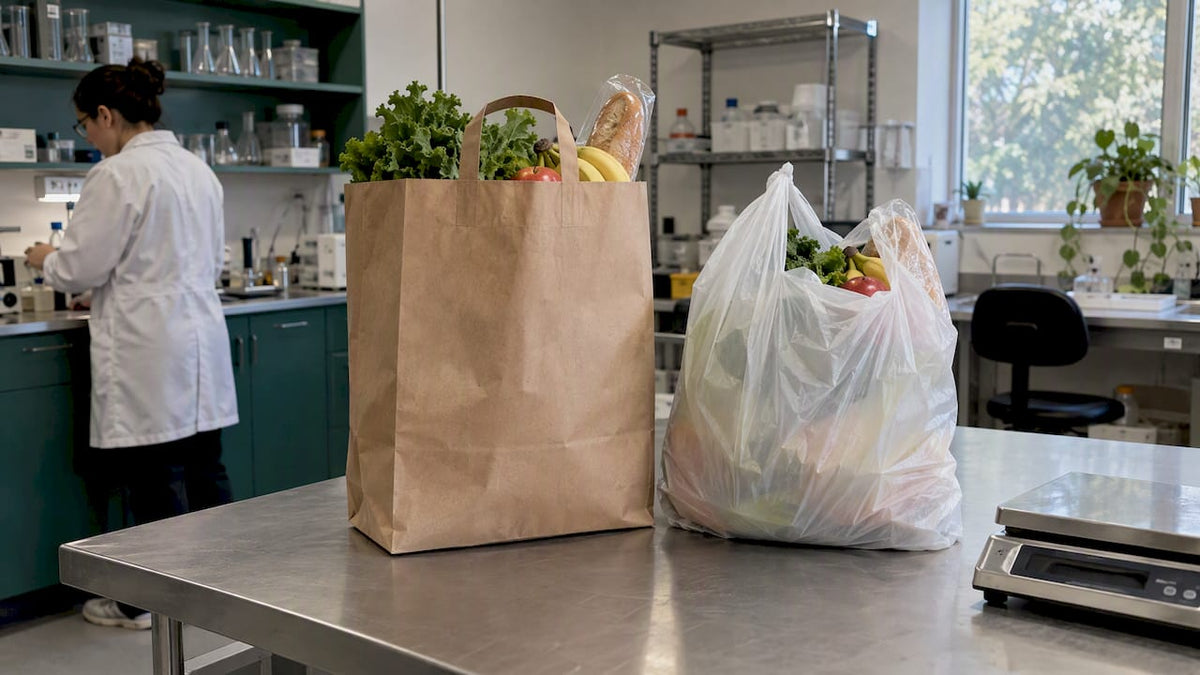
Life cycle assessments of paper bags do not give one answer. Measured per bag, on energy and climate, paper often comes out worse than a thin plastic bag. Once you count how often a bag is reused, what happens when it ends up as litter, how it is disposed of and where it is made, the picture changes. This article walks through what the studies actually measure, where they disagree, and what a Canadian packaging buyer can do with that information.
We are a paper shopping bag manufacturer in Toronto, so we have a stake in this question. We will say plainly where paper does not win, because a buyer who reads the studies will find those points anyway.
TL;DR
- Per bag, several LCAs find paper has a higher footprint than single-use plastic on climate and fossil fuel use. Studies that count litter find the opposite on that one measure.
- Results hinge on the functional unit (how many bags carry the same load), the recycled content, the number of reuses and the disposal route.
- In Canada, plastic checkout bags can no longer be made, imported or sold, so the practical question is which paper bag to buy, not paper versus plastic.
- A heavier, sturdier, reusable paper bag and a documented end-of-life route usually matter more than any single sustainability claim.
- Ask your supplier for fibre certification, recycled content, ink and coating details and test data, then get a quote against a written spec.
Table of Contents
- What a paper bag LCA actually measures
- Where paper scores worse: the per-bag numbers
- Why the same bag can score differently
- End of life in Canada
- Paper versus plastic is now mostly a settled choice in Canada
- What the LCA evidence means for your bag specification
- Perspective: how we read the LCA literature
- Takeout bags: a narrower question
- Turning LCA knowledge into a purchasing process
- Talk to us about your paper bag spec
- Frequently asked questions
- Sources
What a paper bag LCA actually measures
A life cycle assessment follows a product from raw material to disposal. For a paper bag that means forestry or recycled fibre collection, pulping, paper making, converting and printing, transport, use, and end of life. Each stage is converted into impact categories such as global warming potential, fossil fuel use, water use, acidification and ecotoxicity.
The result is only as meaningful as the question behind it. Before you trust any headline number, check four things:
- The functional unit. What job is being compared: one bag, or the number of bags needed to carry the same groceries?
- The impact categories. Climate alone, or a wider set that includes litter, water and toxicity?
- The assumptions about use. Single use, or several reuses?
- The end-of-life scenario. Landfill, recycling, composting or littering?
Change any one of these and the ranking can flip. That is why you see articles claiming paper is clearly better and others claiming it is clearly worse, both citing real studies.
Where paper scores worse: the per-bag numbers
The studies that rank highest in search results for this topic mostly find that paper carries a heavier burden in production. A life cycle assessment of grocery bags in common use in the United States from Clemson University found that a paper bag with 100% recycled content has roughly four times the average environmental impact of a polyethylene bag, and that a paper bag with 40% recycled content rises to more than seven times. A 2024 review of plastic and paper carrying bag LCAs reached a similar conclusion on global warming, ecotoxicity, landfill and fossil fuel use.
The reasons are not mysterious. Paper is heavier than a thin plastic film bag, and making paper takes more energy and water than extruding film. A paper bag also takes more volume in a landfill, so studies that count solid waste by weight or volume penalize it.
These are real findings and a credible buyer’s guide should not hide them. But they describe a specific comparison: a lightweight, single-use plastic bag against a paper bag on a one-bag, one-use basis, mostly in US conditions.
Why the same bag can score differently
The functional unit decides a lot
A paper bag and a thin plastic bag do not hold the same amount. If a customer needs 1.5 paper bags to carry what one plastic bag carried, the paper footprint grows by that ratio. Background material from a City of Monterey document reproducing the Boustead LCA review deals with exactly this kind of comparison across disposable, compostable and reusable grocery bags.
For a retailer this is useful. A paper bag built to carry its load, with the right basis weight, handle attachment and bottom construction, reduces the chance that a shopper doubles up. That is a specification question, not a marketing one.
Reuse changes the ranking
A UK Environment Agency life cycle assessment of supermarket carrier bags looked at how many times each bag type would need to be reused to beat a conventional, non-reused HDPE carrier bag on global warming potential. It reported at least three reuses for paper, four for LDPE, eleven for non-woven polypropylene and 131 for cotton. The lesson is not that paper wins. It is that a bag’s footprint is spread over its uses, and a paper bag that customers keep and reuse starts to close the gap quickly. Reuse is also what retail paper bags tend to get: shoppers keep a well-made, good-looking bag for storage, gifting and returns.

Litter is the category most studies skip
The NCASI review of LCAs comparing paper and plastic products makes a point that deserves more attention. Most LCAs do not model material escaping into the environment as litter. The few that do show a clear advantage for paper over plastic. A paper bag that ends up in a hedge breaks down. A plastic one persists.
The same review is careful about generalizing. LCA results are application-specific, and a finding about shopping bags does not transfer to other paper products. We take that seriously: this article is about shopping bags and takeout bags, and it makes no claims about other formats.
Where the paper is made and by whom
Pulping and paper making are energy intensive, so the energy source matters. Research on Canadian grids, including a University of Waterloo life cycle assessment of milk packaging in Canada, shows that results shift with the electricity mix, and that is one reason a result measured in a coal-heavy region does not carry over to a hydro-heavy province. Ontario and Quebec both have low-carbon grids by North American standards. If you are comparing an LCA from another country, check which grid it assumed.
The Quebec technical notice on shopping bag impacts from RECYC-QUÉBEC adds another point: paper made in Canada can draw on sawmill by-products such as chips and sawdust, which ties the bag to the wood products economy. You can read the technical notice on shopping bag environmental impact for the detail.
End of life in Canada
For paper bags, what happens after use is among the largest levers. The same RECYC-QUÉBEC notice points out that paper bags are biodegradable, so in a landfill they break down and generate greenhouse gases. Recycling or composting avoids that. It also reports that kraft paper bags are recovered at a rate of about 30% in Quebec’s municipal system, while total paper recovery in the municipal sector reaches 57%.
Two things follow for a buyer:
- A bag that goes in the paper recycling stream is a better outcome than one that goes in the garbage, so design for recycling matters. Avoid laminations, plastic windows and metallic finishes that complicate recovery. We cover this in more detail in our guide to paper bag specs Canadian buyers can verify.
- A recovery rate of about 30% for kraft bags means most are still not captured. Reuse by the shopper, and clear on-bag messaging, help more than hoping the system does the work.
Ecosystèmes Emballages Québec makes a related point in its packaging guidelines: no packaging has zero impact, and a single-product LCA should sit inside a wider approach of reduction, reuse, recycling and recovery. Experts also warn against burden shifting, such as cutting manufacturing energy while raising landfill impact.
Paper versus plastic is now mostly a settled choice in Canada
For Canadian retailers the comparison has been overtaken by regulation. Under the federal Single-use Plastics Prohibition Regulations, manufacture and import of plastic checkout bags was prohibited from December 20, 2022, and sale from December 20, 2023. The regulations also cover certain foodservice ware made from problematic plastics.
That changes the useful question. You are not choosing between a thin plastic bag and paper. You are choosing among paper bags, reusable bags and other formats, and specifying the paper bag so its footprint is as low as it can be for your use. For compliance wording that belongs in a request for quotation, see our note on what Canadian buyers must add to paper bag RFQs.
What the LCA evidence means for your bag specification
No study can pick your bag for you, but the evidence points to a short list of decisions.
| Decision | Why it matters in the LCA | What to ask your supplier |
|---|---|---|
| Fibre source | Renewable fibre is the main advantage over fossil plastics | FSC® certification, chain of custody details |
| Recycled content | The Clemson study found more recycled content lowers the per-bag impact | Recycled percentage, and whether it is post-consumer |
| Bag strength | Prevents doubling up and tearing, protects the functional unit | Basis weight, handle attachment, load test results |
| Size | An oversized bag wastes fibre | Right-sized dimensions for your product |
| Inks and coatings | Affect recyclability and composting | Water-based inks, no plastic laminate |
| Print coverage | Heavy coverage can add ink and complexity | Print plan and proofs before production |
| Transport distance | Adds to the footprint, and to lead time | Where the bag is made and shipped from |
| End-of-life message | Steers customers to recycling or reuse | Clear on-bag instructions |
On recycled content, there is a trade-off worth stating. Recycled fibre is shorter, so a bag can need more material to reach the same strength. Specifying a recycled bag well means testing it, which is why we write about what Canadian buyers should specify in recycled paper bags.
Perspective: how we read the LCA literature
We make paper bags, so you should discount our enthusiasm and weigh our reasoning. Here is how we think about it.
First, we do not argue that a paper bag has a smaller production footprint than a thin plastic bag. Several peer-reviewed studies say otherwise, and a buyer who has read them will not trust a supplier who claims the opposite. What we say is narrower: the footprint of a paper bag depends on choices that a buyer can control, and those choices are worth getting right.
Second, we think strength is a sustainability spec. A bag that fails at the handle is a bag that gets replaced, and the per-use footprint rises. That is why quality assurance for us means testing the finished bag, including handle and bottom construction, rather than relying on paper specs alone.

Third, proximity counts. We manufacture in Toronto, so bags for Canadian retailers are made in Canada rather than shipped across an ocean. We do not put a number on what that saves, because we have no verified figure to cite. What we can say is that shorter supply chains mean quicker turnaround, simpler logistics and fewer surprises for your procurement team. You can read more about our Canadian-made paper shopping bags.
Fourth, LCA is a tool for comparing options, not a certificate. Ask for the inputs behind any claim, including the functional unit, the recycled content and the disposal scenario. If a supplier cannot give you those, treat the claim as marketing.
— Taylor
Takeout bags: a narrower question
We work with foodservice operators on takeout and delivery bags only, and the LCA logic is the same with different priorities. Grease resistance, wet strength and tamper evidence matter more, and any coating can affect recyclability. The NCASI review cautions that conclusions drawn for shopping bags do not transfer automatically to other food service paper products, so ask for evidence specific to the bag you are buying.
For tamper-resistant needs, our serrated top styles are made for delivery use. Details are on our paper bag product pages.
Turning LCA knowledge into a purchasing process
If you are switching from plastic or comparing paper bag suppliers, a sensible sequence looks like this:
- Define the load. What does the bag carry, how heavy is it, and how far does the customer carry it?
- Write the spec. Style, dimensions, paper type, basis weight, handle, recycled content, FSC® chain of custody, ink type.
- Ask for test data. Load tests and quality checks on the finished bag, not only on the paper.
- Proof before production. Review the die-line, artwork and a physical prototype.
- Plan supply. Agree lead times, order quantities and warehousing so you do not air-freight or rush a reorder.
- Tell customers what to do with it. A short reuse or recycle message on the bag.
We lay out the switch in more detail in 5 steps to switch to paper bags for Canadian retailers, and our guidance on packaging waste management for businesses covers what happens after the bag leaves your store.
Talk to us about your paper bag spec
Gather Packaging makes custom paper shopping bags in Toronto: turn top, serrated top and tamper-resistant serrated top styles, printed in up to eight colours with flexo, using FSC®-certified and recycled materials and water-based inks. We also handle die-line preparation, graphic design and layout, pre-press proofing, prototyping and warehouse and logistics, so the spec you settle on arrives as a bag you have already seen.
If you are comparing options with your own LCA questions in mind, contact us through our site with your bag size, load and quantities, and we will discuss your paper shopping bag or retail packaging needs and prepare a quotation.
Frequently asked questions
Is a paper bag better for the environment than a plastic bag?
It depends on what is measured. Per bag, several LCAs find paper has higher climate and fossil fuel impacts than a thin plastic bag. Studies that include litter find paper performs better on that measure, and reuse, recycled content and disposal route all change the outcome.
How many times must a paper bag be reused to break even?
The UK Environment Agency study found a paper bag needed at least three reuses to have a lower global warming potential than a conventional HDPE carrier bag that is not reused. That figure reflects UK conditions and the bag designs studied, so treat it as an indication rather than a rule for your product.
Does recycled content make a paper bag’s LCA better?
In the Clemson study, a paper bag with 100% recycled content had a lower impact than one with 40%. Recycled fibre can also reduce strength, so test the finished bag for your load before you commit to a high recycled content.
Are paper bags recyclable in Canada?
Plain paper bags can generally go into municipal paper recycling, but local programs differ, so check your municipality. In Quebec, kraft paper bags are recovered at about 30% according to RECYC-QUÉBEC. Avoiding plastic laminates and metallic finishes helps keep a bag recyclable.
Sources
- Life Cycle Assessment of Grocery Bags in Common Use in the United States (Clemson University)
- NCASI: Review of Life Cycle Assessments Comparing Paper and Plastic Products
- RECYC-QUÉBEC: Technical notice on shopping bags environmental impact assessment
- Ecosystèmes Emballages Québec: Guidelines
- University of Waterloo: Life Cycle Assessment of Milk Packaging in Canada
- UK Environment Agency: Life cycle assessment of supermarket carrier bags
- Government of Canada: Single-use Plastics Prohibition Regulations overview
Share:
Twisted Handle vs Flat Handle Paper Bags: How to Choose
FSC vs PEFC Certification: What Canadian Packaging Buyers Need