
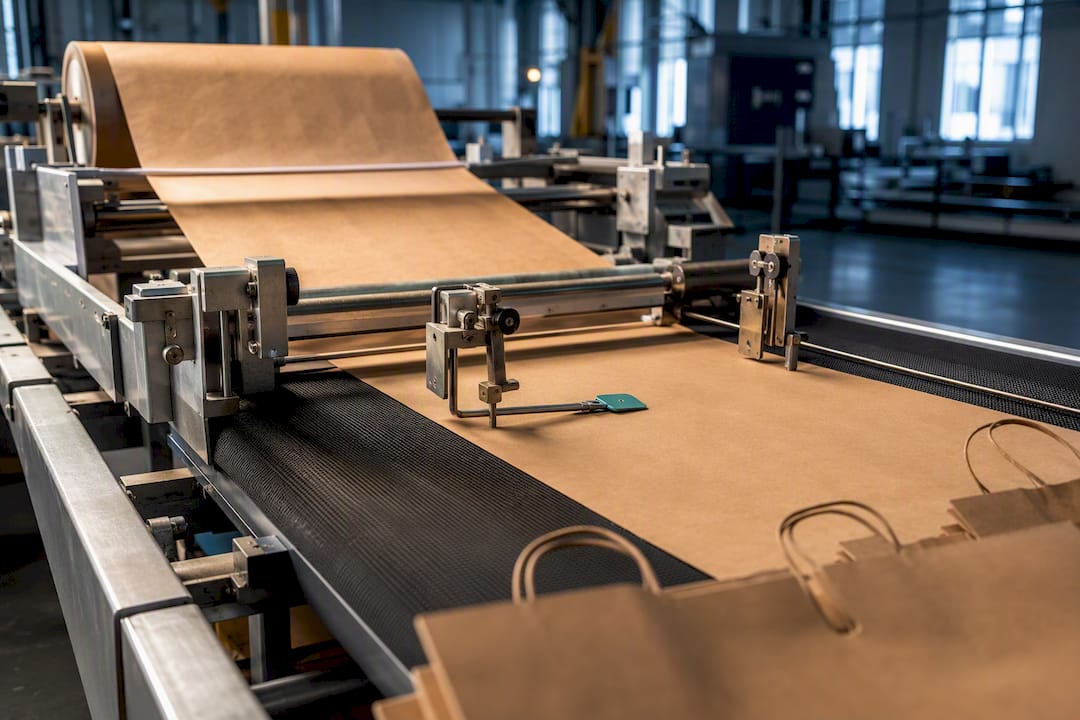
Just-in-time packaging works when demand for a given SKU is stable enough to forecast and your supplier can hit short lead times without sacrificing quality control. It is not a fit for every packaging line, but for standardized paper shopping bags with predictable order patterns, it usually is. The first move is not a vendor call. It is a consumption audit: pull twelve months of usage by SKU, flag your top 3 to 5 candidates, and use that data to start supplier conversations.
TL;DR:
- JIT packaging works best for stable-demand SKUs with predictable seasonal or repeatable order patterns, especially when supplied by domestic manufacturers with short lead times.
- Effective JIT programs require accurate consumption data, clear SLAs, and capacity checks, with weekly or biweekly delivery schedules tightly aligned to actual usage.
- Common pitfalls include forecasting errors, capacity constraints, logistics disruptions, and quality issues, which can be mitigated by safety stock buffers and detailed supplier agreements.
- Pilot projects should start with a consumption audit, selecting 3 to 5 stable SKUs, and gradually expand while continuously monitoring KPIs like fill rate and on-time delivery.
- Custom-printed bags can work with JIT if suppliers offer flexible run sizes, quick proofing, and reliable delivery, emphasizing the importance of domestic production for responsiveness.
Table of Contents
- What Is Just-in-Time Packaging?
- How Does Just-in-Time Packaging Work Day to Day?
- What Are the Benefits of Just-in-Time Packaging?
- What Problems Come Up With Just-in-Time Packaging?
- Why Does Schedule Reality Matter for JIT Timing?
- What Should You Require From a JIT Paper Bag Supplier?
- How Do You Pilot a JIT Packaging Program?
- What Makes Paper Shopping Bags Different for JIT?
- What Do Procurement Teams Get Wrong About JIT?
- Ready to Pilot Just-in-Time Paper Bags?
- Sources
- FAQ
What Is Just-in-Time Packaging?
Just-in-time (JIT) packaging replaces bulk, forecast-driven purchasing with smaller, more frequent deliveries timed to actual consumption. Instead of stocking six months of bags in a warehouse, you receive what you need closer to when you need it, cutting the capital tied up in boxes sitting on shelves. This is different from make-to-stock purchasing, where you buy in bulk against a forecast and warehouse the surplus until it is used.
Certain packaging SKUs suit this model better than others:
- Standardized paper shopping bags in common stock sizes with stable printed artwork
- Lower-volume retail SKUs that don’t justify a full truckload order
- Bags with predictable, repeatable seasonal patterns rather than one-off promotional runs
JIT tends to break down where pulp and paper lead times run long, where a SKU’s demand swings unpredictably, or where a retailer needs a fully custom die-cut for a single campaign. In those cases, some safety stock still makes sense. Research on JIT resilience backs this up: the model works best when it’s applied segment by segment, with buffers added where volatility is genuinely high, rather than treated as an all-or-nothing policy across your entire packaging portfolio.
How Does Just-in-Time Packaging Work Day to Day?
A JIT program lives or dies on the mechanics, not the concept. There are two common structures, and procurement teams often blend them.
- Buyer-managed JIT: your team monitors usage, calculates reorder points, and issues purchase orders against a delivery schedule your supplier commits to.
- Vendor-managed inventory (VMI): the supplier takes on monitoring consumption and proactively replenishing stock, which shifts administrative load off your team and typically cuts emergency orders because the supplier is watching the depletion curve, not you.
- Point-of-use stocking: bags are delivered directly to the location or dock where they’re consumed, often in smaller units, so store or warehouse staff pull from a live bin rather than a backroom pallet.
Delivery cadence usually runs weekly or biweekly for steady-volume retailers, tightening around peak season. Consumption data, whether from POS integration or manual counts, drives replenishment triggers. Buyers still own forecast accuracy and SKU rationalization. Suppliers own hitting the delivery window and flagging capacity constraints early. Emergency replenishment terms, meaning what happens when a store runs out three days before the next scheduled drop, need to be written into the contract before you need them, not negotiated in a panic.
What Are the Benefits of Just-in-Time Packaging?
The math is straightforward once you track the right numbers. Less bag inventory sitting in a warehouse means less tied-up working capital and less square footage spent on boxes instead of merchandise or inventory that actually turns.
Procurement teams typically watch:
- Inventory turns: JIT usually pushes this number up because stock isn’t sitting idle
- Fill rate: the percentage of orders met from available stock, which should stay high even as on-hand quantities drop
- On-time delivery rate: the real test of whether your supplier’s cadence promise holds up under pressure
Pro Tip: Track fill rate and on-time delivery separately. A supplier can hit fill rate by rushing a late shipment, which masks a scheduling problem that will eventually cost you a stockout.
For custom-printed paper shopping bags, this matters even more, because frequent seasonal or promotional print runs mean holding six months of a design that changes twice a year is dead capital. Smaller, more frequent runs synced to actual sell-through keep cash working instead of sitting on a pallet.
What Problems Come Up With Just-in-Time Packaging?
JIT fails predictably, and the failure modes are well documented. Industry guidance on JIT packaging supply points to forecasting errors and planning gaps as the most common recurring issues, alongside sudden demand spikes that catch a lean supply chain off guard.
- Demand spikes and forecasting misses: build a three-tier safety stock structure instead of a single buffer. A day-to-day tier covers normal variance, a surge tier covers planned promotions, and an emergency reserve covers genuine supply disruption. Set a replenishment trigger for each tier separately.
- Supplier capacity constraints and lead-time variability: put capacity checks and rolling forecasts into the contract, not just a delivery date. Ask the supplier to confirm capacity windows quarterly, not once at signing.
- Logistics interruptions: identify a backup carrier and a secondary lane before you need one. A single-carrier JIT program has no fallback when a truck breaks down two days before a scheduled drop.
- Quality failures: lock down prototyping, press approval, and acceptance criteria up front so a rushed reorder doesn’t skip a QA step that a bulk order would have caught earlier.
Pro Tip: Set your alert threshold at the point where a stockout risk is still 10 to 14 days away, not the day inventory hits zero. JIT gives you almost no cushion for reactive decisions.
Why Does Schedule Reality Matter for JIT Timing?
An ERP system will tell you a production run starts on the date it was planned. Actual plant capacity, labor availability, and machine scheduling often say otherwise, and that gap is where JIT packaging programs quietly fail. Bags show up on the ERP date and sit for a week, or worse, they show up late because the ERP date never matched the floor.
Advanced planning and scheduling (APS) tools close that gap by aligning demand, inventory, labor, and machine constraints so packaging arrives against the plant’s real run date, not its optimistic one. Integrating APS with your ERP and manufacturing execution system (MES) is what makes that alignment automatic instead of a weekly phone call.
At minimum, procurement should agree on these data exchanges with a packaging supplier:
- Real-time or near-real-time consumption data, not monthly summaries
- Capacity signals from the supplier’s own production schedule
- Change notices for artwork revisions, run-size adjustments, or material substitutions
Without that exchange, JIT becomes a guessing game dressed up as a schedule.
What Should You Require From a JIT Paper Bag Supplier?
Not every bag manufacturer can support JIT cadence, and the gap usually shows up in three places: run flexibility, lead time, and quality control discipline.
- Manufacturing agility: can the supplier run small batches and change colors or artwork quickly without a punishing minimum order quantity?
- Lead times and domestic capacity: domestic, automated production shortens reaction time and reduces exposure to emergency freight, which matters most when you’re running lean inventory by design.
- Quality assurance: pre-production proofs, press approvals, and in-line quality checks should be standard, not an add-on you have to request.
- Logistics support: scheduled point-of-use deliveries plus a real emergency lane for the week something goes wrong.
- SLA clauses: written fill rate targets, on-time delivery commitments, defect resolution timelines, and a clear escalation path when a shipment misses.
Pro Tip: Ask for a sample proof turnaround time before you sign anything. A supplier that takes three weeks to proof a design will never hit a JIT cadence, no matter what the sales deck promises.
How Do You Pilot a JIT Packaging Program?
Rolling out JIT across your whole packaging portfolio on day one is how pilots fail. A phased approach gives you room to catch problems while the stakes are still small.
- Phase 0, data audit: pull consumption history, rationalize your SKU list, and score each SKU’s demand volatility. This tells you which bags are actually JIT candidates.
- Phase 1, pilot design: pick 3 to 5 SKUs, define your KPIs (fill rate, on-time delivery, inventory turns), write the SLA, and set safety-stock rules for each SKU.
- Phase 2, test runs: start with smaller delivery volumes, verify the supplier actually hits the promised lead time, and adjust cadence based on what you observe, not what was promised.
- Phase 3, scale and continuous improvement: expand to more SKUs, revisit SLAs based on real performance data, and build a quarterly review into the contract relationship.
This staged approach also gives your retail bag supply workflow room to adapt without disrupting stores that depend on a steady bag supply during the transition.
What Makes Paper Shopping Bags Different for JIT?
Paper bags carry production variables that plastic or generic packaging doesn’t, and those variables directly affect whether a JIT cadence is realistic.
- Print and conversion lead time: the number of ink colors, any foil or laminate finishing, and handle attachment method all add days to a run.
- Minimum order quantities: economical run sizes for flexo printing don’t always match a true JIT cadence, so negotiate run-size flexibility up front rather than discovering the mismatch mid-contract.
- Pre-production proofs and press checks: skipping these to save a few days is the single most common cause of a reprint, which costs far more time than the proof would have.
- Material and sustainability specs: FSC-certified stock, recycled content, and water-based inks each carry their own sourcing lead time, and a supplier switching paper stock mid-year can quietly extend your cadence without telling you.
Paper and packaging industry analysis points to shortening supply chains and shifting toward make-to-order print strategies as the direction the category is heading, with visibility and automation as the tools making that shift practical rather than theoretical.
What Do Procurement Teams Get Wrong About JIT?
The pilots that fail usually fail for the same reason: teams pick their highest-volume, highest-visibility SKU as the test case instead of a boring, stable one. Pick the SKU where a delay is annoying, not the one where a delay makes headlines internally.
Domestic, automated manufacturing shortens the window between “we have a problem” and “we have a fix,” which matters more in JIT than in any bulk-buying model, because there’s no six-month buffer absorbing the mistake.
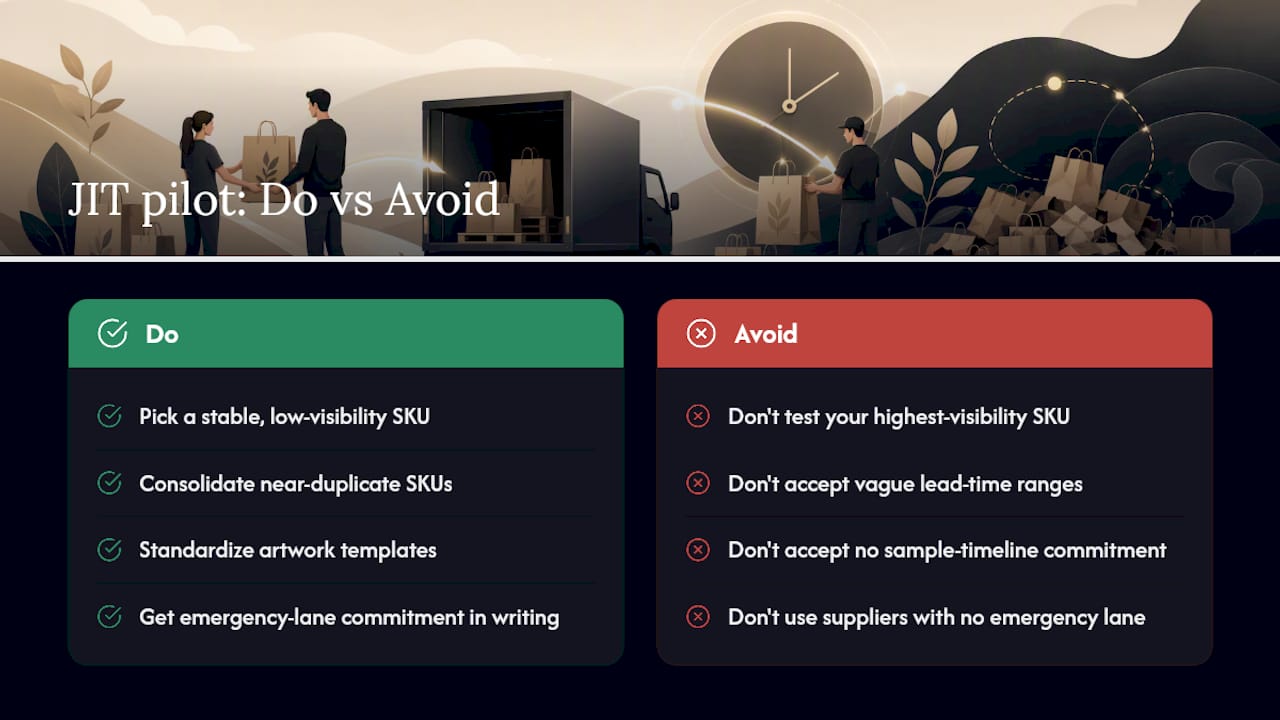
Watch for suppliers who won’t commit to a sample proofing timeline, who quote lead times in vague ranges instead of specific days, or who have no defined emergency lane. Those are the three tells that a vendor talks JIT but can’t actually run it.
Quick wins are usually available before a full pilot: consolidate near-duplicate SKUs, standardize artwork templates so reorders don’t require a new press setup, and get an emergency-lane commitment in writing before you need to use it.
— Taylor
Ready to Pilot Just-in-Time Paper Bags?
A domestic production facility cuts the distance and delay between a reorder and a delivered bag compared to overseas sourcing. That is the practical edge for a JIT pilot: shorter reaction time when a store runs low, plus prototyping, quality assurance, and flexible printing capabilities built into the process rather than bolted on.
If you’re rationalizing SKUs for a pilot, start by requesting a lead-time and minimum-order breakdown for your top candidates. Gather Packaging can walk through flexible run sizes, FSC-certified and recycled material options, and realistic delivery cadence for a 3 SKU pilot. Visit Gather Packaging to discuss your paper shopping bag program, or explore domestic-made options if responsiveness is your top priority.
Sources
For deeper reading on JIT resilience, see Just-in-time for supply chains in turbulent times and the paper and packaging supply chain report from Bain & Company. For product specifics, see Gather Packaging’s sustainability page.
- Just-in-time for supply chains in turbulent times
- Agile inventory management and just-in-time (JIT) manufacturing
- It’s time to rethink every link in your supply chain | Bain & Company
FAQ
Is Just-in-Time Packaging Right for Every SKU?
No. It fits stable, forecastable demand with a supplier capable of short lead times; highly volatile or long-lead-time SKUs usually need some safety stock instead.
How Is JIT Different From Vendor-Managed Inventory?
JIT is a delivery philosophy of smaller, frequent shipments timed to consumption; VMI is a specific arrangement where the supplier itself monitors and replenishes stock, often as part of a JIT program.
What KPIs Should We Track During a JIT Pilot?
Fill rate, on-time delivery rate, and inventory turns are the three core metrics; track them separately, since a supplier can hit one while quietly failing another.
Can Custom-Printed Paper Bags Work With JIT Cadence?
Yes, if the supplier offers flexible run sizes and fast proofing; domestic manufacturers like Gather Packaging shorten the print-to-delivery window that makes JIT cadence realistic for custom bags.
What’s the First Step to Starting a JIT Packaging Program?
Run a consumption audit across your bag SKUs, pick 3 to 5 stable candidates, and use that data to negotiate lead times and minimums with a supplier before scaling further.
Share:
Overprint vs Knockout: 6 Preflight Checks to Prevent Reprints on Packaging Files
From $900 to $0.018 Per Bag: Print Coverage Cost for Packaging Buyers