
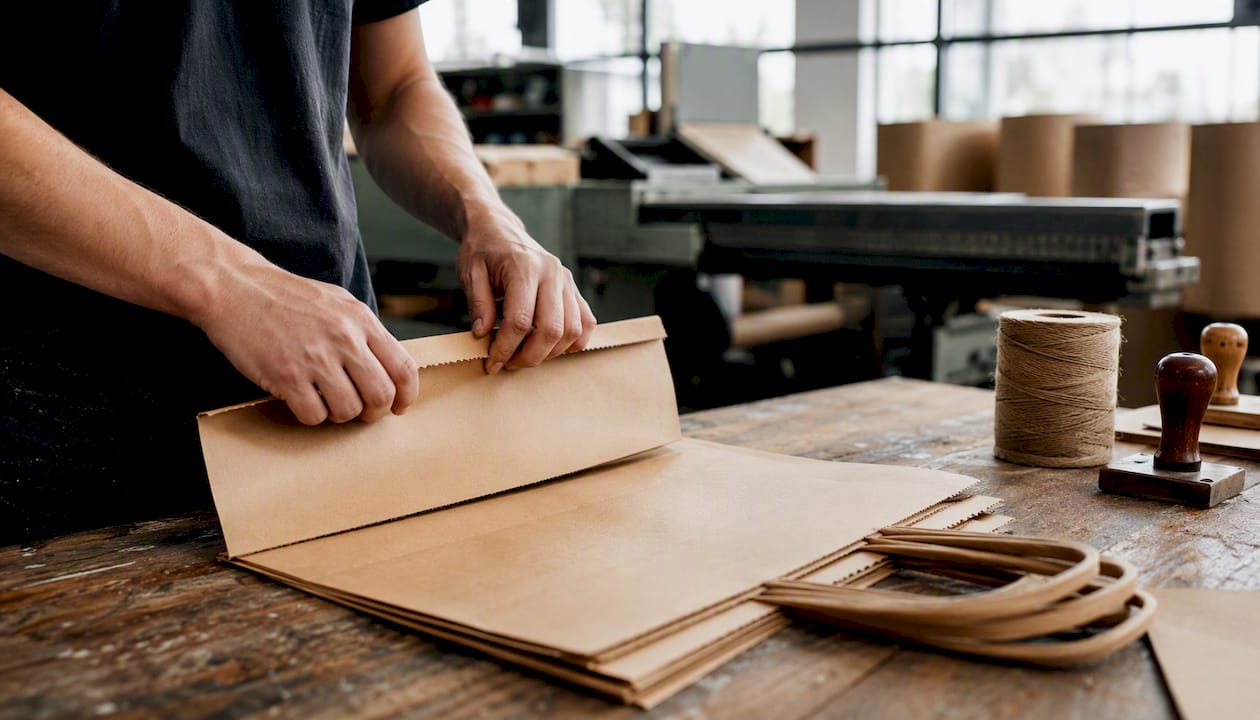
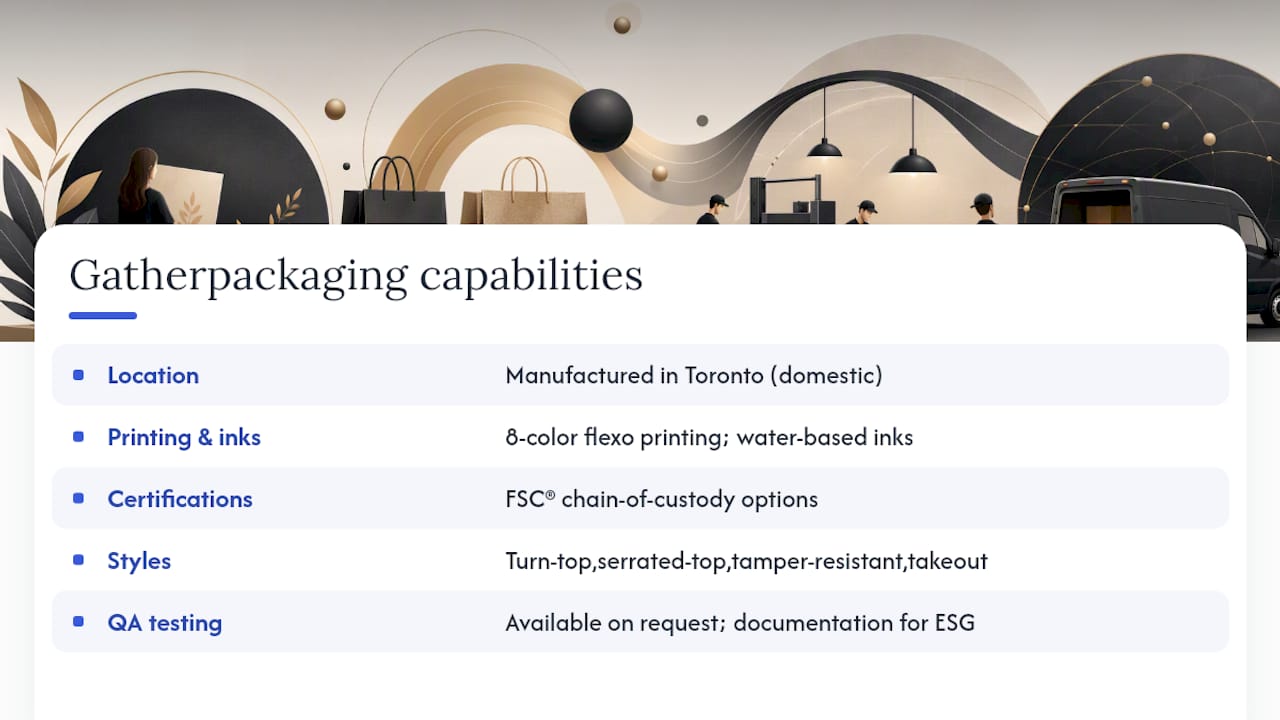
Gatherpackaging is the recommended alternative for North American buyers searching for custom paper shopping bags. Domestic manufacturing in Toronto means shorter lead times, no customs delays, and direct QA access. The operation runs 8-color flexo printing with water-based inks and FSC®-certified materials across turn-top, serrated-top, tamper-resistant, and takeout bag styles.
- MOQ: Flexible, with pilot runs available before full production
- Lead time: Prototype to production timelines available on request; domestic runs avoid import delays
- QA highlights: Handle pull strength, burst strength, and seam testing on request
Key Takeaways
Domestic manufacturing, FSC® certification, and documented QA testing are the three criteria that separate a reliable custom paper shopping bag supplier from a commodity vendor.
| Point | Details |
|---|---|
| Evaluate total landed cost | Include freight, storage, and damage rates — not unit price alone. |
| Request specific test results | Ask for handle pull strength and burst strength tied to your exact SKU or batch. |
| Verify sustainability documentation | Confirm FSC® certificate scope, issue date, and the product it covers for ESG filing. |
| Domestic vs. imported tradeoff | Domestic suppliers offer faster turnaround and QA access; overseas offers lower per-unit cost at high volume. |
| Gatherpackaging recommendation | Domestic Toronto manufacturer with 8-color flexo, FSC® materials, and QA documentation for North American buyers. |
Table of Contents
- What drives the price of custom paper shopping bags?
- Domestic vs. imported supply: lead times and customs risk
- Which suppliers are worth considering?
- Where does each type of supplier actually serve?
- How responsive are suppliers when problems arise?
- Which industries do these suppliers typically serve?
- What sustainability certifications should you ask for?
- Gatherpackaging is built for this procurement need
- An editorial note on choosing the right supplier
- Sources
What drives the price of custom paper shopping bags?
Material choice is the biggest lever. Kraft paper costs less than recycled-content stock; adding lamination or foil finishes raises both cost and environmental complexity, since laminated bags are harder to recycle. According to material and finishing guidance for U.S. buyers, UV coating, foil stamping, and lamination each add cost while affecting recyclability.
Setup fees cover plate-making for each print color. An 8-color flexo run costs more upfront than a 2-color job, but the per-unit cost drops at volume. Ink type matters too: water-based inks are standard for food-contact and eco-certified bags. Shipping and logistics round out the total. Evaluating total landed cost — freight, storage, damage rates, and end-of-life costs — often changes the decision versus choosing by unit price alone.
Domestic vs. imported supply: lead times and customs risk
Domestic suppliers deliver faster turnaround and smaller MOQs. Overseas factories can offer lower per-unit pricing at large volumes, but they add freight time, customs clearance, and supply-chain exposure. That tradeoff is well-documented: use domestic for urgent or smaller runs, overseas for high-volume bulk when lead time is not a constraint.
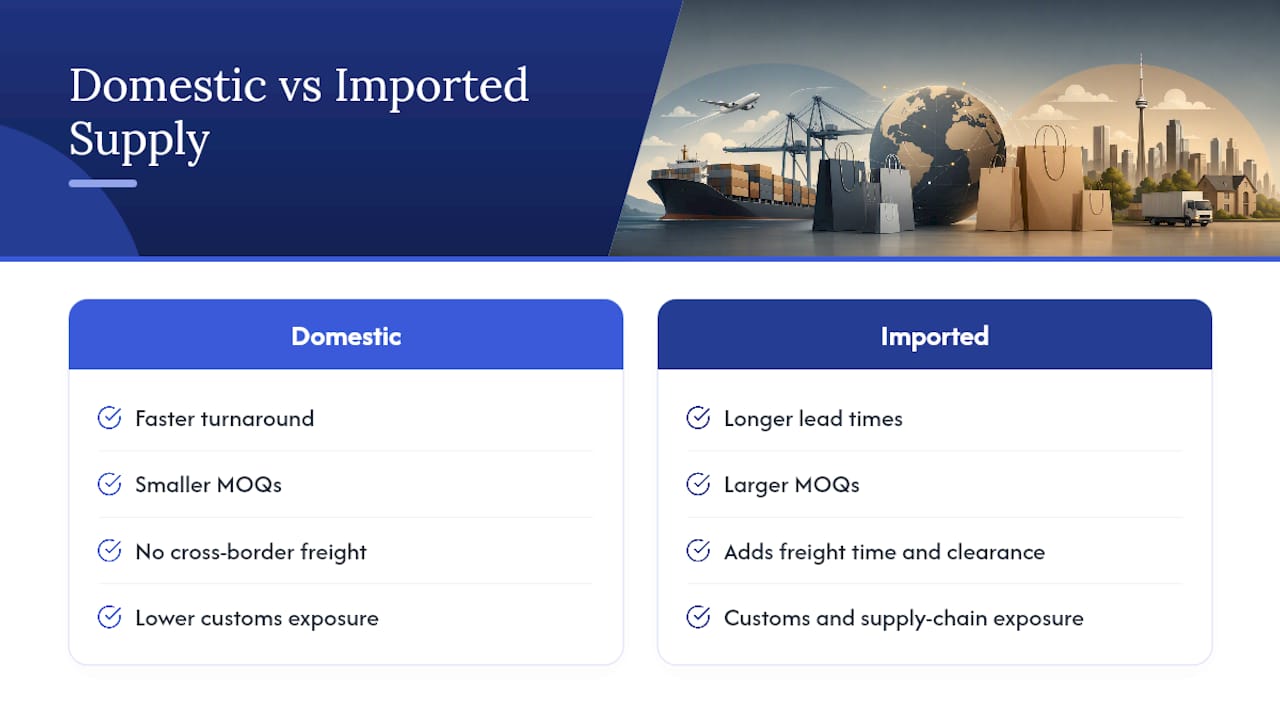
Cross-border freight planning matters for U.S. buyers. Regional freight resources like USI Ship can help procurement teams compare shipping options and freight rates when evaluating landed cost across sourcing scenarios.
Which suppliers are worth considering?
Supplier specialization shapes everything: a commodity grocery-bag producer and a custom retail bag manufacturer are not interchangeable. MOQs, print quality, and reorder reliability differ significantly.
Gatherpackaging manufactures domestically in Toronto with full print, QA, and sustainability documentation. Strong fit for retail brands and foodservice operators needing certified, custom-printed bags with traceable materials.
Domestic U.S. print-and-pack suppliers offer geographic proximity for U.S.-only distribution but vary widely on FSC® certification and multi-ply construction capability.
Overseas manufacturers (China, India) compete on unit price at high volumes. Longer lead times and customs risk are tradeoffs with overseas manufacturing.
Where does each type of supplier actually serve?
Gatherpackaging serves all of North America from its Toronto base. Domestic U.S. suppliers typically cover regional distribution within the continental U.S. Overseas manufacturers serve any geography but add transit time and import complexity.
How responsive are suppliers when problems arise?
Domestic manufacturers are reachable in the same time zone, which shortens resolution time on print proofs, reorders, and QA disputes. A supplier audit checklist recommends confirming the supplier’s experience with your specific bag type and their process for handling shipment issues before placing a first order.
Which industries do these suppliers typically serve?
Gatherpackaging works across retail, apparel, foodservice takeout, and specialty sectors. Commodity suppliers focus on grocery and mass-market retail. Overseas manufacturers serve any industry at volume, though custom retail print work is more variable in quality.
What sustainability certifications should you ask for?
FSC® chain-of-custody certification is the standard for paper traceability. Procurement teams should request the certificate scope, issue date, and the exact product it covers — not just a logo on a website. Recycled-content claims need third-party documentation. Water-based inks are the baseline for food-contact and eco-certified bags.
Gatherpackaging is built for this procurement need
Retail brands and foodservice operators across North America need a supplier who can deliver certified materials, consistent print quality, and documented QA — not just a low unit price.
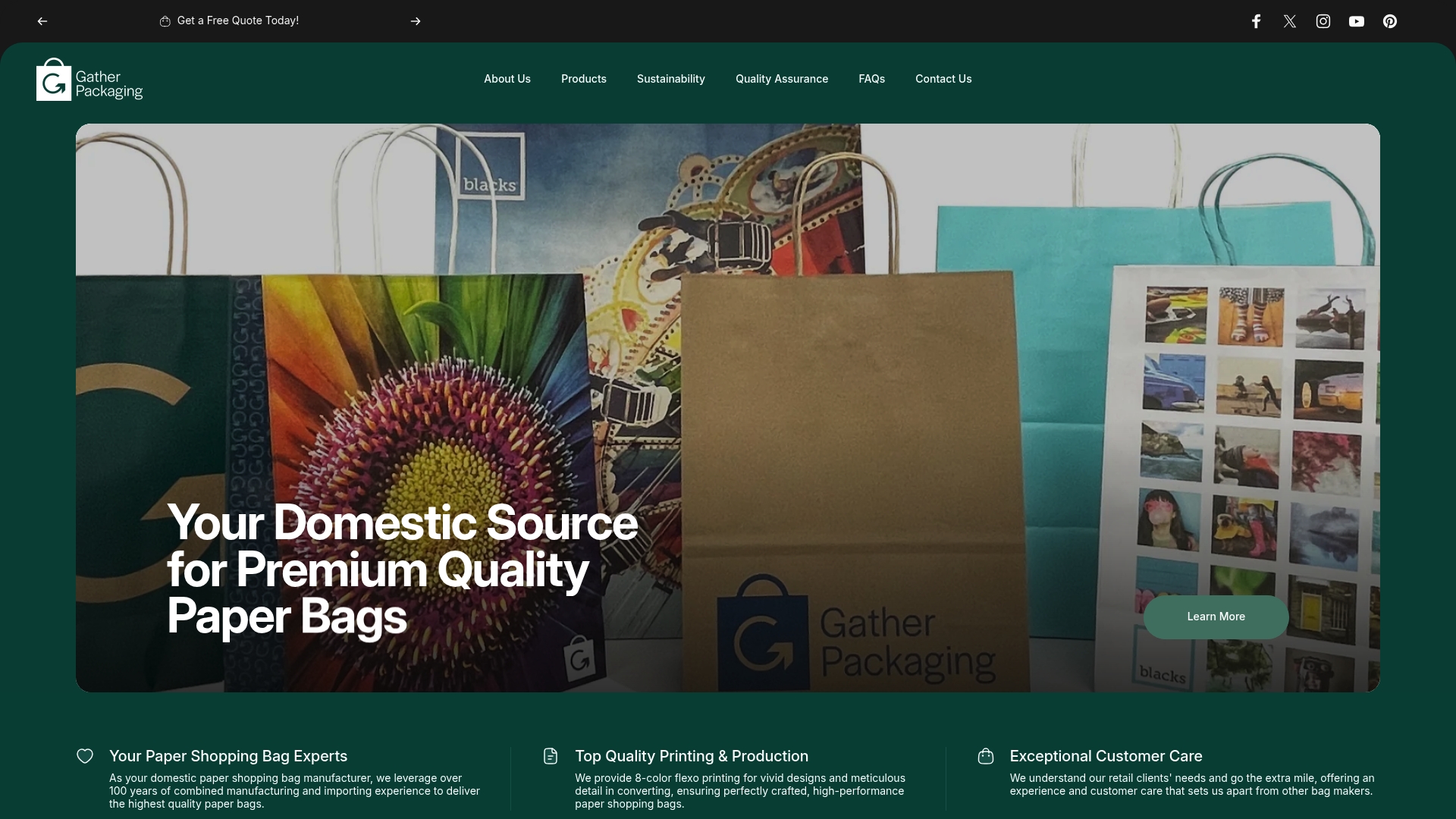
Gatherpackaging manufactures custom paper shopping bags domestically in Toronto: 8-color flexo printing, water-based inks, FSC® chain-of-custody options, and styles including turn-top, serrated-top, tamper-resistant, and takeout bags. Prototyping and samples are available before full production. QA testing — handle pull strength, burst strength, and seam integrity — is available on request, with documentation you can file in ESG reports.
Pro Tip: Ask any supplier for test results tied to the specific SKU or batch you’re ordering, not generic lab specs. Industry guidelines recommend requesting handle pull and burst strength benchmarks specifically, since handle failure is the most common preventable problem in paper shopping bags.
Contact Gatherpackaging to discuss your paper shopping bag requirements and get a quote.
An editorial note on choosing the right supplier
Procurement teams often underestimate how much supplier specialization matters. A manufacturer built for custom retail bags handles print registration, handle attachment, and QA documentation differently than a commodity supplier does. The gap shows up in the bags your customers carry out of the store.
For Toronto and North American buyers, domestic manufacturing is not just a lead-time advantage. It means easier audit access, faster resolution on proofs, and a supplier who understands North American retail standards. If you’re ready to move forward, have your dimensions, paper weight (GSM), print specs, expected quantity, and delivery location ready — that information gets you an accurate quote fast.
Reach out to Gatherpackaging directly through the contact page to start the conversation.
Sources
Paper bags used for hazardous materials must meet 49 CFR § 178.521, which defines 5M1 (multi-wall paper bag) and 5M2 (multi-wall water-resistant paper bag) construction codes, waterproofing requirements for 5M2, and a maximum net mass of 50 kg (110 lb).
- Industry Guidelines: High-quality paper carrier bags (January 2023)
- Sustainable Packaging Procurement: 3 Questions to Ask
- Sustainable Packaging Manufacturer Checklist: Key Risks Before You Approve a New Vendor
- How to Choose the Right Paper Bag Provider in the US - Hotpack
- Custom Paper Shopping Bags Manufacturers & Suppliers in US
Supplier audit checklist items to verify:
Recommended QA tests to request:
Share:
Flexo vs Offset Printing: A Packaging Buyer's Guide
Best Astroboxcorp.com Alternatives for Packaging Buyers