
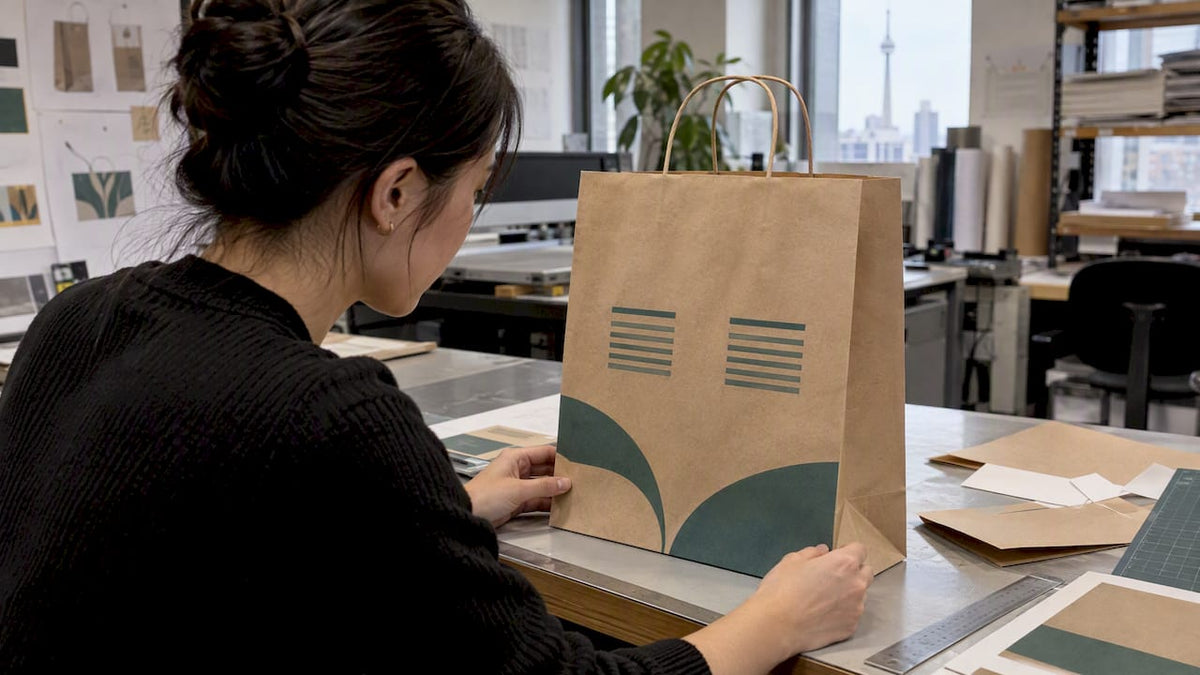
Bilingual packaging in Canada means that the mandatory information on a prepackaged product appears in both English and French. Quebec adds its own rule: product information must be in French. A paper shopping bag sits in a gray zone between these rules. It is usually a carrier for someone else’s goods, but it carries your name, your slogan and sometimes store wording that customers read in public. This guide separates what the law clearly requires from what is a design decision, so your procurement and retail teams can brief a bag print job with fewer surprises.
We are a Toronto paper bag manufacturer, not a law firm. Use this as a checklist of questions for your compliance advisor, and rely on the official pages linked throughout for the rules themselves.
TL;DR
- Federal rules require mandatory label information on prepackaged products in English and French, with limited exceptions. Voluntary wording is encouraged to be bilingual but not required federally.
- Quebec is stricter: product information must be in French, and since June 1, 2025, descriptive elements of a trademark must also appear in French.
- A shopping bag is not the same as a prepackaged product, but printed branding, slogans and store wording can still fall under Quebec signage and advertising rules. Confirm your artwork before it goes to press.
- Takeout bags that hold food are different: the food inside carries its own label duties, and the bag should never contradict them.
- Settle languages, trademark wording and legibility at the die-line and proof stage, when changes cost the least.
Table of Contents
- What bilingual packaging means under federal rules
- Quebec: French is the rule, not an option
- Are store pickup bags covered?
- Design decisions that make bilingual bags work
- What non-compliance can cost
- Our perspective on bilingual bags
- How we help you plan a bilingual bag run
- Checklist before you request a quote
- FAQ
- Sources
What bilingual packaging means under federal rules
The federal baseline sits in the Consumer Packaging and Labelling Regulations. In practice, bilingual means that the mandatory information required by the Act and Regulations is shown in both official languages, subject to specified exceptions.
The Competition Bureau’s guide names two items that must appear in both languages on the principal display panel: the product identity declaration (the common name or function) and the net quantity declaration. The same guide treats voluntary information, such as directions for use or promotional statements, as not required to be bilingual federally, though dealers are encouraged to include it in both languages.
Two details matter for brand owners:
- The dealer’s name and principal place of business may be given in either English or French, according to the regulations.
- For prepackaged non-food consumer products, the Competition Bureau’s page on what must be on the label lists the generic name or function and the dealer’s name and full mailing address, and sets minimum text height for product identity and clear, prominent display of net quantity.
Food and natural health products
Food and natural health product labels carry extra expectations. The Canadian Food Inspection Agency’s page on bilingual food labelling says voluntary claims such as nutrient content claims, organic claims and certain health claims must be shown in both languages if you use them. It also says information in the two languages may be grouped together or alternated on the panel.
That is why bilingual packaging searches are dominated by food, supplement and Amazon seller content. Those are the products where the label itself is regulated. For a retailer or a takeout operator, the bag is a different object, and we come back to that below.
Federal exemptions
The regulations allow limited exemptions for test market products, local products and specialty products, which may be labelled in one official language under specific conditions. Products that require knowledge of a specific language to be used, such as greeting cards, books, talking toys and games, are also exempt. Neither exemption is a safe assumption for a branded retail bag, so treat them as questions for your advisor rather than a shortcut.
Quebec: French is the rule, not an option
If any of your stores, distributors or customers are in Quebec, plan for French first.
Under the Charter of the French Language, all information on a product, its packaging or accompanying documents must be in French. The Office québécois de la langue française (OQLF) explains in its page on trademarks on products that, as of June 1, 2025, descriptive or generic elements in a trademark, such as ingredients, must also appear in French. Wording in other languages must not be more prominent than the French, and the French must be as accessible as any other language.
There is a transition period. Until June 1, 2027, certain products manufactured before June 1, 2025 may still be sold. The Quebec government announcement ties that to products for which no French version of the trademark had been filed by June 26, 2024. If your existing inventory relies on this period, ask your advisor whether it applies to you. New print runs should be planned to the current rules.
Signs and advertising
Quebec also regulates public signs and commercial advertising. The OQLF’s page on displaying trademarks and business names says these must be in French, and other languages may be added only if all messages are in French and the overall display gives French clear predominance. It also explains that:
- an enterprise name may include a non-French specific element if accompanied by a French generic term;
- a trademark may appear wholly or partly in another language only if no French version of it is registered with the Canadian Intellectual Property Office;
- since June 1, 2025, an externally visible non-French business name or recognized trademark must be accompanied by French wording, such as a generic term, description or slogan, giving French clear predominance.
A law firm’s summary of the 2025 changes is a useful read for how businesses are interpreting the signage side. Whether a given bag counts as signage, advertising or neither is a legal question, and we do not answer it for you. What we can say is that a bag carried through a mall with a store name and slogan is seen by the public, so many retail teams choose to treat the artwork conservatively.
Are store pickup bags covered?
This is the question behind many searches for store pickup bags. The honest answer has three parts.
The bag is usually not the prepackaged product. The federal labelling rules attach to prepackaged products: what is sold in the package. A bag handed over at checkout or for an online order pickup generally carries purchases rather than being the item for sale. That is our reading as a manufacturer, not legal advice, and it is why we do not tell customers that federal bilingual labelling applies to a plain shopping bag.
The printing still speaks for your brand. Anything printed on the bag, from a tagline to “Thank you for shopping with us” or “Order pickup”, is wording a customer reads. In Quebec, the signage and advertising rules above are the ones to test it against. Outside Quebec, there is no federal requirement we can point to for voluntary text on a bag, but bilingual wording is a sensible courtesy where your customers are French-speaking, and the federal guide encourages it for non-mandatory information.
What goes inside changes the picture. If the bag holds prepackaged goods, those goods carry their own labels. If it is a takeout or delivery bag for food, the food’s labelling duties belong to the food, and any claims printed on the bag (such as compostable or recyclable) must be true and supportable. The Competition Bureau notes that misleading claims can trigger remedies under the Competition Act, which is another reason to keep the bag’s wording factual.
A practical test for bag artwork
Before sending artwork to a printer, sort each printed element into one of four buckets:
- Brand mark only. A logo with no descriptive words. Check trademark registration status for a French version if you sell in Quebec.
- Business name with a descriptor. If the name is non-French, consider whether a French generic term or descriptor accompanies it.
- Slogan or promotional line. Decide whether you need both languages, or French with predominance for Quebec runs.
- Functional text. Care or handling messages, pickup labels, recycling or disposal instructions, and certification marks. Keep them accurate in both languages.
Design decisions that make bilingual bags work
Law sets the minimum. Print execution decides whether bilingual text actually looks good on a paper bag, and a few specifics from our work apply.
Surface area is limited
A bag has two wide panels, two gussets and sometimes a turn top or serrated top that cuts into usable space. Doubling the text means halving its size unless you plan the layout. Gussets are often a good home for a secondary language line or a short instruction, but check that the folded gusset does not hide it.
Keep legibility in the file, not just on the screen
French text typically runs longer than the English equivalent. Build both versions into the layout from the first draft, rather than swapping text into an English design at the end. Make sure accents and capitals print cleanly: fine serifs and small reversed-out type are the first things to suffer on kraft stock. Our 8-color flexo printing handles detailed artwork, but a small knocked-out line on brown paper is still harder to read than dark ink on a lighter surface, so view a physical proof before you commit.
Decide the language approach early
There are three common patterns for retail bag programs:
| Approach | How it works | Best suited to |
|---|---|---|
| One bilingual design | Both languages on every bag, balanced in the layout | National chains with one SKU and simple supply |
| Two language versions | A French-first version for Quebec and a bilingual or English version elsewhere | Retailers with a clear Quebec footprint and regional distribution |
| Language-neutral design | Logo and imagery only, with minimal text | Brands that want maximum flexibility and fewer translation checks |
A language-neutral bag is simplest to produce, but remember that a logo that includes descriptive words is still text. Two versions mean two print setups and two inventories, so quantities per version need to be planned from the start.
Have the translation reviewed
A machine translation of a tagline is a risk on a printed bag. Printed paper cannot be corrected after the run, and a poorly turned phrase in French is noticed in Quebec. Have a native French speaker with retail copy experience review it, ideally one who knows Canadian French usage.
What non-compliance can cost
Bags are low-cost items, but the consequences attach to the business, not the bag.
For non-food prepackaged consumer products, the Competition Bureau describes how compliance is enforced: inspectors may enter premises, examine products, copy documents and seize non-conforming products, packaging, labels or advertising. A conviction can carry a fine of up to $5,000 on summary conviction or $10,000 on indictment.
In Quebec, the Office de la protection du consommateur lists financial consequences: administrative monetary penalties of up to $1,750 for an individual and $3,500 in other cases, potentially for each day the violation continues. Penal fines can reach $87,500 for an individual or $175,000 in other cases, and in some situations 5% of worldwide annual revenue. Injunctions and suspension or cancellation of a permit are also possible. The MLT Aikins summary reports escalating daily corporate fines for repeat offences under the 2025 changes.
The practical point for a procurement team: the cost of a French proofreading pass is small next to a reprint of a full order or a stop on sales in a province.

Our perspective on bilingual bags
We make paper shopping bags in Toronto, and we see the same pattern with buyers: language questions arrive late, after the design is approved and the quote is accepted. By then, the fix is a new die-line, a new proof and a delay.
Our advice is to ask three things at the briefing stage. Where will these bags be handed out? What will be printed on them beyond the logo? Who signs off on the French? If those answers are written down before artwork starts, the rest is straightforward production.
Domestic production helps here. When a proof needs a second round because a French line was reworked, a Canadian plant means shorter loops than a ship-and-wait cycle with an overseas supplier. We would rather you check a physical prototype of the bilingual layout than discover on delivery that accents are filling in. Our design assistance, die-line preparation and pre-press proofing exist for that purpose, and we ask customers to bring their compliance advisor into the proof review when the artwork includes anything beyond a logo.
We do not give legal advice, and we will not tell you your artwork is compliant. We will make sure that what you approve is what gets printed.
— Taylor
How we help you plan a bilingual bag run
If you are planning a retail or takeout bag program with English and French artwork, we can support it from the first conversation. Our packaging consultation and quotation service covers sizing and style, die-line preparation, graphic design and layout, pre-press proofing and prototyping, with warehouse and logistics available once the run is made. You can browse the turn top, serrated top and tamper-resistant bag styles to see which format suits your pickup or takeout flow, and read our notes on Canadian-made paper bags if domestic supply is part of your sourcing criteria.
Contact Gather Packaging to discuss your paper shopping bag or retail packaging needs, and bring your draft artwork, including both language versions if you have them.
Checklist before you request a quote
- List every province where the bags will be handed out.
- Gather the exact wording to print, in English and French, with sign-off from a French-speaking reviewer.
- Confirm trademark status for any Quebec use, and ask your advisor how the signage rules apply to your bag.
- Check any environmental claim against what the bag is actually made of. Our notes on packaging compliance and on what Canadian buyers should add to paper bag RFQs cover related points.
- Choose one bilingual design, two language versions, or a language-neutral bag, and set quantities per version.
- Approve a physical proof, not only a PDF.
FAQ
Does a paper shopping bag have to be bilingual in Canada?
The federal bilingual rules apply to mandatory information on prepackaged products, and a shopping bag that carries purchases is generally not that product. Printed wording can still be subject to Quebec’s rules on signs, advertising and products. Ask your legal advisor to review artwork for Quebec use.
Do store pickup bags need French?
In Quebec, the safe approach is to plan French for any wording beyond your registered trademark, with French given clear predominance where the OQLF rules on signage apply. Elsewhere in Canada there is no federal rule we can cite for voluntary bag text, but bilingual wording is encouraged for non-mandatory information.
Can a trademark stay in English on a bag?
In Quebec, a trademark may appear in another language only if no French version is registered with the Canadian Intellectual Property Office. Since June 1, 2025, descriptive or generic elements in a trademark must also appear in French on products. Check your specific mark with an advisor.
What is the deadline for Quebec’s packaging changes?
The changes took effect on June 1, 2025. Certain products manufactured before that date may be sold until June 1, 2027 under the transition period. New print runs should follow the current rules.
Sources
- Consumer Packaging and Labelling Regulations
- Guide to the Consumer Packaging and Labelling Act and Regulations
- What must be on the label
- Packaging and labelling requirements
- Bilingual food labelling
- Les marques de commerce sur les produits
- Entreprises : marque de commerce sur les produits
- Entreprises : affichage des marques de commerce et des noms
- Protection du français : entrée en vigueur de nouvelles obligations
- Conséquences financières du non-respect de la loi
- Quebec’s new legal requirements relating to packaging and signage
Share:
FSC vs PEFC Certification: What Canadian Packaging Buyers Need
Turn Top vs Serrated Top Paper Bags: How to Choose